

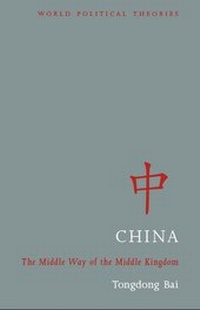
China
The Political Philosophy of the Middle Kingdom
Published on 11. October 2012
Book
Hardback
216 pages
978-1-78032-076-2 (ISBN)
Description
China is a rising economic and political power. But what is the message of this rise? Tongdong Bai addresses this increasingly pressing question by examining the rich history of political theories and practices from China's past, and showing how it impacts upon the present.
Chinese political traditions are often viewed negatively as 'authoritarian' (in contrast with 'Western' democratic traditions), but the historical reality is much more complex and there is a need to understand the political values shaping China's rise. Going beyond this, Bai argues that the debates between China's two main political theories - Confucianism and Legalism - anticipate themes in modern political thought and hence offer valuable resources for thinking about contemporary political problems.
Part of Zed's World Political Theories series, this groundbreaking work offers a remarkable insight into the political history and thought of a nation that is becoming increasingly powerful on the world stage.
Chinese political traditions are often viewed negatively as 'authoritarian' (in contrast with 'Western' democratic traditions), but the historical reality is much more complex and there is a need to understand the political values shaping China's rise. Going beyond this, Bai argues that the debates between China's two main political theories - Confucianism and Legalism - anticipate themes in modern political thought and hence offer valuable resources for thinking about contemporary political problems.
Part of Zed's World Political Theories series, this groundbreaking work offers a remarkable insight into the political history and thought of a nation that is becoming increasingly powerful on the world stage.
Reviews / Votes
Tongdong Bai is a unique voice among scholars of Chinese philosophy: fluent in English and Chinese, trained in China and the US, and expert in both the natural sciences and the humanities. Not surprisingly, this erudite book sets the bar higher than previous works on the topic. While the book will interest newcomers to Chinese political philosophy, it is more than an introduction. Bai develops an original argument that ancient debates in "pre-modern" times anticipate many of the political problems of contemporary societies and provide resources for some solutions. * Daniel A. Bell, Jiaotong University, Shanghai and Tsinghua University, Beijing * In a single generation China has precipitated a dramatic sea change in the economic and political order of the world. But what about culture? In this tour de force Tongdong Bai explores the distinctive political philosophies of Warring States China during its early formative period as a resource for responding to the most pressing questions of our own day: "What does Chinese political philosophy as both a source of corroboration and as a substantive challenge to Western liberalism have on offer for a changing world culture?", and at the end of the day, "What does China really want?" * Roger T. Ames, University of Hawai'i * Tongdong Bai's new book pulls off a remarkable balancing act. It is accessible and yet provocative; it is solidly based on China's early history and yet full of fascinating comparisons with Western thought and with the contemporary world. It is a splendid introduction to Chinese philosophy for all readers. * Stephen C. Angle, Wesleyan University *More details
Series
Language
English
Place of publication
United Kingdom
Publishing group
Bloomsbury Publishing PLC
Target group
College/higher education
Product notice
Paper over boards
Dimensions
Height: 216 mm
Width: 138 mm
Weight
390 gr
ISBN-13
978-1-78032-076-2 (9781780320762)
Copyright in bibliographic data and cover images is held by Nielsen Book Services Limited or by the publishers or by their respective licensors: all rights reserved.
Schweitzer Classification
Other editions
Person
Tongdong Bai is a professor at Fudan University in Shanghaiand was previously an associate professor of philosophy at Xavier University in Cincinnati.
Content
Introduction
1. Modernity before its time: the historical context of 'classical' Chinese political thought
2. The middle way of Confucianism: humanity as the new social glue
3. The middle way of Confucianism: equality-based mobile hierarchy
4. Daoism: return to an age of innocence
5. The Legalists: builders of modern bureaucracy and institutions
6. Later developments: the middle way
Conclusion: The contemporary relevance of traditional Chinese political philosophy
1. Modernity before its time: the historical context of 'classical' Chinese political thought
2. The middle way of Confucianism: humanity as the new social glue
3. The middle way of Confucianism: equality-based mobile hierarchy
4. Daoism: return to an age of innocence
5. The Legalists: builders of modern bureaucracy and institutions
6. Later developments: the middle way
Conclusion: The contemporary relevance of traditional Chinese political philosophy