

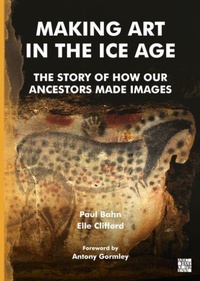
Making Art in the Ice Age
The Story of How Our Ancestors Made Images
Published on 13. November 2025
Book
Paperback/Softback
94 pages
978-1-80583-088-7 (ISBN)
Description
The extraordinary phenomenon of Ice Age art endured for over 30,000 years of our prehistory. This book will show you how the art was discovered, how it was made, how we know its age and if it's genuine. But this art is much more than pictures and paint - it tells us more about our early ancestors than bones and tools ever will. Life during the Ice Age was a huge part of our human journey, and the people who lived then, by painting on cave walls and engraving their myths on animal bones, have reached out to us down the millennia with their stories and memories. It is unlikely we will ever know the meanings of the simple handprints or the animal silhouette paintings, or the ideas that were shared in great cave wall murals, but they are likely to be profound. And despite our inability to understand the messages, we can still marvel at the valuable gifts these Ice Age artists have bestowed on us.
Reviews / Votes
'...Making Art in the Ice Age provides enough detail to inspire children to learn more about Ice Age life and living, perhaps even to try making copies of the artworks, -though not in caves! I think this book will be a valuable and essential purchase for public libraries and for school libraries. Any schoolteachers contemplating teaching about Ice Age people and their world would do well to read this book first.' - John Shea (2026) 'Over the course of 94 colourful and well-illustrated pages, Bahn and Clifford have taken this monumental and deeply mysterious part of our human story and succeeded in creating an accessible, engaging, and fascinating resource.' - Simon Norton (2026): Current World Archaeology #136More details
Language
English
Place of publication
Oxford
United Kingdom
Publishing group
Archaeopress
Target group
Primary & secondary/elementary & high school
Illustrations
Highly illustrated in full colour throughout
Dimensions
Height: 244 mm
Width: 175 mm
Thickness: 7 mm
Weight
264 gr
ISBN-13
978-1-80583-088-7 (9781805830887)
DOI
10.32028/9781805830887
Copyright in bibliographic data and cover images is held by Nielsen Book Services Limited or by the publishers or by their respective licensors: all rights reserved.
Schweitzer Classification
Persons
Paul Bahn has a PhD in archaeology from Cambridge University, and for decades has been an independent researcher, writing and editing a wide range of archaeological books, including several on Ice Age art. He also lectures on numerous tours to the decorated Ice Age caves.
Elle Clifford began her career lecturing in social and developmental psychology, and researching stress and women's reproductive health. She published over a dozen academic papers on these topics. She then acquired a Master's degree in prehistory at York University with a thesis on cave art and mythological worlds. In recent years Elle has accompanied Paul on visits to more than 50 of the most important decorated caves. They have co-authored two papers on the so-called 'Lion Man' figurine of the Ice Age.
Elle Clifford began her career lecturing in social and developmental psychology, and researching stress and women's reproductive health. She published over a dozen academic papers on these topics. She then acquired a Master's degree in prehistory at York University with a thesis on cave art and mythological worlds. In recent years Elle has accompanied Paul on visits to more than 50 of the most important decorated caves. They have co-authored two papers on the so-called 'Lion Man' figurine of the Ice Age.
Content
Foreword
Deep time line
How was cave art discovered?
What did they draw and paint?
Drawing humans
Portable art
Techniques in cave art
What did they use to make art?
Images outside caves
How old is the art?
Fakes and forgeries
Can we know what the art means?
Conclusion
Glossary
Appendix: Further reading
Image credits
Deep time line
How was cave art discovered?
What did they draw and paint?
Drawing humans
Portable art
Techniques in cave art
What did they use to make art?
Images outside caves
How old is the art?
Fakes and forgeries
Can we know what the art means?
Conclusion
Glossary
Appendix: Further reading
Image credits