

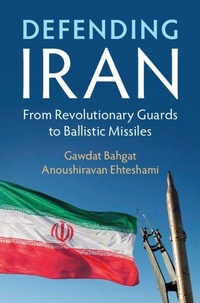
Defending Iran
From Revolutionary Guards to Ballistic Missiles
Published on 23. September 2021
Book
Hardback
304 pages
978-1-108-47678-2 (ISBN)
Description
Since the 1979 revolution, the ruling establishment of Iran has developed and articulated a defense strategy reflective of the country's Iran-Iraq war experience and its international isolation. Its asymmetrical warfare doctrine, use of irregular forces in military campaigns, deployment of ballistic missiles, use of fast naval vessels to harass and confuse adversaries, and finally development of a sophisticated cyber warfare capability, are all features of this unique defense strategy. Based on a wide range of primary sources in Persian, Arabic and English, Gawdat Bahgat and Anoushiravan Ehteshami offer a detailed and authoritative analysis of Iran's defense strategy. Additionally, this book provides a comparative analysis of the Islamic Republic's capabilities in relation to Israel and Saudi Arabia, its main regional adversaries. Framing Tehran's threat perceptions following the revolution within a wider historical context, this book will facilitate further analytical reflections on the country's changing role in the region, and its relations further afield, with the United States, Europe, Russia and China.
Reviews / Votes
'Defending Iran provides a first-class assessment of Iran's defense doctrines, motivations, and capabilities. In doing so, it deftly highlights the opportunities and constraints that the Islamic Republic confronts in its effort to establish its dominance in the Persian Gulf - and underscores the challenges that the United States and others face in seeking to foil that ambition.' James M. Lindsay, Council on Foreign Relations 'This is a book of impressive scope and depth, providing one of the most valuable and insightful examinations of the Iranian military and its capabilities. Defending Iran is essential reading for anyone seeking a thorough understanding of the country's politics and the role, composition, and profile of its armed forces.' Mehran Kamrava, Georgetown University Qatar 'Gawdat Baghat and Anoushiravan Ehteshami, two well-respected experts, have produced an important and insightful analysis of Iran's defense and security doctrine tracing its evolution from pre-revolutionary days to the current context deftly weaving together the nexus of ideology, threat perceptions and national interests amid the changing strategic international and regional landscape.' Sanam Vakil, Chatham HouseMore details
Language
English
Place of publication
Cambridge
United Kingdom
Target group
College/higher education
Professional and scholarly
Illustrations
Worked examples or Exercises
Dimensions
Height: 235 mm
Width: 157 mm
Thickness: 21 mm
Weight
594 gr
ISBN-13
978-1-108-47678-2 (9781108476782)
Copyright in bibliographic data and cover images is held by Nielsen Book Services Limited or by the publishers or by their respective licensors: all rights reserved.
Schweitzer Classification
Other editions
Additional editions
Gawdat Bahgat | Anoushiravan Ehteshami
Defending Iran
From Revolutionary Guards to Ballistic Missiles
E-Book
10/2021
Cambridge University Press
€23.49
Available for download
Gawdat Bahgat | Anoushiravan Ehteshami
Defending Iran
From Revolutionary Guards to Ballistic Missiles
Book
09/2021
Cambridge University Press
€49.20
Shipment within 15-20 days
E-Book
09/2021
Cambridge University Press
€23.49
Available for download
Persons
Gawdat Bahgat is Professor of National Security in the Near East South Asia Center for Strategic Studies at the National Defense University. He is the author of twelve books including Energy Security in the Gulf (2015), Alternative Energy in the Middle East (2013), Energy Security (2011), International Political Economy (2010), Proliferation of Nuclear Weapons in the Middle East (2007), Israel and the Persian Gulf (2006) and American Oil Diplomacy (2003). He has appeared as a frequent contributor to media outlets including the BBC, CNN and Washington Post.
Content
Preface; 1. Iran's Threat Perceptions; 2. Defense Institutions: Politics and Power; 3. Iran's Military-industrial Complex; 4. Structure and Make-up of Iran's Armed Forces; 5. Iran's Ballistic Missiles and Space Program; 6. Cyber Security: Iran and Its Neighbors; 7. Naval Forces; 8. Iran's Drone Capabilities; 9. Proxies and Partners; Conclusion: The Way Forward.