

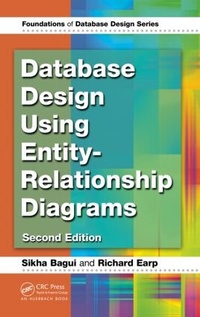
Database Design Using Entity-Relationship Diagrams
2nd Edition
Published on 7. September 2011
Book
Hardback
371 pages
978-1-4398-6176-9 (ISBN)
Description
Essential to database design, entity-relationship (ER) diagrams are known for their usefulness in mapping out clear database designs. They are also well-known for being difficult to master. With Database Design Using Entity-Relationship Diagrams, Second Edition, database designers, developers, and students preparing to enter the field can quickly learn the ins and outs of ER diagramming.
Building on the success of the bestselling first edition, this accessible text includes a new chapter on the relational model and functional dependencies. It also includes expanded chapters on Enhanced Entity Relationship (EER) diagrams and reverse mapping. It uses cutting-edge case studies and examples to help readers master database development basics and defines ER and EER diagramming in terms of requirements (end user requests) and specifications (designer feedback to those requests).
Describes a step-by-step approach for producing an ER diagram and developing a relational database from it
Contains exercises, examples, case studies, bibliographies, and summaries in each chapter
Details the rules for mapping ER diagrams to relational databases
Explains how to reverse engineer a relational database back to an entity-relationship model
Includes grammar for the ER diagrams that can be presented back to the user
The updated exercises and chapter summaries provide the real-world understanding needed to develop ER and EER diagrams, map them to relational databases, and test the resulting relational database. Complete with a wealth of additional exercises and examples throughout, this edition should be a basic component of any database course. Its comprehensive nature and easy-to-navigate structure makes it a resource that students and professionals will turn to throughout their careers.
Building on the success of the bestselling first edition, this accessible text includes a new chapter on the relational model and functional dependencies. It also includes expanded chapters on Enhanced Entity Relationship (EER) diagrams and reverse mapping. It uses cutting-edge case studies and examples to help readers master database development basics and defines ER and EER diagramming in terms of requirements (end user requests) and specifications (designer feedback to those requests).
Describes a step-by-step approach for producing an ER diagram and developing a relational database from it
Contains exercises, examples, case studies, bibliographies, and summaries in each chapter
Details the rules for mapping ER diagrams to relational databases
Explains how to reverse engineer a relational database back to an entity-relationship model
Includes grammar for the ER diagrams that can be presented back to the user
The updated exercises and chapter summaries provide the real-world understanding needed to develop ER and EER diagrams, map them to relational databases, and test the resulting relational database. Complete with a wealth of additional exercises and examples throughout, this edition should be a basic component of any database course. Its comprehensive nature and easy-to-navigate structure makes it a resource that students and professionals will turn to throughout their careers.
More details
Edition
2nd edition
Language
English
Place of publication
Washington
United States
Target group
College/higher education
Database professionals, data analysts, strategists, and data administration
Illustrations
130 s/w Abbildungen
130 Illustrations, black and white
Dimensions
Height: 234 mm
Width: 156 mm
Weight
700 gr
ISBN-13
978-1-4398-6176-9 (9781439861769)
Copyright in bibliographic data and cover images is held by Nielsen Book Services Limited or by the publishers or by their respective licensors: all rights reserved.
Schweitzer Classification
Other editions
New editions
Sikha Saha Bagui | Richard Walsh Earp
Database Design Using Entity-Relationship Diagrams
Book
09/2022
3rd Edition
Auerbach
€232.70
Shipment within 10-20 days
Previous edition
Sikha Bagui | Richard Earp
Database Design Using Entity-Relationship Diagrams
Book
06/2003
1st Edition
Auerbach
€76.74
Article exhausted; check for reprint
Persons
Dr. Sikha Saha Bagui is an associate professor and interim associate chair in the Department of Computer Science at the University of West Florida, Pensacola, Florida. She teaches a variety of computer science and database courses, and her research areas of concentration are database design, web databases, data mining and statistical computing. Dr. Bagui has published many journal articles and co-authored several books with Dr. Earp.
Dr. Richard Walsh Earp, Professor Emeritus, is a former chair of and former associate professor in the Department of Computer Science and former dean of the College of Science and Technology at the University of West Florida in Pensacola, Florida. Dr. Earp was also an instructor with Learning Tree International and worked for Computer Sciences Corporation at the Naval Air Station in Pensacola as a database consultant after his retirement from academia. He has co-authored several books with Dr. Bagui.
Dr. Richard Walsh Earp, Professor Emeritus, is a former chair of and former associate professor in the Department of Computer Science and former dean of the College of Science and Technology at the University of West Florida in Pensacola, Florida. Dr. Earp was also an instructor with Learning Tree International and worked for Computer Sciences Corporation at the Naval Air Station in Pensacola as a database consultant after his retirement from academia. He has co-authored several books with Dr. Bagui.
Content
Data, Databases, and the Software Engineering Process. Data and Data Models. The Relational Model and Functional Dependencies. The Basic Entity Relationship (ER) Diagram: A Data Modeling Schema. Beyond the First Entity Diagram. Extending Relationships/Structural Constraints. The Weak Entity. Further Extensions for ER Diagrams with Binary Relationships. Ternary and Higher-Order ER Diagrams. The Enhanced Entity Relationship (EER) Model. Relational Mapping and Reverse Engineering ER/EER Diagrams. IA Brief Overview of the Barker/Oracle-Like Model.