

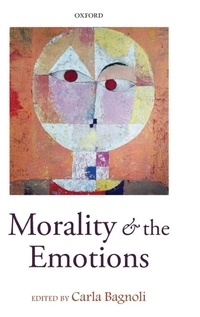
Morality and the Emotions
Published on 27. October 2011
Book
Hardback
314 pages
978-0-19-957750-7 (ISBN)
Description
Emotions shape our mental and social lives. Their relation to morality is, however, problematic. Since ancient times, philosophers have disagreed about the place of emotions in morality. One the one hand, some hold that emotions are disorderly and unpredictable animal drives, which undermine our autonomy and interfere with our reasoning. For them, emotions represent a persistent source of obstacles to morality, as in the case of self-love. Some virtues, such as prudence, temperance, and fortitude, require or simply consist in the capacity to counteract the disruptive effect of emotions. On the other hand, venerable traditions of thought place emotions such as respect, love, and compassion at the very heart of morality. Emotions are sources of moral knowledge, modes of moral recognition, discernment, valuing, and understanding. Emotions such as blame, guilt, and shame are the voice of moral conscience, and are central to the functioning of our social lives and normative practices. New scientific findings about the pervasiveness of emotions posit new challenges to ethical theory. Are we responsible for emotions? What is their relation to practical rationality? Are they roots of our identity or threats to our autonomy? This volume is born out of the conviction that philosophy provides a distinctive approach to these problems. Fourteen original articles, by prominent scholars in moral psychology and philosophy of mind, offer new arguments about the relation between emotions and practical rationality, value, autonomy, and moral identity.
Reviews / Votes
I found the volume highly stimulating and extremely valuable for people interested in moral emotions. * Heidi L. Maibom, Ethics * This volume comprises new work from philosophers who by and large affirm the important role of the emotions in moral experience, but represent varying traditions ranging from the Humean, through the Kantian to the phenomenological. It also ranges over the role of the emotions in areas such as moral motivation, moral epistemology, identity and moral responsibility. As such it presents a good overview of the fertile work being done in this area at the present time and will be an important resource for those working on the topic. * Chris Bennett, Notre Dame Philosophical Reviews *More details
Language
English
Place of publication
Oxford
United Kingdom
Target group
College/higher education
Professional and scholarly
Scholars and advanced students working on philosophy of the emotions, ethics, meta-ethics, action theory, philosophical psychology, philosophy of mind, and moral psychology
Dimensions
Height: 240 mm
Width: 161 mm
Thickness: 21 mm
Weight
637 gr
ISBN-13
978-0-19-957750-7 (9780199577507)
Copyright in bibliographic data and cover images is held by Nielsen Book Services Limited or by the publishers or by their respective licensors: all rights reserved.
Schweitzer Classification
Person
Carla Bagnoli is Full Professor of Philosophy at the University of Wisconsin-Milwaukee where she has taught since 1998. She was nominated Professore Straordinario di Filosofia Teoretica at the Universita di Modena and Reggio Emilia in 2010. She has written three monographs on moral dilemmas, perplexity, and the authority of morality. Her work has appeared in journals such as the Canadian Journal of Philosophy, European Journal of Philosophy, Philosophical Explorations, Ethical Theory and Moral Practice, Nomos, Dialectica, and Topoi. Her current research project concerns ethical objectivity and the subjective aspects of practical reason.
Content
Contents ; List of Contributors ; Introduction ; 1. Craving the right: emotions and moral reasons ; 2. Emotions and the categorical authority of moral reasons ; 3. Self-Love and Practical Rationality ; 4. The Nature and Morality of Romantic Compromises ; 5. Values and Emotions: Neo-Sentimentalism's Prospects ; 6. Emotions, perceptions and reasons ; 7. Conscience: What is Moral Intuition? ; 8. Empathy and empirical psychology. A critique of Shaun Nichols's Neo-sentimentalism ; 9. Reactive Attitudes Revisited ; 10. Responsibility and Dignity: Strawsonian Themes ; 11. Guilty Thoughts ; 12. Moral Sentiment and the Sources of Moral Identity ; 13. On Alienated Emotions ; Index