

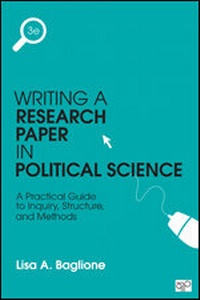
Writing a Research Paper in Political Science
A Practical Guide to Inquiry, Structure, and Methods
3rd Edition
Published on 19. May 2015
Book
Paperback/Softback
224 pages
978-1-4833-7616-5 (ISBN)
Description
Writing an introduction, coming up with effective headings and titles, presenting a conclusion, and the important steps of editing and revising are covered with class-tested advice and know-how in this book. In addition to using updated examples of student topics that pull from both American government and international relations, Baglione also includes examples of actual student writing to show readers how someone "just like them" accomplished tasks while writing their papers. Practical summaries, calendars, exercises, and a series of handy checklists make this a must-have supplement for any writing-intensive political science course.
Reviews / Votes
"I introduced Baglione's book to my colleagues who advise students in our senior capstone projects, and now they are all using it. Students are being told to hang on to the book for later and are making good use of all its sections." -- Ashlie B. Delshad "Students will be able to use Baglione's book throughout their career on campus. It is especially helpful for students who are hesitant their about writing a research paper or struggling to find a suitable topic. The book walks through the research process and provides very helpful checklists to ensure students stay on the right track." -- Aaron King "One of the greatest difficulties students face when writing research papers is finding a good research question to guide the rest of the writing process. Baglione's text tackles that issue head on and does so quite well." -- Jack D. Collens "This is a very relatable book. The prose is accessible, there is little jargon, and the use of examples is perfect for an undergraduate audience." -- David Mislan "Baglione offers an extremely practical and useful text for understanding the content and structure of a thesis-length research paper. For some students, the clear outlining of the sequential steps is most useful, while for others who have the basics down, it offers a broad view of the goals and long-term responsibilities for such a project." -- Jennifer Seely "I love the checklists! I require students to submit every section of their paper drafts with the corresponding checklist attached." -- Emily BeaulieuMore details
Edition
3rd Revised edition
Language
English
Place of publication
Thousand Oaks
United States
Target group
College/higher education
Edition type
Revised edition
Dimensions
Height: 229 mm
Width: 152 mm
Weight
303 gr
ISBN-13
978-1-4833-7616-5 (9781483376165)
Copyright in bibliographic data and cover images is held by Nielsen Book Services Limited or by the publishers or by their respective licensors: all rights reserved.
Schweitzer Classification
Other editions
New editions
Lisa A. Baglione
Writing a Research Paper in Political Science
A Practical Guide to Inquiry, Structure, and Methods
Book
01/2019
4th Edition
CQ Press
€53.50
Article exhausted; check for reprint
Previous edition
Lisa A. Baglione
Writing a Research Paper in Political Science
A Practical Guide to Inquiry, Structure, and Methods
Book
10/2011
2nd Edition
CQ Press
€43.55
Article exhausted; check for reprint
Person
Dr. Lisa A. Baglione is a professor in the
Department of Political Science and a member
of the International Relations Program at Saint
Joseph's University in Philadelphia. Currently,
Dr. Baglione also serves as the co-director of the
Gender Studies Program.
During her career, Dr. Baglione has conducted
research in five areas, and while they
are varied, she has benefited from the ways that
insights from each have interwoven: negotiations
between adversaries, authoritarian transformation,
peacebuilding, gender in politics, and
pedagogy. She has published two other books, To
Agree or Not to Agree: Leadership, Bargaining, and
Arms Control with University of Michigan Press
and Writing a Research Paper in Political Science:
A Practical Guide to Inquiry, Structure, and
Methods, now in its fourth edition, with Sage.
Department of Political Science and a member
of the International Relations Program at Saint
Joseph's University in Philadelphia. Currently,
Dr. Baglione also serves as the co-director of the
Gender Studies Program.
During her career, Dr. Baglione has conducted
research in five areas, and while they
are varied, she has benefited from the ways that
insights from each have interwoven: negotiations
between adversaries, authoritarian transformation,
peacebuilding, gender in politics, and
pedagogy. She has published two other books, To
Agree or Not to Agree: Leadership, Bargaining, and
Arms Control with University of Michigan Press
and Writing a Research Paper in Political Science:
A Practical Guide to Inquiry, Structure, and
Methods, now in its fourth edition, with Sage.
Content
Chapter 1: So You Have to Write a Research Paper
What Is a Research Paper? A Few Helpful Metaphors
What Research Paper Writing Entails
Blueprint of the Book
Chapter 2: Getting Started: Finding a Research Question
Characteristics of a Good Question
Practical Summary
Recipe 1: The Research Question
Exercises
Chapter 3: Learning Proper Citation Forms, Finding the Scholarly Debate, and Summarizing and Classifying Arguments: The Annotated Bibliography
What Are Bibliographies, and Why Do We Bother with Them?
Plagiarism versus Paraphrasing
Annotating the Bibliography
Identifying the Key Conceptual Issues
Searching for Sources
Identifying Similar Arguments and Grouping Your Sources
One Last Word of Advice: Generic Schools of Thought
Writing the Annotated Bibliography
Practical Summary
Recipe 2: Annotated Bibliography
Exercises
Chapter 4: Making Sense of the Scholarly Answers to Your Research Question: Writing the Literature Review
Preparing for and Understanding the Literature Review
The Fundamentals of the Literature Review
Writing the Literature Review
Practical Summary
Recipe 3: Literature Review
Exercises
Chapter 5: Effectively Distilling Your Argument: The Thesis, Model, and Hypothesis
The Thesis
The Model
The Hypothesis
Applying These Insights
Practical Summary
Recipe 4: Model & Hypothesis Section
Exercises
Chapter 6: Revising and Editing Your Work: The Writing-Thinking Spiral
Practical Summary
Recipe 5: Revising and Editing
Chapter 7: Making Your Plan and Protecting Yourself from Criticism: The Research Design
Research Design: The Medical Science Analogy
Writing the Research Design
Finishing Touches on the Research Design
Practical Summary
Recipe 6: Research Design
Exercises
Chapter 8: Evaluating the Argument: The Analysis and Assessment Section
Qualitative Analysis
Quantitative Analysis
Practical Summary
Recipe 7: Analysis & Assessment
Exercises
Chapter 9: Bringing the Paper Together in Three Essential Ways: The Conclusion, Introduction, and Title
Considering the Significance and Limitations of Your Findings: The Conclusion
Writing a Good Introduction
A Last Element in Attracting Readers: Developing an Appealing Title
Are You Done? The Joy (and Continued Responsibilities) of Finalizing Your Draft
Practical Summary
Recipe 8: Conclusion, Introduction, & Title
Exercises
Bibliography
What Is a Research Paper? A Few Helpful Metaphors
What Research Paper Writing Entails
Blueprint of the Book
Chapter 2: Getting Started: Finding a Research Question
Characteristics of a Good Question
Practical Summary
Recipe 1: The Research Question
Exercises
Chapter 3: Learning Proper Citation Forms, Finding the Scholarly Debate, and Summarizing and Classifying Arguments: The Annotated Bibliography
What Are Bibliographies, and Why Do We Bother with Them?
Plagiarism versus Paraphrasing
Annotating the Bibliography
Identifying the Key Conceptual Issues
Searching for Sources
Identifying Similar Arguments and Grouping Your Sources
One Last Word of Advice: Generic Schools of Thought
Writing the Annotated Bibliography
Practical Summary
Recipe 2: Annotated Bibliography
Exercises
Chapter 4: Making Sense of the Scholarly Answers to Your Research Question: Writing the Literature Review
Preparing for and Understanding the Literature Review
The Fundamentals of the Literature Review
Writing the Literature Review
Practical Summary
Recipe 3: Literature Review
Exercises
Chapter 5: Effectively Distilling Your Argument: The Thesis, Model, and Hypothesis
The Thesis
The Model
The Hypothesis
Applying These Insights
Practical Summary
Recipe 4: Model & Hypothesis Section
Exercises
Chapter 6: Revising and Editing Your Work: The Writing-Thinking Spiral
Practical Summary
Recipe 5: Revising and Editing
Chapter 7: Making Your Plan and Protecting Yourself from Criticism: The Research Design
Research Design: The Medical Science Analogy
Writing the Research Design
Finishing Touches on the Research Design
Practical Summary
Recipe 6: Research Design
Exercises
Chapter 8: Evaluating the Argument: The Analysis and Assessment Section
Qualitative Analysis
Quantitative Analysis
Practical Summary
Recipe 7: Analysis & Assessment
Exercises
Chapter 9: Bringing the Paper Together in Three Essential Ways: The Conclusion, Introduction, and Title
Considering the Significance and Limitations of Your Findings: The Conclusion
Writing a Good Introduction
A Last Element in Attracting Readers: Developing an Appealing Title
Are You Done? The Joy (and Continued Responsibilities) of Finalizing Your Draft
Practical Summary
Recipe 8: Conclusion, Introduction, & Title
Exercises
Bibliography