

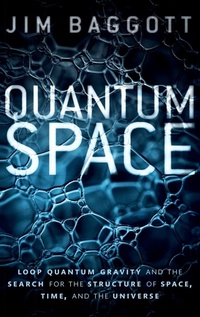
Quantum Space
Loop Quantum Gravity and the Search for the Structure of Space, Time, and the Universe
Published on 22. November 2018
Book
Hardback
448 pages
978-0-19-880911-1 (ISBN)
Description
Today we are blessed with two extraordinarily successful theories of physics. The first is Albert Einstein's general theory of relativity, which describes the large-scale behaviour of matter in a curved spacetime. This theory is the basis for the standard model of big bang cosmology. The discovery of gravitational waves at the LIGO observatory in the US (and then Virgo, in Italy) is only the most recent of this theory's many triumphs.
The second is quantum mechanics. This theory describes the properties and behaviour of matter and radiation at their smallest scales. It is the basis for the standard model of particle physics, which builds up all the visible constituents of the universe out of collections of quarks, electrons and force-carrying particles such as photons. The discovery of the Higgs boson at CERN in Geneva is only the most recent of this theory's many triumphs.
But, while they are both highly successful, these two structures leave a lot of important questions unanswered. They are also based on two different interpretations of space and time, and are therefore fundamentally incompatible. We have two descriptions but, as far as we know, we've only ever had one universe. What we need is a quantum theory of gravity.
Approaches to formulating such a theory have primarily followed two paths. One leads to String Theory, which has for long been fashionable, and about which much has been written. But String Theory has become mired in problems. In this book, Jim Baggott describes "the road less travelled": an approach which takes relativity as its starting point, and leads to a structure called Loop Quantum Gravity. Baggott tells the story through the careers and pioneering work of two of the theory's most prominent contributors, Lee Smolin and Carlo Rovelli. Combining clear discussions of both quantum theory and general relativity, this book offers one of the first efforts to explain the new quantum theory of space and time.
The second is quantum mechanics. This theory describes the properties and behaviour of matter and radiation at their smallest scales. It is the basis for the standard model of particle physics, which builds up all the visible constituents of the universe out of collections of quarks, electrons and force-carrying particles such as photons. The discovery of the Higgs boson at CERN in Geneva is only the most recent of this theory's many triumphs.
But, while they are both highly successful, these two structures leave a lot of important questions unanswered. They are also based on two different interpretations of space and time, and are therefore fundamentally incompatible. We have two descriptions but, as far as we know, we've only ever had one universe. What we need is a quantum theory of gravity.
Approaches to formulating such a theory have primarily followed two paths. One leads to String Theory, which has for long been fashionable, and about which much has been written. But String Theory has become mired in problems. In this book, Jim Baggott describes "the road less travelled": an approach which takes relativity as its starting point, and leads to a structure called Loop Quantum Gravity. Baggott tells the story through the careers and pioneering work of two of the theory's most prominent contributors, Lee Smolin and Carlo Rovelli. Combining clear discussions of both quantum theory and general relativity, this book offers one of the first efforts to explain the new quantum theory of space and time.
Reviews / Votes
...if you have enjoyed/got through popular science books about such areas as strings and superstrings, time, and the God particle, here is a fine addition to the oeuvre. * Ian Francis, School Science Review * There is no doubt that Jim Baggott is an excellent popular science writer, and Quantum Space is the first complete and approachable account to a quantum theory that delves deep into the quest to resolve one of the great unanswered problems of modern physics: How can general relativity be made compatible with quantum mechanics? Baggott proposes Loop Quantum Gravity, which in our mind is one of the best explanations for anyone who wants to understand more about our puling universe ... It's a triumph. * All About Space Magazine * There's no doubt that Jim Baggott is one of the best popular science writers currently active ... [he] has done a huge favour for anyone who really wants to understand modern theoretical physics, giving a much better understanding of this fascinating attempt to deal with a central requirement to explain the workings of our universe. It's a triumph. * Brian Clegg, popularscience.com * A lucid exposition of loop quantum gravity and the search for the structural space, time and the universe focusing around the work of Lee Smolin and Carlo Rovelli. * David Lorimer, Paradigm Explorer * The discovery and development of Loop Quantum Gravity has been a great adventure. Jim's story beautifully captures its insights and excitement. * Carlo Rovelli, author of Seven Brief Lessons on Physics *More details
Language
English
Place of publication
Oxford
United Kingdom
Target group
College/higher education
Illustrations
30 black and white images
Dimensions
Height: 240 mm
Width: 161 mm
Thickness: 29 mm
Weight
834 gr
ISBN-13
978-0-19-880911-1 (9780198809111)
Copyright in bibliographic data and cover images is held by Nielsen Book Services Limited or by the publishers or by their respective licensors: all rights reserved.
Schweitzer Classification
Other editions
Additional editions
Jim Baggott
Quantum Space
Loop Quantum Gravity and the Search for the Structure of Space, Time, and the Universe
E-Book
11/2018
1st Edition
OUP eBook
€10.49
Available for download
Jim Baggott
Quantum Space
Loop Quantum Gravity and the Search for the Structure of Space, Time, and the Universe
E-Book
11/2018
1st Edition
OUP eBook
€10.49
Available for download
Person
Jim Baggott is a freelance science writer. He was a lecturer in chemistry at the University of Reading but left to work with Shell International Petroleum Company, and then as an independent business consultant and trainer. His many books include Quantum Reality: The Quest for the Real Meaning of Quantum Mechanics - A Game of Theories (OUP, 2020), Mass: The Quest to Understand Matter from Greek Atoms to Quantum Fields (OUP, 2017), Origins: The Scientific Story of Creation(OUP, 2015), Higgs: The Invention and Discovery of the 'God Particle' (OUP, 2012), The Quantum Story: A History in 40 Moments (OUP, 2011), and A Beginners Guide to Reality (Penguin, 2005).
Content
Preface Prologue Part I: Foundations
1: The Laws of Physics are the Same for Everyone
2: There's No Such Thing as the Force of Gravity
3: Why Nobody Understands Quantum Mechanics
4: Mass Ain't What it Used To Be
5: How to Fudge the Equations of the Universe
Part II: Formulation
6: To Get There I Wouldn't Start From Here
7: A Gift From the Devil's Grandmother
8: Our Second or Third Guess Solved the Equations Exactly
9: I Used Every Available Key Ring in Verona
10: Is There Really No Time Like the Present?
Part III: Elaborations
11: Gravitons, Holographic Physics and Why Things Fall Down
12: Fermions, Emergent Particles and the Nature of Stuff
13: Relational Quantum Mechanics and Why 'Here' Might Actually be 'Over There'
14: Not With a Bang: the 'Big Bounce', Superinflation and Spinfoam Cosmology
15: Black Hole Entropy, the Information Paradox and Planck Stars
16: Close to the Edge: The Reality of Time and the Principles of the Open Future
Epilogue: A Few Questions, and Some Answers Endnotes Glossary Bibliography
1: The Laws of Physics are the Same for Everyone
2: There's No Such Thing as the Force of Gravity
3: Why Nobody Understands Quantum Mechanics
4: Mass Ain't What it Used To Be
5: How to Fudge the Equations of the Universe
Part II: Formulation
6: To Get There I Wouldn't Start From Here
7: A Gift From the Devil's Grandmother
8: Our Second or Third Guess Solved the Equations Exactly
9: I Used Every Available Key Ring in Verona
10: Is There Really No Time Like the Present?
Part III: Elaborations
11: Gravitons, Holographic Physics and Why Things Fall Down
12: Fermions, Emergent Particles and the Nature of Stuff
13: Relational Quantum Mechanics and Why 'Here' Might Actually be 'Over There'
14: Not With a Bang: the 'Big Bounce', Superinflation and Spinfoam Cosmology
15: Black Hole Entropy, the Information Paradox and Planck Stars
16: Close to the Edge: The Reality of Time and the Principles of the Open Future
Epilogue: A Few Questions, and Some Answers Endnotes Glossary Bibliography