

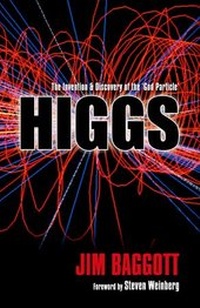
Higgs
The Invention and Discovery of the 'God Particle'
Published on 13. August 2012
Book
Hardback
304 pages
978-0-19-960349-7 (ISBN)
Description
The hunt for the Higgs particle has involved the biggest, most expensive experiment ever. So exactly what is this particle? Why does it matter so much? What does it tell us about the Universe? Has the discovery announced on 4 July 2012 finished the search? And was finding it really worth all the effort? The short answer is yes. The Higgs field is proposed as the way in which particles gain mass - a fundamental property of matter. It's the strongest indicator yet that the Standard Model of physics really does reflect the basic building blocks of our Universe. Little wonder the hunt and discovery of this new particle has produced such intense media interest. Here, Jim Baggott explains the science behind the discovery, looking at how the concept of a Higgs field was invented, how the vast experiment was carried out, and its implications on our understanding of all mass in the Universe. The book was written over the eighteen months of the CERN Large Hadron Collider experiment, with its final chapter rounded off on the day of the announcement 'that a particle consistent with the standard model Higgs boson has been discovered.'
Reviews / Votes
Baggott tells a snappy story about people and ideas. Times Higher Education Supplement Higgs helps put Higgs' contribution in context ... It's a book I imagine the reticent Higgs would approve of. Jessica Griggs, New Scientist a tendency towards brevity and clarity make for a handy guide to the long hunt for an elusive quarry. NatureMore details
Language
English
Place of publication
Oxford
United Kingdom
Illustrations
27 black and white illustrations
Dimensions
Height: 205 mm
Width: 142 mm
Thickness: 28 mm
Weight
420 gr
ISBN-13
978-0-19-960349-7 (9780199603497)
Copyright in bibliographic data and cover images is held by Nielsen Book Services Limited or by the publishers or by their respective licensors: all rights reserved.
Schweitzer Classification
Other editions
New editions
Book
06/2013
Oxford University Press
€18.50
Shipment within 15-20 days
Additional editions
Book
06/2013
Oxford University Press
€18.50
Shipment within 15-20 days
E-Book
08/2012
1st Edition
OUP eBook
€10.49
Available for download
E-Book
08/2012
1st Edition
OUP eBook
€10.49
Available for download
Person
Jim Baggott is a freelance science writer. He was a lecturer in chemistry at the University of Reading but left to pursue a business career, where he first worked with Shell International Petroleum Company and then as an independent business consultant and trainer. His many books include Atomic: The First War of Physics (Icon, 2009), Beyond Measure: Modern Physics, Philosophy and the Meaning of Quantum Theory (OUP, 2003), A Beginner's Guide to Reality (Penguin, 2005), and A Quantum Story: A History in 40 Moments (OUP, 2010).
Content
PREFACE ; PROLOGUE: FORM AND SUBSTANCE ; 1. INVENTION ; 1. The poetry of logical ideas ; 2. Not a sufficient excuse ; 3. People will be very stupid about it ; 4. Applying the right ideas to the wrong problem ; 5. I can do that ; 2. DISCOVERY ; 6. Alternating neutral currents ; 7. They must be Ws ; 8. Throw deep ; 9. A fantastic moment ; 10. The Shakespeare question ; EPILOGUE: THE CONSTRUCTION OF MASS ; ENDNOTES ; GLOSSARY ; BIBLIOGRAPHY ; INDEX