

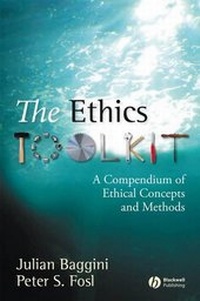
The Ethics Toolkit
A Compendium of Ethical Concepts and Methods
Published on 6. August 2007
Book
Paperback/Softback
272 pages
978-1-4051-3231-2 (ISBN)
Description
The Ethics Toolkit provides an accessible and engaging compendium of concepts, theories, and strategies that encourage students and advanced readers to think critically about ethics so that they can engage intelligently in ethical study, thought, and debate.
* Written by the authors of the popular The Philosophers' Toolkit (Blackwell, 2001); Baggini is also a renowned print and broadcast journalist, and a prolific author of popular philosophy books
* Uses clear and accessible language appropriate for use both inside and beyond the classroom
* Enlivened through the use of real-world and hypothetical examples
* Cross-referencing of entries helps to connect and contrast ideas
* Features lists of prominent ethics organizations and useful websites
* Encourages readers to think critically about ethics and teaches them how to engage intelligently in ethical study, thought, and debate
* Written by the authors of the popular The Philosophers' Toolkit (Blackwell, 2001); Baggini is also a renowned print and broadcast journalist, and a prolific author of popular philosophy books
* Uses clear and accessible language appropriate for use both inside and beyond the classroom
* Enlivened through the use of real-world and hypothetical examples
* Cross-referencing of entries helps to connect and contrast ideas
* Features lists of prominent ethics organizations and useful websites
* Encourages readers to think critically about ethics and teaches them how to engage intelligently in ethical study, thought, and debate
Reviews / Votes
"...Baggini and Fosl have provided an admirably no-nonsense tour through the crowded landscape of contemporary philosophical ethics." -Metapsychology Online Reviews"The Ethics Toolkit is a truly innovative introduction to ethics. Students will have the opportunity to gain familiarity with the tools of ethics (concepts, principles, critiques, and definitions) before they are asked to build their own grand theory of ethics. Far better than a dictionary or encyclopedia of ethics, The Ethics Toolkit provides readers with an appreciation of the crucial role ethics plays in our lives." -Rosemarie Tong, UNC Charlotte
"This Toolkit is very appropriate for various pedagogical uses in university philosophy courses in ethics. Used thoughtfully in conjunction with other possible course readings, it will provide accessible, reliable content helpful for clarifying assignments by faculty and for furthering student learning." -Ed Sankowski, University of Oklahoma
"Very good sense, so clearly and neatly expressed, about ideas in and around ethics worth disagreeing about." -Prof. Ted Honderich, University College London
"The Ethics Toolkit is a great resource for teachers, students, and general readers, and makes an extremely valuable accompaniment to primary texts in introductory ethics courses. It is much more engaging than standard philosophical handbooks, which means that one can read it cover-to-cover in addition to using it as a reference for a wide and eclectic range of concepts that are crucial to clear thinking about ethics." -Avery Kolers, University of Louisville
More details
Edition
1. Auflage
Language
English
Place of publication
Hoboken
United Kingdom
Publishing group
John Wiley and Sons Ltd
Target group
Professional and scholarly
general readers interested in ethics, beginning to mid-level students taking ethics courses
Dimensions
Height: 22.9 cm
Width: 15.6 cm
Thickness: 1.6 cm
Weight
382 gr
ISBN-13
978-1-4051-3231-2 (9781405132312)
Schweitzer Classification
Other editions
New editions
Book
12/2023
2nd Edition
Wiley-Blackwell
€25.00
Available immediately
Additional editions
Book
08/2007
Wiley
Unfortunately, price unknown
Article exhausted; check for reprint
Persons
Julian Baggini is editor and co-publisher of The Philosophers' Magazine. He is the author or co-author of over a dozen books on philosophy. His journalism also appears in newspapers and magazines such as the Guardian, Times Higher Education Supplement, and Times Educational Supplement. His PhD was awarded by University College London in 1996.
Peter S. Fosl is Professor of Philosophy at Transylvania University in Lexington, KY, and recipient of the 2006 Acorn Award for Kentucky's outstanding university teacher of the year. Educated at Bucknell University, Emory University, the London School of Economics, and the University of Edinburgh, Fosl is a contributing editor to The Philosophers' Magazine and co-editor of the Dictionary of Literary Biography volumes on British philosophers. He has published on Hume, skepticism, the philosophy of religion, and topics in the history of philosophy.
Peter S. Fosl is Professor of Philosophy at Transylvania University in Lexington, KY, and recipient of the 2006 Acorn Award for Kentucky's outstanding university teacher of the year. Educated at Bucknell University, Emory University, the London School of Economics, and the University of Edinburgh, Fosl is a contributing editor to The Philosophers' Magazine and co-editor of the Dictionary of Literary Biography volumes on British philosophers. He has published on Hume, skepticism, the philosophy of religion, and topics in the history of philosophy.
Content
Acknowledgements.
INTRODUCTION.
I The Grounds of Ethics.
1.1 Aesthetics.
1.2 Agency.
1.3 Authority.
1.4 Autonomy.
1.5 Care.
1.6 Character.
1.7 Conscience.
1.8 Evolution.
1.9 Finitude.
1.10 Flourishing.
1.11 Harmony.
1.12 Interest.
1.13 Intuition.
1.14 Merit.
1.15 Natural Law.
1.16 Need.
1.17 Pain and pleasure.
1.18 Revelation.
1.19 Rights.
1.20 Sympathy.
1.21 Tradition and history.
II Frameworks for Ethics.
2.1 Consequentialism.
2.2 Contractarianism.
2.3 Cultural critique.
2.4 Deontological ethics.
2.5 Discourse Ethics.
2.6 Divine command.
2.7 Egoism.
2.8 Hedonism.
2.9 Naturalism.
2.10 Particularism.
2.11 Perfectionism.
2.12 Pragmatism.
2.13 Rationalism.
2.14 Relativism.
2.15 Subjectivism.
2.16 Virtue ethics.
III Central Concepts in Ethics.
3.1 Absolute/Relative.
3.2 Act/Rule.
3.3 Bad/evil.
3.4 Beneficence/non-maleficence.
3.5 Cause/reason.
3.6 Cognitivism/non-cognitivism.
3.7 Commission/omission.
3.8 Consent.
3.9 Facts/values.
3.10 The Golden Mean.
3.11 Honour/shame.
3.12 Individual/collective.
3.13 Injury.
3.14 Intentions/consequences.
3.15 Internalism/externalism.
3.16 Intrinsic/instrumental Value.
3.17 Legal/moral.
3.18 Liberation/oppression.
3.19 Means/ends.
3.20 Metaethics/normative ethics.
3.21 Moral subjects/moral agents.
3.22 Prudence.
3.23 Public and private.
3.24 Stoic cosmopolitanism.
IV Assessment, Judgement & Critique.
4.1 Alienation.
4.2 Authenticity.
4.3 Consistency.
4.4 Counterexamples.
4.5 Fairness.
4.6 Fallacies.
4.7 Impartiality and Objectivity.
4.8 The 'is/ought' gap.
4.9 Justice and lawfulness.
4.10 Just war theory.
4.11 Paternalism.
4.12 Proportionality.
4.13 Reflective equilibrium.
4.14 Restoration.
4.15 Sex and gender.
4.16 Speciesism.
4.17 Thought Experiments.
4.18 Universalisability.
V The Limits of Ethics.
5.1 Akrasia.
5.2 Amoralism.
5.3 Bad faith and self-deception.
5.4 Casuistry and Rationalisation.
5.5 Fallenness.
5.6 False consciousness.
5.7 Free Will and Determinism.
5.8 Moral Luck.
5.9 Nihilism.
5.10 Pluralism.
5.11 Power.
5.12 Radical particularity.
5.13 Scepticism.
5.14 The Separateness of Persons.
5.15 Standpoint.
5.16 Supererogation.
5.17 Tragedy
INTRODUCTION.
I The Grounds of Ethics.
1.1 Aesthetics.
1.2 Agency.
1.3 Authority.
1.4 Autonomy.
1.5 Care.
1.6 Character.
1.7 Conscience.
1.8 Evolution.
1.9 Finitude.
1.10 Flourishing.
1.11 Harmony.
1.12 Interest.
1.13 Intuition.
1.14 Merit.
1.15 Natural Law.
1.16 Need.
1.17 Pain and pleasure.
1.18 Revelation.
1.19 Rights.
1.20 Sympathy.
1.21 Tradition and history.
II Frameworks for Ethics.
2.1 Consequentialism.
2.2 Contractarianism.
2.3 Cultural critique.
2.4 Deontological ethics.
2.5 Discourse Ethics.
2.6 Divine command.
2.7 Egoism.
2.8 Hedonism.
2.9 Naturalism.
2.10 Particularism.
2.11 Perfectionism.
2.12 Pragmatism.
2.13 Rationalism.
2.14 Relativism.
2.15 Subjectivism.
2.16 Virtue ethics.
III Central Concepts in Ethics.
3.1 Absolute/Relative.
3.2 Act/Rule.
3.3 Bad/evil.
3.4 Beneficence/non-maleficence.
3.5 Cause/reason.
3.6 Cognitivism/non-cognitivism.
3.7 Commission/omission.
3.8 Consent.
3.9 Facts/values.
3.10 The Golden Mean.
3.11 Honour/shame.
3.12 Individual/collective.
3.13 Injury.
3.14 Intentions/consequences.
3.15 Internalism/externalism.
3.16 Intrinsic/instrumental Value.
3.17 Legal/moral.
3.18 Liberation/oppression.
3.19 Means/ends.
3.20 Metaethics/normative ethics.
3.21 Moral subjects/moral agents.
3.22 Prudence.
3.23 Public and private.
3.24 Stoic cosmopolitanism.
IV Assessment, Judgement & Critique.
4.1 Alienation.
4.2 Authenticity.
4.3 Consistency.
4.4 Counterexamples.
4.5 Fairness.
4.6 Fallacies.
4.7 Impartiality and Objectivity.
4.8 The 'is/ought' gap.
4.9 Justice and lawfulness.
4.10 Just war theory.
4.11 Paternalism.
4.12 Proportionality.
4.13 Reflective equilibrium.
4.14 Restoration.
4.15 Sex and gender.
4.16 Speciesism.
4.17 Thought Experiments.
4.18 Universalisability.
V The Limits of Ethics.
5.1 Akrasia.
5.2 Amoralism.
5.3 Bad faith and self-deception.
5.4 Casuistry and Rationalisation.
5.5 Fallenness.
5.6 False consciousness.
5.7 Free Will and Determinism.
5.8 Moral Luck.
5.9 Nihilism.
5.10 Pluralism.
5.11 Power.
5.12 Radical particularity.
5.13 Scepticism.
5.14 The Separateness of Persons.
5.15 Standpoint.
5.16 Supererogation.
5.17 Tragedy