

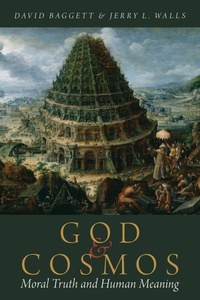
God and Cosmos
Moral Truth and Human Meaning
Published on 17. March 2016
Book
Paperback/Softback
344 pages
978-0-19-993121-7 (ISBN)
Description
Naturalistic ethics is the reigning paradigm among contemporary ethicists; in God and Cosmos, Baggett and Walls argue that this approach is seriously flawed. This book canvasses a broad array of secular and naturalistic ethical theories in an effort to test their adequacy in accounting for moral duties, intrinsic human value, prospects for radical moral transformation, and the rationality of morality. In each case, the authors argue, although various secular accounts provide real insights and indeed share common ground with theistic ethics, the resources of classical theism and orthodox Christianity provide the better explanation of the moral realities under consideration. Among such realities is the fundamental insight behind the problem of evil, namely, that the world is not as it should be. Baggett and Walls argue that God and the world, taken together, exhibit superior explanatory scope and power for morality classically construed, without the need to water down the categories of morality, the import of human value, the prescriptive strength of moral obligations, or the deliverances of the logic, language, and phenomenology of moral experience. This book thus provides a cogent moral argument for God's existence, one that is abductive, teleological, and cumulative.
Reviews / Votes
"Baggett and Walls provide a veritable history of ethical philosophy as they develop and support their thesis. The number of scholars cited-ancient, enlightenment, and modern-is impressive "--CHOICE"This is the book I had hoped they would write after Good God. Their previous book was mostly constructing their own theory, but God and Cosmos engages in significant detail with much of the best recent work in non-theist ethical theory. It is characteristically punchy in style, but at the end movingly eloquent in defense of a theist foundation for the authority of morality. The section on moral knowledge is especially fine, and takes the
subject forward in an interesting way." --John E. Hare, Noah Porter Professor of Philosophical Theology, Yale Divinity School
"Baggett and Walls are to be commended for developing a very interesting and important line of reasoning that I hope they and others will continue to explore in the coming years." --Notre Dame Philosophical Reviews
More details
Language
English
Place of publication
New York
United States
Target group
College/higher education
Professional and scholarly
Dimensions
Height: 234 mm
Width: 156 mm
Thickness: 20 mm
Weight
583 gr
ISBN-13
978-0-19-993121-7 (9780199931217)
Copyright in bibliographic data and cover images is held by Nielsen Book Services Limited or by the publishers or by their respective licensors: all rights reserved.
Schweitzer Classification
Other editions
Additional editions
Book
03/2016
Oxford University Press Inc
€211.00
Shipment within 15-20 days
E-Book
02/2016
1st Edition
OUP eBook
€30.49
Available for download
E-Book
02/2016
1st Edition
OUP eBook
€30.49
Available for download
Persons
David Baggett is a professor of philosophy and apologetics in the graduate school of the School of Divinity at Liberty University in Lynchburg, Virginia. He has written or edited about ten books, in such areas as philosophy and popular culture, apologetics, and ethics; and published several dozen articles in the philosophy of religion, epistemology, and theology. He is the executive editor of MoralApologetics.com, and his book Good God: The Theistic Foundations of Morality, co-written with Jerry Walls, won Christianity Today's 2012 Best Book in Apologetics.
Jerry L. Walls is Professor of Philosophy and Scholar in Residence at Houston Baptist University. He is the author or co-author of over a dozen books, including a trilogy on the afterlife.
Jerry L. Walls is Professor of Philosophy and Scholar in Residence at Houston Baptist University. He is the author or co-author of over a dozen books, including a trilogy on the afterlife.
Content
Acknowledgments
Introduction
Introduction to Part I
Chapter 1: Alone in the Cosmos
Chapter 2: The Case for Abduction
Chapter 3: The Problem of Evil, Freedom, and Moral Responsibility
Introduction to Part II
Chapter 4: Moral Value
Chapter 5: Moral Obligations
Chapter 6: Moral Knowledge
Chapter 7: Moral Transformation
Chapter 8: Moral Rationality
Introduction to Part III
Chapter 9: A Moral Argument
Conclusion
Index
Introduction
Introduction to Part I
Chapter 1: Alone in the Cosmos
Chapter 2: The Case for Abduction
Chapter 3: The Problem of Evil, Freedom, and Moral Responsibility
Introduction to Part II
Chapter 4: Moral Value
Chapter 5: Moral Obligations
Chapter 6: Moral Knowledge
Chapter 7: Moral Transformation
Chapter 8: Moral Rationality
Introduction to Part III
Chapter 9: A Moral Argument
Conclusion
Index