

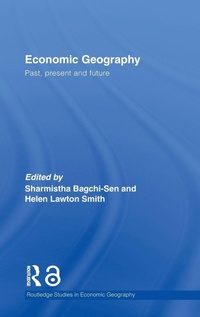
Economic Geography
Past, Present and Future
Published on 21. September 2006
Book
Hardback
288 pages
978-0-415-36784-4 (ISBN)
Description
The impact of economic geography both within and beyond the wider field of geography has been constrained in the past by its own limitations. Drawing together the work of several eminent geographers this superb collection assesses the current state of knowledge in the sub discipline and its future direction. In doing so, the contributors show how economic geographers have offered explanations that affect places and lives in the broader context of the global economy.
Offering a discussion of theoretical constructs and methodologies with the purpose to show the need to combine different approaches in understanding spatial (inter) dependencies, contributors also demonstrate the need to engage with multiple audiences, and within this context they proceed to examine how geographers have interfaced with businesses and policy.
This excellent collection moves economic geography from a preoccupation with theory towards more rigorous empirical research with greater relevance for public policy. With excellent breadth of coverage, it provides an outstanding introduction to research topics and approaches.
Offering a discussion of theoretical constructs and methodologies with the purpose to show the need to combine different approaches in understanding spatial (inter) dependencies, contributors also demonstrate the need to engage with multiple audiences, and within this context they proceed to examine how geographers have interfaced with businesses and policy.
This excellent collection moves economic geography from a preoccupation with theory towards more rigorous empirical research with greater relevance for public policy. With excellent breadth of coverage, it provides an outstanding introduction to research topics and approaches.
Reviews / Votes
This is a powerful and valuable contribution to current debates in Economic Geography. For anyone wishing to quickly get up to speed on the current challenges facing the sub-discipline or to understand the multiple positionalities of leading scholars in the field, this book is an essential read. James Faulconbridge, Lancaster University"...the collection strikingly captures the salient features of economic geography's present incarnation: its fragmentation, its slapdash ways, its lack of agreement about methods, its object of inquiry, and its subdisciplinary boundaries." -- Trevor J. Barnes, Annals of the Association of American Geographers
More details
Series
Language
English
Place of publication
London
United Kingdom
Publishing group
Taylor & Francis Ltd
Target group
College/higher education
Professional and scholarly
Illustrations
1 s/w Abbildung, 1 s/w Zeichnung
1 Line drawings, black and white; 1 Illustrations, black and white
Dimensions
Height: 240 mm
Width: 161 mm
Thickness: 20 mm
Weight
599 gr
ISBN-13
978-0-415-36784-4 (9780415367844)
Copyright in bibliographic data and cover images is held by Nielsen Book Services Limited or by the publishers or by their respective licensors: all rights reserved.
Schweitzer Classification
Other editions
Additional editions
Book
02/2015
1st Edition
Routledge
€77.20
Shipment within 10-20 days
E-Book
09/2006
Routledge
€0.00
Available for download
E-Book
09/2006
Routledge
€0.00
Available for download
Persons
Sharmistha Bagchi-Sen is a Professor in the Department of Geography, University at Buffalo-State University of New York.
Helen Lawton Smith is Reader in Management, School of Management and Organisational Psychology, Birkbeck, London University and a Distinguished Research Associate at the School of Geography, Oxford University.
Helen Lawton Smith is Reader in Management, School of Management and Organisational Psychology, Birkbeck, London University and a Distinguished Research Associate at the School of Geography, Oxford University.
Content
Introduction: The Past, Present, and Future of Economic Geography Section 1: Economic Geography: Roots and Legacy Section 2: Globalization and Contemporary Capitalism Section 3: Regional Competitive Advantage: Industrial Change, Human Capital, and Public Policy Index Bios