

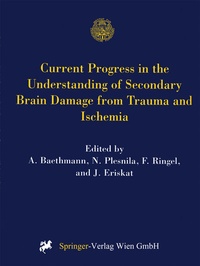
Current Progress in the Understanding of Secondary Brain Damage from Trauma and Ischemia
Proceedings of the 6th International Symposium: Mechanisms of Secondary Brain Damage-Novel Developments, Mauls/Sterzing, Italy, February 1998
Published on 19. August 1999
Book
Hardback
VIII, 120 pages
978-3-211-83313-1 (ISBN)
Description
Information is provided from the basic and clinical sciences on the mechanisms damaging the brain from trauma or ischemia. New aspects involve the endoplasmic reticulum, mitochondrial failure, pathobiology of axonal injury, molecular signals activating glial elements, or the emerging therapeutical role of neurotrophins. Experimental issues involve a better analysis of the ischemic penumbra, the salvagable tissue. Therapeutic contributions reach from the environmental influence to gene expression, including neuroprotection, such as hibernation - mother nature's experiment - or hypothermia which is reported to induce cell swelling. Treatment issues deal also with thrombolysis and combination therapies, or with the clearance of adverse blood components - LDL/fibrinogen - by a novel procedure using heparin. Other highlights are discussing the specificities of pediatric vs. adult brain trauma, or the evolving role of the Apolipoprotein-E e4 gene in severe head injury. An update is also provided on an online assessment of the patient management during the pre- and early hospital phase in Southern Bavaria.
The empirical observation of neuroworsening is analyzed in further details, whether this is a specificity autonomously driving the posttraumatic course. Finally, the unsolved question why drug trials in severe head injury have failed so far in view of the promising evidence from the laboratory is subjected to an expert analysis.
The empirical observation of neuroworsening is analyzed in further details, whether this is a specificity autonomously driving the posttraumatic course. Finally, the unsolved question why drug trials in severe head injury have failed so far in view of the promising evidence from the laboratory is subjected to an expert analysis.
More details
Series
Edition
1999 ed.
Language
English
Place of publication
Vienna
Austria
Publishing group
Springer Wien
Target group
Adult education
Professional/practitioner
Illustrations
VIII, 120 p.
Dimensions
Height: 27.9 cm
Width: 21 cm
Weight
660 gr
ISBN-13
978-3-211-83313-1 (9783211833131)
DOI
10.1007/978-3-7091-6391-7
Schweitzer Classification
Other editions
Additional editions
A. Baethmann | N. Plesnila | F. Ringel
Current Progress in the Understanding of Secondary Brain Damage from Trauma and Ischemia
Proceedings of the 6th International Symposium: Mechanisms of Secondary Brain Damage-Novel Developments, Mauls/Sterzing, Italy, February 1998
E-Book
12/2012
Springer
€149.79
Available for download
A. Baethmann | N. Plesnila | F. Ringel
Current Progress in the Understanding of Secondary Brain Damage from Trauma and Ischemia
Proceedings of the 6th International Symposium: Mechanisms of Secondary Brain Damage-Novel Developments, Mauls/Sterzing, Italy, February 1998
Book
10/2012
Springer
€160.49
Shipment within 10-15 days
Content
Molecular and Cellular Mechanisms.- Disturbance of Endoplasmic Reticulum Functions: A Key Mechanism Underlying Cell Damage ?.- Role and Mechanisms of Secondary Mitochondrial Failure.- Initiating Mechanisms Involved in the Pathobiology of Traumatically Induced Axonal Injury and Interventions Targeted at Blunting Their Progression.- Molecular Signals for Glial Activation: Pro- and Anti-Inflammatory Cytokines in the Injured Brain.- Mechanical and Excitotoxic Lesion of Motoneurons: Effects of Neurotrophins and Ciliary Neurotrophic Factor on Survival and Regeneration.- News from Cerebral Ischemia.- Modelling of the Ischemic Penumbra.- The Acute Ischemic Penumbra: Topography, Life Span, and Therapeutic Response.- Environmental Influence on Gene Expression and Recovery from Cerebral Ischemia.- Neuroprotective Strategies in Nature - Novel Clues for the Treatment of Stroke and Trauma.- Glial Cell Swelling - Effect of Hypothermia.- The Clot Thickens - Thrombolysis and Combination Therapies.- Assessment of Brain Tissue Viability Under Clinical Circumstances.- Heparin-Mediated Extracorporeal LDL/Fibrinogen Precipitation - H.E.L.P. - In Coronary and Cerebral Ischemia.- Remaining Problems in Severe Head Injury.- Pediatric Head Injury: What is Unique and Different.- Apolipoprotein E and the Response of the Brain to Injury.- System Analysis of Patient Management During the Pre- and Early Clinical Phase in Severe Head Injury.- The Frequency, Antecedent Events, and Causal Relationships of Neurologic Worsening Following Severe Head Injury.- Neuroprotective Effects of Riluzole in Neurotrauma Models: A Review.- Challenges in Translating the Efficacy of Neuroprotective Agents in Experimental Models Into Knowledge of Clinical Benefits in Head Injured Patients.- Author Index.- Indexof Keywords.