

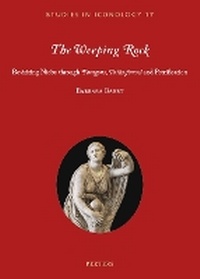
The Weeping Rock
Revisiting Niobe through 'Paragone', 'Pathosformel' and Petrification
1st Edition
Published on 14. August 2020
Book
Paperback/Softback
125 pages
978-90-429-4202-8 (ISBN)
Unfortunately, price unknown
Available (delivery time upon request)
Not available
Description
Publius Ovid (43 BC-17/18 AD) describes in his Metamorphoses
Niobe's transformation into a weeping rock. Niobe's transformation
incorporates the form and matter of the medium of sculpture. According
to the humanist paragone debate, painting and sculpture struggle
to be the medium with the highest qualities of virtuosity. Aby Warburg
(1866-1929) refers to the Niobe motif's Nachleben in his Tafel
5: Beraubte Mutter. (Niobe, Flucht und Schrecken). This displays the
images of both the bereaved mother (Niobe) and the murderous mother
(Medea). The montage also introduces the theme of the descent to the
underworld. It becomes clear how the cluster of motifs around the figure
of Niobe - hybris, lamentatio and the chthonic substrate -
functions as a direct entry to a bipolar hermeneutics of the visual
medium: the 'historical psychology of human expression' that navigates
between Apollo and Dionysus. The 'weeping rock' that according to legend
still stands on Mount Sipylus in Turkey, draws upon deeper
anthropological patterns. Petrification indicates inertia, frigidity and
a Medusan psychosis of fear. In nature, stones and rocks have a
'slumbering insistence' that can be captivating. Stones are after all
visible but impenetrable, they index an irrevocable absence in their
presence, and 'have abode' in an otherworldly region of utter blindness
and silence. From a psychoanalytical perspective, Niobe's petrifaction
symbolises the straitening of her life and the loss of anima within a
culture divorced from authentic feeling, nature, and instinct. Here
Niobe meets Echo.
Niobe's transformation into a weeping rock. Niobe's transformation
incorporates the form and matter of the medium of sculpture. According
to the humanist paragone debate, painting and sculpture struggle
to be the medium with the highest qualities of virtuosity. Aby Warburg
(1866-1929) refers to the Niobe motif's Nachleben in his Tafel
5: Beraubte Mutter. (Niobe, Flucht und Schrecken). This displays the
images of both the bereaved mother (Niobe) and the murderous mother
(Medea). The montage also introduces the theme of the descent to the
underworld. It becomes clear how the cluster of motifs around the figure
of Niobe - hybris, lamentatio and the chthonic substrate -
functions as a direct entry to a bipolar hermeneutics of the visual
medium: the 'historical psychology of human expression' that navigates
between Apollo and Dionysus. The 'weeping rock' that according to legend
still stands on Mount Sipylus in Turkey, draws upon deeper
anthropological patterns. Petrification indicates inertia, frigidity and
a Medusan psychosis of fear. In nature, stones and rocks have a
'slumbering insistence' that can be captivating. Stones are after all
visible but impenetrable, they index an irrevocable absence in their
presence, and 'have abode' in an otherworldly region of utter blindness
and silence. From a psychoanalytical perspective, Niobe's petrifaction
symbolises the straitening of her life and the loss of anima within a
culture divorced from authentic feeling, nature, and instinct. Here
Niobe meets Echo.
More details
Series
Language
English
Place of publication
Leuven
Belgium
Target group
Professional and scholarly
ISBN-13
978-90-429-4202-8 (9789042942028)
Copyright in bibliographic data and cover images is held by Nielsen Book Services Limited or by the publishers or by their respective licensors: all rights reserved.
Schweitzer Classification