

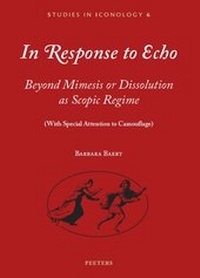
In Response to Echo
Beyond Mimesis or Dissolution as Scopic Regime (with Special Attention to Camouflage)
1st Edition
Published on 5. October 2016
Book
Paperback/Softback
112 pages
978-90-429-3346-0 (ISBN)
Unfortunately, price unknown
Available (delivery time upon request)
Not available
Description
In his Metamorphoses, Ovid (43 BC - AD 17) tells the story of
Echo and Narcissus. Echo's love for Narcissus ended in a cruel twist of
fate. Already punished with an echo for a voice, the nymph suffered
further as she petrified and her bones became stones. The study of art
has long focused on the Narcissus-mirror syndrome as a paradigm for
painting (Leon Battista Alberti (1404-1472)). Echo had no place in this
masculine scopic discipline. Recent approaches have rehabilitated Echo
from a visual, cultural and gendered point of view. Echo cries; she
cries for an alternative to the mirror paradigm and oculocentrism. She
helps us break free from Narcissus in favour of visual modalities such
as dissolution, camouflage and contamination, in short, disappearance as
an alternative to the scopic regime. In this essay I treat the impact of
Echo on art history through the lenses of: gender, speech and hearing;
Echo as textilisation and sacrifice; Echo as chthonic art; and, finally,
Echo and le desir mimetique. With this approach, I
develop a new hermeneutic to reintegrate the sonoric senses, camouflage
theory, gender epistemology, and the anthropological substrata of
nature, love and death into our Western obsession for mimetic thinking.
Echo and Narcissus. Echo's love for Narcissus ended in a cruel twist of
fate. Already punished with an echo for a voice, the nymph suffered
further as she petrified and her bones became stones. The study of art
has long focused on the Narcissus-mirror syndrome as a paradigm for
painting (Leon Battista Alberti (1404-1472)). Echo had no place in this
masculine scopic discipline. Recent approaches have rehabilitated Echo
from a visual, cultural and gendered point of view. Echo cries; she
cries for an alternative to the mirror paradigm and oculocentrism. She
helps us break free from Narcissus in favour of visual modalities such
as dissolution, camouflage and contamination, in short, disappearance as
an alternative to the scopic regime. In this essay I treat the impact of
Echo on art history through the lenses of: gender, speech and hearing;
Echo as textilisation and sacrifice; Echo as chthonic art; and, finally,
Echo and le desir mimetique. With this approach, I
develop a new hermeneutic to reintegrate the sonoric senses, camouflage
theory, gender epistemology, and the anthropological substrata of
nature, love and death into our Western obsession for mimetic thinking.
More details
Series
Language
English
Place of publication
Leuven
Belgium
Target group
Professional and scholarly
ISBN-13
978-90-429-3346-0 (9789042933460)
Copyright in bibliographic data and cover images is held by Nielsen Book Services Limited or by the publishers or by their respective licensors: all rights reserved.
Schweitzer Classification