

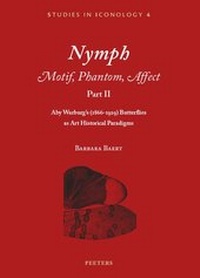
Nymph. Motif, Phantom, Affect. Part II
Aby Warburg's (1866-1929) Butterflies as Art Historical Paradigms
1st Edition
Published on 5. October 2016
Book
Paperback/Softback
115 pages
978-90-429-3347-7 (ISBN)
Unfortunately, price unknown
Available (delivery time upon request)
Not available
Description
This essay, a meditation on the butterfly and its resonance in art
history, is organized in three parts. I begin with Aby Warburg's
fascination with moths and butterflies as documented by (1) his letters
to Andre Jolles (e.g. the letter from 1900 known as 'But such high-flown
movements are not for me'), (2) the Kreuzlingen pathological report and
archives by Ludwig Binswanger (1881-1966) preserved in Tuebingen, and (3)
the Ninfa fiorentina file in the Warburg Institute. As Seelentierchen
- soul animals, psyche - butterflies are archetypically
connected to deep cultural affects regarding the soul, resurrection and
immortality. Part 2 of the paper considers the butterfly as paradigm for
the visual medium and the oculocentric paradigms in art history. Indeed,
the butterfly has a specific visual (and sensory) impact on humankind
with its flashy, quick, vibrant and hypnotic wings, its medusian eyes
and its capability to camouflage itself (cf. 'Sciences diagonales' by
Roger Caillois (1913-1978)). Hypnosis, Medusa and camouflage are three
important paradigms with which to consider the essence of the image as a
dis/appearing, enchanting, and deceiving medium. In Part 3, the three
paradigms become the basis for new reflections about art history (and
the history of art history) as a study of the butterfly, in short, as
'lepidopterology'.
history, is organized in three parts. I begin with Aby Warburg's
fascination with moths and butterflies as documented by (1) his letters
to Andre Jolles (e.g. the letter from 1900 known as 'But such high-flown
movements are not for me'), (2) the Kreuzlingen pathological report and
archives by Ludwig Binswanger (1881-1966) preserved in Tuebingen, and (3)
the Ninfa fiorentina file in the Warburg Institute. As Seelentierchen
- soul animals, psyche - butterflies are archetypically
connected to deep cultural affects regarding the soul, resurrection and
immortality. Part 2 of the paper considers the butterfly as paradigm for
the visual medium and the oculocentric paradigms in art history. Indeed,
the butterfly has a specific visual (and sensory) impact on humankind
with its flashy, quick, vibrant and hypnotic wings, its medusian eyes
and its capability to camouflage itself (cf. 'Sciences diagonales' by
Roger Caillois (1913-1978)). Hypnosis, Medusa and camouflage are three
important paradigms with which to consider the essence of the image as a
dis/appearing, enchanting, and deceiving medium. In Part 3, the three
paradigms become the basis for new reflections about art history (and
the history of art history) as a study of the butterfly, in short, as
'lepidopterology'.
More details
Series
Language
English
Place of publication
Leuven
Belgium
Target group
Professional and scholarly
Weight
340 gr
ISBN-13
978-90-429-3347-7 (9789042933477)
Copyright in bibliographic data and cover images is held by Nielsen Book Services Limited or by the publishers or by their respective licensors: all rights reserved.
Schweitzer Classification