

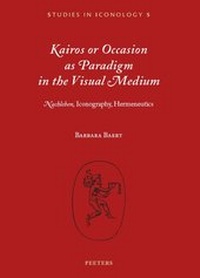
Kairos or Occasion as Paradigm in the Visual Medium
"Nachleben", Iconography, Hermeneutics
1st Edition
Published on 5. October 2016
Book
Paperback/Softback
141 pages
978-90-429-3379-8 (ISBN)
Unfortunately, price unknown
Available (delivery time upon request)
Not available
Description
The meaning of tearing and splitting as a life-, love- and
wisdom-generating event (for example, the tearing of the temple curtain)
is profoundly rooted in the visual and literary 'bodies' of ancient and
Christian thought. The primordial cosmogonic split is always sudden, is
always sharp (like a knife), appears as a flash (sudden and all
encompassing) and is experienced through the whole bodily sensorium (in
shivering, bliss, sigh, wind, breath). The split is the epiphany of
radical change, revolution and the transition beyond. The Greek deity
Kairos embodies this mystery. The reach of Kairos can be detected in the
theory of rhetoric (Sophists vs. Aristotle (385-322 BC)), in humanistic
politics, in postmodern theology and in contemporary time-management.
Iconographical studies have treated Kairos's Nachleben in
Byzantine and Latin visual traditions where the god is conflated with
Fortuna and Occasio. This essay addresses the impact of Kairos and its
iconographic Nachleben from a literary and historical
perspective, and further considers Kairos as a new art historical
paradigm. Indeed, Kairos can offer us alternative hermeneutics to
reconceive the image as chronotopos, as epiphany and as intercession.
wisdom-generating event (for example, the tearing of the temple curtain)
is profoundly rooted in the visual and literary 'bodies' of ancient and
Christian thought. The primordial cosmogonic split is always sudden, is
always sharp (like a knife), appears as a flash (sudden and all
encompassing) and is experienced through the whole bodily sensorium (in
shivering, bliss, sigh, wind, breath). The split is the epiphany of
radical change, revolution and the transition beyond. The Greek deity
Kairos embodies this mystery. The reach of Kairos can be detected in the
theory of rhetoric (Sophists vs. Aristotle (385-322 BC)), in humanistic
politics, in postmodern theology and in contemporary time-management.
Iconographical studies have treated Kairos's Nachleben in
Byzantine and Latin visual traditions where the god is conflated with
Fortuna and Occasio. This essay addresses the impact of Kairos and its
iconographic Nachleben from a literary and historical
perspective, and further considers Kairos as a new art historical
paradigm. Indeed, Kairos can offer us alternative hermeneutics to
reconceive the image as chronotopos, as epiphany and as intercession.
More details
Series
Language
English
Place of publication
Leuven
Belgium
Target group
Professional and scholarly
ISBN-13
978-90-429-3379-8 (9789042933798)
Copyright in bibliographic data and cover images is held by Nielsen Book Services Limited or by the publishers or by their respective licensors: all rights reserved.
Schweitzer Classification