

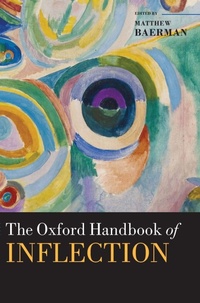
The Oxford Handbook of Inflection
Published on 30. July 2015
Book
Hardback
714 pages
978-0-19-959142-8 (ISBN)
Description
This is the latest addition to a group of handbooks covering the field of morphology, alongside The Oxford Handbook of Case (2008), The Oxford Handbook of Compounding (2009), and The Oxford Handbook of Derivational Morphology (2014). It provides a comprehensive state-of-the-art overview of work on inflection - the expression of grammatical information through changes in word forms. The volume's 24 chapters are written by experts in the field from a variety of theoretical backgrounds, with examples drawn from a wide range of languages.
The first part of the handbook covers the fundamental building blocks of inflectional form and content: morphemes, features, and means of exponence. Part 2 focuses on what is arguably the most characteristic property of inflectional systems, paradigmatic structure, and the non-trivial nature of the mapping between function and form. The third part deals with change and variation over time, and the fourth part covers computational issues from a theoretical and practical standpoint. Part 5 addresses psycholinguistic questions relating to language acquisition and neurocognitive disorders. The final part is devoted to sketches of individual inflectional systems, illustrating a range of typological possibilities across a genetically diverse set of languages from Africa, Asia and the Pacific, Australia, Europe, and South America.
The first part of the handbook covers the fundamental building blocks of inflectional form and content: morphemes, features, and means of exponence. Part 2 focuses on what is arguably the most characteristic property of inflectional systems, paradigmatic structure, and the non-trivial nature of the mapping between function and form. The third part deals with change and variation over time, and the fourth part covers computational issues from a theoretical and practical standpoint. Part 5 addresses psycholinguistic questions relating to language acquisition and neurocognitive disorders. The final part is devoted to sketches of individual inflectional systems, illustrating a range of typological possibilities across a genetically diverse set of languages from Africa, Asia and the Pacific, Australia, Europe, and South America.
Reviews / Votes
The handbook ends with a sixty-page bibliography, which is a treasure chest for anybody in-terested in inflectional morphology. There are also three indexes for authors, languages, and sub-jects that make the handbook useful as a reference tool ... the handbook under review is an extremely valuable contribution to morphology -- a resource that deserves to be widely used for many years to come. * Tore Nesset, Voprosy Jazykoznanija *More details
Other editions
Additional editions
Matthew Baerman
The Oxford Handbook of Inflection
E-Book
07/2015
1st Edition
OUP eBook
€25.49
Available for download
Matthew Baerman
The Oxford Handbook of Inflection
E-Book
07/2015
1st Edition
OUP eBook
€25.49
Available for download
Person
Matthew Baerman is a research fellow in the Surrey Morphology Group at the University of Surrey. His research focuses on the typology, diachrony, and formal analysis of inflectional systems, with a particular concentration on phenomena whose interpretation is problematic or controversial. His work has appeared in such journals as Language, Journal of Linguistics, Morphology, Lingua, Russian Linguistics and Natural Language and Linguistic Theory. He is co-author of The Syntax-Morphology Interface: a Study of Syncretism (CUP, 2005) and co-editor of Understanding and Measuring Morphological Complexity (OUP, 2014).
Content
PART I: BUILDING BLOCKS; PART II: PARADIGMS AND THEIR VARIANTS; PART III: CHANGE; PART IV: COMPUTATION; PART V: PSYCHOLINGUISTICS; PART VI: SKETCHES OF INDIVIDUAL SYSTEMS