

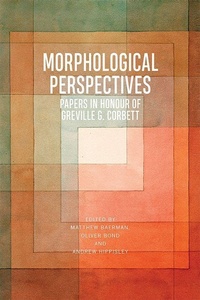
Morphological Perspectives
Papers in Honour of Greville G. Corbett
Published on 22. April 2019
Book
Hardback
474 pages
978-1-4744-4600-6 (ISBN)
Description
In a field still dominated by syntactic perspectives, it is easy to overlook the words that are the irreducible building blocks of language. Morphological Perspectives takes words as the starting point for any questions about linguistic structure: their form, their internal structure, their paradigmatic extensions, and their role in expressing and manipulating syntactic configurations. With a team of authors that run the typological gamut of languages, this book examines these questions from multiple perspectives, both the canonical and the non-canonical. By taking these questions seriously, and letting loose a full battery of analytical techniques, the following chapters not only celebrate the pioneering work of Greville G. Corbett but present new thinking on traditional approaches, including the paradigm, deponency and morphological features.
More details
Language
English
Place of publication
Edinburgh
United Kingdom
Target group
College/higher education
Product notice
sewn/stitched
Cloth over boards
Dimensions
Height: 241 mm
Width: 168 mm
Thickness: 30 mm
Weight
953 gr
ISBN-13
978-1-4744-4600-6 (9781474446006)
Copyright in bibliographic data and cover images is held by Nielsen Book Services Limited or by the publishers or by their respective licensors: all rights reserved.
Schweitzer Classification
Other editions
Additional editions
Matthew Baerman | Oliver Bond | Andrew Hippisley
Morphological Perspectives
Papers in Honour of Greville G. Corbett
E-Book
04/2019
Edinburgh University Press
€0.00
Available for download
Persons
Matthew Baerman is Principal Research Fellow in the Surrey Morphology Group, University of Surrey. His research focuses on the typology, diachrony and formal analysis of morphological systems, with a particular concentration on phenomena that are unusual or difficult to categorize. He is the co-author (with Dunstan Brown and Greville Corbett) of Morphlogical Complexity (CUP, 2017) and the editor of the Oxford Handbook of Inflection (OUP, 2015). Andrew Hippisley is Professor of Linguistics and Dean of the Fairmount College of Liberal Arts and Sciences at Wichita State University. He is the co-editor of Deponency and Morphological Mismatches (2007, OUP) and co-author of Network Morphology (2012, CUP).
Content
1. Taking The Morphological Perspective
Matthew Baerman, Oliver Bond and Andrew Hippisley
2. Canonical Compounds
Andrew Spencer
3. How (Non-)Canonical Is Italian Morphology?
Anna M. Thornton
4. Waiting For The Word: Distributed Deponency and the Semantic Interpretation Of Number In The Nen Verb
Nicholas Evans
5. Feature Duality
Matthew Baerman
6. Canonical Syncretism and Chomsky's S
Mark Aronoff
7. Canonical Tough Cases
Johanna Nichols
8. Paradigm Uniformity and The French Gender System
Olivier Bonami and Gilles Boye
9. Case Loss in Pronominal Systems: Evidence From Bulgarian
Alexander Krasovitsky
10. Measuring The Complexity Of The Stem Alternation Patterns Of Spanish Verbs
Enrique L. Palancar
11. Verb Root Ellipsis
Bernard Comrie and Raoul Zamponi
12. Bound But Still Independent: Quotative and Verificative In Archi
Marina Chumakina
13. To Agree Or Not To Agree? - A Typology of Sporadic Agreement
Sebastian Fedden
14. Where Are Gender Values and How Do I Get To Them?
Oliver Bond
15. Focus as A Morphosyntactic and Morphosemantic Feature
Irina Nikolaeva
16. When Agreement and Binding Go Their Separate Ways: Generic Second Person Pronoun In Russian
Maria Polinsky
17. Rara and Theory Testing In Typology: The Natural Evolution of Non-Canonical Agreement
Erich Round
Matthew Baerman, Oliver Bond and Andrew Hippisley
2. Canonical Compounds
Andrew Spencer
3. How (Non-)Canonical Is Italian Morphology?
Anna M. Thornton
4. Waiting For The Word: Distributed Deponency and the Semantic Interpretation Of Number In The Nen Verb
Nicholas Evans
5. Feature Duality
Matthew Baerman
6. Canonical Syncretism and Chomsky's S
Mark Aronoff
7. Canonical Tough Cases
Johanna Nichols
8. Paradigm Uniformity and The French Gender System
Olivier Bonami and Gilles Boye
9. Case Loss in Pronominal Systems: Evidence From Bulgarian
Alexander Krasovitsky
10. Measuring The Complexity Of The Stem Alternation Patterns Of Spanish Verbs
Enrique L. Palancar
11. Verb Root Ellipsis
Bernard Comrie and Raoul Zamponi
12. Bound But Still Independent: Quotative and Verificative In Archi
Marina Chumakina
13. To Agree Or Not To Agree? - A Typology of Sporadic Agreement
Sebastian Fedden
14. Where Are Gender Values and How Do I Get To Them?
Oliver Bond
15. Focus as A Morphosyntactic and Morphosemantic Feature
Irina Nikolaeva
16. When Agreement and Binding Go Their Separate Ways: Generic Second Person Pronoun In Russian
Maria Polinsky
17. Rara and Theory Testing In Typology: The Natural Evolution of Non-Canonical Agreement
Erich Round