

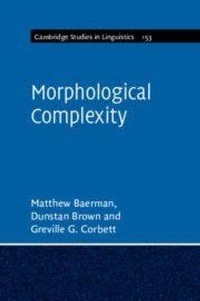
Morphological Complexity
Published on 7. June 2023
Book
Paperback/Softback
210 pages
978-1-107-54361-4 (ISBN)
Description
Inflectional morphology plays a paradoxical role in language. On the one hand it tells us useful things, for example that a noun is plural or a verb is in the past tense. On the other hand many languages get along perfectly well without it, so the baroquely ornamented forms we sometimes find come across as a gratuitous over-elaboration. This is especially apparent where the morphological structures operate at cross purposes to the general systems of meaning and function that govern a language, yielding inflection classes and arbitrarily configured paradigms. This is what we call morphological complexity. Manipulating the forms of words requires learning a whole new system of structures and relationships. This book confronts the typological challenge of characterising the wildly diverse sorts of morphological complexity we find in the languages of the world, offering both a unified descriptive framework and quantitative measures that can be applied to such heterogeneous systems.
More details
Series
Language
English
Place of publication
Cambridge
United Kingdom
Target group
Professional and scholarly
Product notice
Paperback (trade)
Illustrations
150 Tables, black and white; 5 Line drawings, black and white
Dimensions
Height: 226 mm
Width: 152 mm
Thickness: 15 mm
Weight
295 gr
ISBN-13
978-1-107-54361-4 (9781107543614)
Copyright in bibliographic data and cover images is held by Nielsen Book Services Limited or by the publishers or by their respective licensors: all rights reserved.
Schweitzer Classification
Other editions
Additional editions
Matthew Baerman | Dunstan Brown | Greville G. Corbett
Morphological Complexity
Book
06/2017
Cambridge University Press
€130.50
Shipment within 15-20 days
Persons
Matthew Baerman is Senior Research Fellow in the Surrey Morphology Group at the University of Surrey, whose work concentrates on the description, typology and diachrony of morphology, particularly complex infllectional systems. He is the editor of the recent Oxford Handbook of Inflection (2015).
Content
1. Introduction; 2. External typology of inflection classes; 3. Features; 4. Motivation; 5. Conditions on paradigms; 6. Paradigm structure; 7. Lexicon and grammar; 8. Morphological complexity and morphological autonomy; Appendix; References; Indices.