

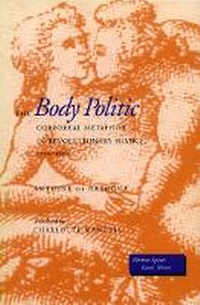
The Body Politic
Corporeal Metaphor in Revolutionary France, 1770-1800
Will be published approx. on 1. October 1997
Book
Paperback/Softback
384 pages
978-0-8047-2817-1 (ISBN)
Description
This is a remarkable history of the French Revolution told through the study of images of the body as they appeared in the popular literature of the time, showing how these images were at the very center of the metaphoric language used to describe the revolution in progress.
The author draws upon some 2,000 texts, pamphlets, announcements, opinions, accounts, treatises, and journals to exhume the textual reality of the Revolution, the body of its history. The deployment of bodily images-the degeneracy of the nobility, the impotence of the king, the herculean strength of the citizenry, the goddess of politics appearing naked like Truth, the bleeding wounds of the Republican martyrs-allowed political society to represent itself at a pivotal moment in its history.
Searching for "the body of history," the author finds three forms of political representation: first, the metaphysical representation of the body as an anthropomorphic symbol of the political system-the transition of sovereignty from the body of the king to the great citizen body; second, the metaphorical representation of the body as a tool of discourse for persuasion-the embodied tale of the revolutionary epic; and third, the representation of the body in public ceremonies-street carnivals and funerals.
The introductory chapter studies the symbolic defeat of the king's body and the transfer of virility to the Republican body. Later chapters examine the new patriotic body as described in medical terms; paintings by David that show the revolutionary hero as "political body"; the Revolutionary subject conceived in terms of regeneration; its opposite, the aristocratic body, conceived as monstrous; and the bestial images projected onto Marie Antoinette.
The author draws upon some 2,000 texts, pamphlets, announcements, opinions, accounts, treatises, and journals to exhume the textual reality of the Revolution, the body of its history. The deployment of bodily images-the degeneracy of the nobility, the impotence of the king, the herculean strength of the citizenry, the goddess of politics appearing naked like Truth, the bleeding wounds of the Republican martyrs-allowed political society to represent itself at a pivotal moment in its history.
Searching for "the body of history," the author finds three forms of political representation: first, the metaphysical representation of the body as an anthropomorphic symbol of the political system-the transition of sovereignty from the body of the king to the great citizen body; second, the metaphorical representation of the body as a tool of discourse for persuasion-the embodied tale of the revolutionary epic; and third, the representation of the body in public ceremonies-street carnivals and funerals.
The introductory chapter studies the symbolic defeat of the king's body and the transfer of virility to the Republican body. Later chapters examine the new patriotic body as described in medical terms; paintings by David that show the revolutionary hero as "political body"; the Revolutionary subject conceived in terms of regeneration; its opposite, the aristocratic body, conceived as monstrous; and the bestial images projected onto Marie Antoinette.
More details
Series
Language
English
Place of publication
Palo Alto
United States
Target group
College/higher education
Professional and scholarly
Illustrations
17 illus
Dimensions
Height: 229 mm
Width: 153 mm
ISBN-13
978-0-8047-2817-1 (9780804728171)
Copyright in bibliographic data and cover images is held by Nielsen Book Services Limited or by the publishers or by their respective licensors: all rights reserved.
Schweitzer Classification
Persons
Antoine de Baecque is Professor at the University of Saint Quentin in Yvelynes, France.
Content
Notes; Introduction: the body of history; Part I. The State-Body: Metaphor of the Transition of Sovereignty: 1. The defeat of the body of the king: essay on the impotence of Louis XVI; 2. Sieyes, doctor of the body politic: the metaphor of the great body of the citizens; Part II. The Narrative Body, or History in Fiction: 3. Regeneration: the marvellous body, or the body raised upright of the new revolutionary man; 4. The monsters of a fantastic aristocracy, or how the Revolution embodies its horrors; 5. David, or the struggle of bodies; Part III. The Body as Spectacle: The Flesh of Political Ceremony: 6. The great spectacle of transparency: public denunciation and the classification of appearances; 7. The bodies of the political carnival; 8. The offertory of the martyrs: the wounded body of the Revolution; Conclusion: a few bodies to e nd (the Revolution); Notes; Index.