

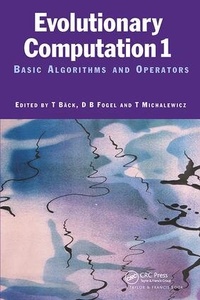
Evolutionary Computation 1
Basic Algorithms and Operators
1st Edition
Published on 27. July 2017
Book
Hardback
378 pages
978-1-138-41308-5 (ISBN)
Description
The field of evolutionary computation is expanding dramatically, fueled by the vast investment that reflects the value of applying its techniques. Culling material from the Handbook of Evolutionary Computation, Evolutionary Computation 1: Basic Algorithms and Operators contains up-to-date information on algorithms and operators used in evolutionary computing. This volume discusses the basic ideas that underlie the main paradigms of evolutionary algorithms, evolution strategies, evolutionary programming, and genetic programming. It is intended to be used by individual researchers, teachers, and students working and studying in this expanding field.
Reviews / Votes
"This new volume contains some extended material and provides basic information on evolutionary algorithms ... This book provides an interesting reference for theorists, teachers, and practitioners also."-H.D. Hecker, Zentralblatt Math
More details
Language
English
Place of publication
London
United Kingdom
Publishing group
Taylor & Francis Ltd
Target group
College/higher education
Undergraduate
Dimensions
Height: 234 mm
Width: 156 mm
Weight
662 gr
ISBN-13
978-1-138-41308-5 (9781138413085)
Copyright in bibliographic data and cover images is held by Nielsen Book Services Limited or by the publishers or by their respective licensors: all rights reserved.
Schweitzer Classification
Other editions
Additional editions
E-Book
10/2018
CRC Press
€114.99
Available for download
E-Book
10/2018
1st Edition
CRC Press
€114.99
Available for download
Book
01/2000
1st Edition
Institute of Physics Publishing
€123.00
Shipment within 10-20 days
Persons
Thomas Baeck, D.B Fogel, Z Michalewicz
Content
PART 1 WHY EVOLUTIONARY COMPUTATION? 1. Introduction to evolutionary computation. 2. Possible applications of evolutationary computation. 3. Advantages (and disadvantages) of evolutionary computation over other approaches. PART 2. EVOLUTIONARY COMPUTATION: THE BACKGROUND. 4. Principles of evolutionary processes. 5. Principles of genetics. 6. A history of evolutionary computation. PART 3 EVOLUTIONARY ALGORITHMS AND THEIR STANDARD INSTANCES. 7. Introduction to evolutionary algorithms. 8. Genetic algorithms. 9. Evolution strategies. 10. Evolutionary programming. 11. Derivative methods in genetic programming. 12. Learning classifier systems. 13. Hybrid methods. PART 4. REPRESENTATIONS. 14. Introduction to representations. 15. Binary strings. 16. Real-valued vectors. 17. Permutations. 18. Finite-state representations. 19. Parse trees. 20. Guidelines for a suitable encoding. 21. Other representations. PART 5. SELECTION. 22. Introduction to selection. 23. Proportionary selection and sampling algorithms. 24. Tournament selection. 25. Rank-based selection. 26. Boltzmann selection. 27. Other selection methods. 28. Generation gap methods. 29. A comparison of selection mechanisms. 30. Interactive evolution. PART 6. SEARCH OPERATORS. 31. Introduction to search operators. 32. Mutation operators. 33. Recombination. 34. Other operators. Index.