

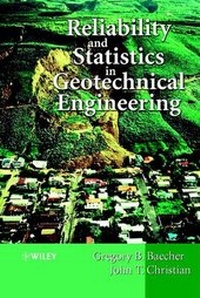
Reliability and Statistics in Geotechnical Engineering
Published on 19. September 2003
Book
Hardback
618 pages
978-0-471-49833-9 (ISBN)
Description
Risk and reliability analysis is an area of growing importance in geotechnical engineering, where many variables have to be considered. Statistics, reliability modeling and engineering judgement are employed together to develop risk and decision analyses for civil engineering systems. The resulting engineering models are used to make probabilistic predictions, which are applied to geotechnical problems.
Reliability & Statistics in Geotechnical Engineering comprehensively covers the subject of risk and reliability in both practical and research terms
* Includes extensive use of case studies
* Presents topics not covered elsewhere--spatial variability and stochastic properties of geological materials
* No comparable texts available
Practicing engineers will find this an essential resource as will graduates in geotechnical engineering programmes.
More details
Product info
gebunden
Edition
1. Auflage
Language
English
Place of publication
New York
United States
Target group
Professional and scholarly
Product notice
sewn/stitched
Cloth over boards
Dimensions
Height: 250 mm
Width: 175 mm
Thickness: 38 mm
Weight
1235 gr
ISBN-13
978-0-471-49833-9 (9780471498339)
Schweitzer Classification
Other editions
Additional editions
Gregory Baecher | John Christian
Reliability and Statistics in Geotechnical Engineering
E-Book
08/2005
Wiley
€139.99
Available for download
Persons
Gregory B. Baecher is the author of Reliability and Statistics in Geotechnical Engineering, published by Wiley.
John T. Christian is the author of Reliability and Statistics in Geotechnical Engineering, published by Wiley.
John T. Christian is the author of Reliability and Statistics in Geotechnical Engineering, published by Wiley.
Content
Preface.
Part I.
1 Introduction - uncertainty and risk in geotechnical engineering.
2 Uncertainty.
3 Probability.
4 Inference.
5 Risk, decisions and judgment.
Part II.
6 Site characterization.
7 Classification and mapping.
8 Soil variability.
9 Spatial variability within homogeneous deposits.
10 Random field theory.
11 Spatial sampling.
12 Search theory.
Part III.
13 Reliability analysis and error propagation.
14 First order second moment (FOSM) methods.
15 Point estimate methods.
16 The Hasofer-Lind approach (FORM).
17 Monte Carlo simulation methods.
18 Load and resistance factor design.
19 Stochastic finite elements.
Part IV.
20 Event tree analysis.
21 Expert opinion.
22 System reliability assessment.
Appendix A: A primer on probability theory.
References.
Index.