

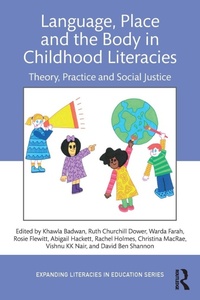
Language, Place, and the Body in Childhood Literacies
Theory, Practice, and Social Justice
1st Edition
Published on 21. August 2025
Book
Paperback/Softback
256 pages
978-1-032-62075-6 (ISBN)
Description
Challenging dominant views of early childhood language development and knowledge, this thought-provoking volume illuminates the importance of place, the body, and movement in opening space for young children's improvisatory, creative, playful language practices.
Bringing together a rich collection of contemporary research and diverse perspectives, the book centers on the premise that 'where' talk happens-be it spoken, mimed, signed, or assisted through one or more communication tools-is not a neutral backdrop or controllable variable. Rather, it is deeply entangled in the emergence of language from bodies, in how these vocalizations make their way into the world, what they might feel like and set into motion, and how they are received, heard and listened to by other humans and by non-humans. Chapter authors introduce theories about language, body, and place, while also providing examples of what this work may look like in practice.
This book is key reading for those who work with young children and families, including teachers, pre-service teachers studying child development, speech and language therapists, support workers, and those in the arts, cultural and environmental sectors. It is also highly relevant to researchers, literacy education scholars, and anyone who endeavors to think more expansively and critically about language and literacy in early childhood contexts.
Bringing together a rich collection of contemporary research and diverse perspectives, the book centers on the premise that 'where' talk happens-be it spoken, mimed, signed, or assisted through one or more communication tools-is not a neutral backdrop or controllable variable. Rather, it is deeply entangled in the emergence of language from bodies, in how these vocalizations make their way into the world, what they might feel like and set into motion, and how they are received, heard and listened to by other humans and by non-humans. Chapter authors introduce theories about language, body, and place, while also providing examples of what this work may look like in practice.
This book is key reading for those who work with young children and families, including teachers, pre-service teachers studying child development, speech and language therapists, support workers, and those in the arts, cultural and environmental sectors. It is also highly relevant to researchers, literacy education scholars, and anyone who endeavors to think more expansively and critically about language and literacy in early childhood contexts.
Reviews / Votes
'This exemplary book goes far beyond simple meanings and interpretations about language, to reconceptualise language as multimodal and embodied in spoken and signed words, created with machines and symbols, danced, painted ... and always connected to place. The interdisciplinary authors are academics, pedagogues, located in communities and various practitioners who give us new insights into how children create their own language in their unique learning ecologies and share what this actually looks like in their lifeworlds.'- Nicola Yelland, Professor of Early Childhood Studies, University of Melbourne, Australia
'If "it takes a village to raise a child," this book powerfully shows that it is not only the people in the village, but the land, objects, and the whole host of non-human beings there who shape this development. The book demonstrates that language and cognition are embodied, shaped by an ecology of expansive social and material resources. How children draw from all the resources in their environment to think and talk in creative, spontaneous, and unorthodox ways suggests a complex language development. Judging their communication as deficient stems from our limited ideological assumptions. This book educates scholars to expand their perspectives by listening to the more-than-human communication "out of the mouth of babes and infants"!'
- Suresh Canagarajah, Evan Pugh University Professor, Pennsylvania State University, USA
'If you are interested in how, why and when children communicate, you will be informed, provoked, stimulated and engaged by this collection of papers. Rejecting simple and reductive approaches, the authors collectively show that children's languaging practices are full-bodied, material, placed, unpredictable and delightfully opaque and slippery.'
- Pat Thomson, Professor of Education, The University of Nottingham, UK
More details
Series
Language
English
Place of publication
London
United Kingdom
Publishing group
Taylor & Francis Ltd
Target group
College/higher education
Professional and scholarly
Academic, Postgraduate, and Undergraduate Advanced
Illustrations
26 s/w Abbildungen, 26 s/w Photographien bzw. Rasterbilder
26 Halftones, black and white; 26 Illustrations, black and white
Dimensions
Height: 229 mm
Width: 152 mm
Thickness: 15 mm
Weight
410 gr
ISBN-13
978-1-032-62075-6 (9781032620756)
Copyright in bibliographic data and cover images is held by Nielsen Book Services Limited or by the publishers or by their respective licensors: all rights reserved.
Schweitzer Classification
Other editions
Additional editions
Khawla Badwan | Ruth Churchill Dower | Warda Farah
Language, Place, and the Body in Childhood Literacies
Theory, Practice, and Social Justice
E-Book
08/2025
Routledge
€60.49
Available for download
Khawla Badwan | Ruth Churchill Dower | Warda Farah
Language, Place, and the Body in Childhood Literacies
Theory, Practice, and Social Justice
E-Book
08/2025
Routledge
€60.49
Available for download
Khawla Badwan | Ruth Churchill Dower | Warda Farah
Language, Place, and the Body in Childhood Literacies
Theory, Practice, and Social Justice
Book
08/2025
1st Edition
Routledge
€206.60
Shipment within 10-20 days
Persons
Khawla Badwan is Reader in TESOL and Applied Linguistics at Manchester Metropolitan University, UK.
Ruth Churchill Dower is a PhD scholar at Manchester Metropolitan University, UK, exploring young children's nonlingual ways of being through experiments in movement.
Warda Farah is a Social Entrepreneur, Speech & Language Therapist, Writer and Consultant.
Rosie Flewitt is Professor of Early Childhood Communication at Manchester Metropolitan University, UK.
Abigail Hackett is a Professor of Childhood and Education at Sheffield Hallam University.
Rachel Holmes is a Professor in the Education and Social Research Institute of Manchester Metropolitan University, UK.
Christina MacRae is a Visiting Research Fellow at Manchester Metropolitan University.
Vishnu KK Nair is a Lecturer in the School of Psychology and Clinical Language Sciences at University of Reading.
David Ben Shannon is a Lecturer in the School of Education at the University of Sheffield.
Ruth Churchill Dower is a PhD scholar at Manchester Metropolitan University, UK, exploring young children's nonlingual ways of being through experiments in movement.
Warda Farah is a Social Entrepreneur, Speech & Language Therapist, Writer and Consultant.
Rosie Flewitt is Professor of Early Childhood Communication at Manchester Metropolitan University, UK.
Abigail Hackett is a Professor of Childhood and Education at Sheffield Hallam University.
Rachel Holmes is a Professor in the Education and Social Research Institute of Manchester Metropolitan University, UK.
Christina MacRae is a Visiting Research Fellow at Manchester Metropolitan University.
Vishnu KK Nair is a Lecturer in the School of Psychology and Clinical Language Sciences at University of Reading.
David Ben Shannon is a Lecturer in the School of Education at the University of Sheffield.
Content
Contents
Book Series Editors' Forward
Foreword: Warda Farah
SECTION I: Introduction
1 Introduction
KHAWLA BADWAN, RUTH CHURCHILL DOWER, WARDA FARAH, ROSIE FLEWITT, RACHEL HOLMES, ABIGAIL HACKETT, CHRISTINA MACRAE, VISHNU NAIR, DAVID BEN SHANNON
SECTION II: Language as bodily and material
2a Language as bodily and material
ROSIE FLEWITT, RACHEL HOLMES, CHRISTINA MACRAE
2b Making time for unruliness in the special education classroom: Resisting the narrowing of neurotypicality in England
YVONNE WILLIAMS and DAVID BEN SHANNON
2c Letting things become what they want to become: Uncertainty, improvisation, and resisting the tyranny of talk
CHARLOTTE ARCULUS
2d Facilitating expressive language through body movements: Clinical implications
MAYA LEELA
2e Speech Bubbles: How play, joy, and storytelling open up expansive possibilities for language
ADAM POWER-ANNAND with ABIGAIL HACKETT
2f Coming together: Roundtable discussion on language as bodily and material
CHARLOTTE ARCULUS, RACHEL HOLMES, MAYA LEELA, CHRISTINA MACRAE, ADAM POWER-ANNAND, DAVID BEN SHANNON, YVONNE WILLIAMS
SECTION III: Place and language
3a Place and Language
WARDA FARAH, VISHNU NAIR, DAVID BEN SHANNON
3b Researching language and place: What is the evidence base?
ABIGAIL HACKETT and DAVID BEN SHANNON
3c Rituals, vocalisations and creating comfortable spaces: A spatialised view of young children's language in museums
ABI HACKETT, CHRISTINA MACRAE, DAVID BEN SHANNON, ROBERT CHESTER, LUCY COOKE, ESTHER HALLBERG, GEORGINA SIMMONS, LAURA SMITH-HIGGINS, SALLY TOON
3d Spaces of Reprieve: An emancipatory practice centring Black and Brown children labelled with communication difficulties
WARDA FARAH and VISHNU NAIR
3e The entanglement between signed language, embodiment, and place
LEALA HOLCOMB
3f Coming together: Roundtable discussion on place and language
WARDA FARAH, ABI HACKETT, LEALA HOLCOMB, VISHNU KK NAIR, DAVID BEN SHANNON
SECTION IV: Language beyond meaning
4a Language beyond meaning
KHAWLA BADWAN, RUTH CHURCHILL DOWER, ABIGAIL HACKETT
4b Beyond 'deficit' or 'lack': Enjoying the richness of language and meaning-making in a complex early childhood classroom
WILLOW SPENCER, JESS CLARKE, DAVID BEN SHANNON
4c How might body-listening open up space for body-languaging?
RUTH CHURCHILL DOWER
4d Who chooses my words?
ANDREA LEE
4e Listening Body
LOUISE KLARNETT
4f Coming together: Roundtable discussion on language beyond meaning
RUTH CHURCHILL DOWER, ABIGAIL HACKETT, ANDREA LEE, DAVID BEN SHANNON
SECTION V: Rights of the Talker
5. The Rights of the Talker. A manifesto for chattering, whispering, translanguaging, not-speaking, non-verbalising, screeching, signing, clicking, twirling, stimming, assistive technology-ing, jumping, shouting, grasping, gasping, dancing, drawing, repeating, refusing, gesturing, glancing, smirking, eye-rolling, whistling......
ABIGAIL HACKETT, KHAWLA BADWAN, RUTH CHURCHILL DOWER, ESTER EHIYAZARYAN-WHITE, WARDA FARAH, ROSIE FLEWITT, KAREN GRAINGER, RACHEL HOLMES, CHRISTINA MACRAE, VISHNU NAIR, DAVID BEN SHANNON
Book Series Editors' Forward
Foreword: Warda Farah
SECTION I: Introduction
1 Introduction
KHAWLA BADWAN, RUTH CHURCHILL DOWER, WARDA FARAH, ROSIE FLEWITT, RACHEL HOLMES, ABIGAIL HACKETT, CHRISTINA MACRAE, VISHNU NAIR, DAVID BEN SHANNON
SECTION II: Language as bodily and material
2a Language as bodily and material
ROSIE FLEWITT, RACHEL HOLMES, CHRISTINA MACRAE
2b Making time for unruliness in the special education classroom: Resisting the narrowing of neurotypicality in England
YVONNE WILLIAMS and DAVID BEN SHANNON
2c Letting things become what they want to become: Uncertainty, improvisation, and resisting the tyranny of talk
CHARLOTTE ARCULUS
2d Facilitating expressive language through body movements: Clinical implications
MAYA LEELA
2e Speech Bubbles: How play, joy, and storytelling open up expansive possibilities for language
ADAM POWER-ANNAND with ABIGAIL HACKETT
2f Coming together: Roundtable discussion on language as bodily and material
CHARLOTTE ARCULUS, RACHEL HOLMES, MAYA LEELA, CHRISTINA MACRAE, ADAM POWER-ANNAND, DAVID BEN SHANNON, YVONNE WILLIAMS
SECTION III: Place and language
3a Place and Language
WARDA FARAH, VISHNU NAIR, DAVID BEN SHANNON
3b Researching language and place: What is the evidence base?
ABIGAIL HACKETT and DAVID BEN SHANNON
3c Rituals, vocalisations and creating comfortable spaces: A spatialised view of young children's language in museums
ABI HACKETT, CHRISTINA MACRAE, DAVID BEN SHANNON, ROBERT CHESTER, LUCY COOKE, ESTHER HALLBERG, GEORGINA SIMMONS, LAURA SMITH-HIGGINS, SALLY TOON
3d Spaces of Reprieve: An emancipatory practice centring Black and Brown children labelled with communication difficulties
WARDA FARAH and VISHNU NAIR
3e The entanglement between signed language, embodiment, and place
LEALA HOLCOMB
3f Coming together: Roundtable discussion on place and language
WARDA FARAH, ABI HACKETT, LEALA HOLCOMB, VISHNU KK NAIR, DAVID BEN SHANNON
SECTION IV: Language beyond meaning
4a Language beyond meaning
KHAWLA BADWAN, RUTH CHURCHILL DOWER, ABIGAIL HACKETT
4b Beyond 'deficit' or 'lack': Enjoying the richness of language and meaning-making in a complex early childhood classroom
WILLOW SPENCER, JESS CLARKE, DAVID BEN SHANNON
4c How might body-listening open up space for body-languaging?
RUTH CHURCHILL DOWER
4d Who chooses my words?
ANDREA LEE
4e Listening Body
LOUISE KLARNETT
4f Coming together: Roundtable discussion on language beyond meaning
RUTH CHURCHILL DOWER, ABIGAIL HACKETT, ANDREA LEE, DAVID BEN SHANNON
SECTION V: Rights of the Talker
5. The Rights of the Talker. A manifesto for chattering, whispering, translanguaging, not-speaking, non-verbalising, screeching, signing, clicking, twirling, stimming, assistive technology-ing, jumping, shouting, grasping, gasping, dancing, drawing, repeating, refusing, gesturing, glancing, smirking, eye-rolling, whistling......
ABIGAIL HACKETT, KHAWLA BADWAN, RUTH CHURCHILL DOWER, ESTER EHIYAZARYAN-WHITE, WARDA FARAH, ROSIE FLEWITT, KAREN GRAINGER, RACHEL HOLMES, CHRISTINA MACRAE, VISHNU NAIR, DAVID BEN SHANNON