

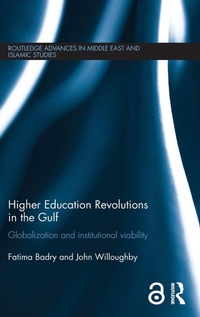
Higher Education Revolutions in the Gulf
Globalization and Institutional Viability
1st Edition
Published on 8. September 2015
Book
Hardback
236 pages
978-0-415-50565-9 (ISBN)
Description
Over the past quarter century, the people of the Arabian Peninsula have witnessed a revolutionary transformation in higher education. In 1990, there were fewer than ten public universities that offered their Arabic-language curricula in sex-segregated settings to national citizens only. In 2015, there are more than one hundred public, semi-public, and private colleges and universities. Most of these institutions are open to expatriates and national citizens; a few offer gender integrated instruction; and the language of instruction is much more likely to be in English than Arabic.
Higher Education Revolutions in the Gulf explores the reasons behind this dramatic growth. It examines the causes of the sharp shift in educational practices and analyses how these new systems of higher education are regulated, evaluating the extent to which the new universities and colleges are improving quality. Questioning whether these educational changes can be sustained, the book explores how the new curricula and language policies are aligned with official visions of the future. Written by leading scholars in the field, it draws upon their considerable experiences of teaching and doing research in the Arabian Gulf, as well as their different disciplinary backgrounds (linguistics and economics), to provide a holistic and historically informed account of the emergence and viability of the Arabian Peninsula's higher education revolutions.
Offering a comprehensive, critical assessment of education in the Gulf Arab states, this book represents a significant contribution to the field and will be of interest to students and scholars of Middle East and Gulf Studies, and essential for those focused on higher education.
Higher Education Revolutions in the Gulf explores the reasons behind this dramatic growth. It examines the causes of the sharp shift in educational practices and analyses how these new systems of higher education are regulated, evaluating the extent to which the new universities and colleges are improving quality. Questioning whether these educational changes can be sustained, the book explores how the new curricula and language policies are aligned with official visions of the future. Written by leading scholars in the field, it draws upon their considerable experiences of teaching and doing research in the Arabian Gulf, as well as their different disciplinary backgrounds (linguistics and economics), to provide a holistic and historically informed account of the emergence and viability of the Arabian Peninsula's higher education revolutions.
Offering a comprehensive, critical assessment of education in the Gulf Arab states, this book represents a significant contribution to the field and will be of interest to students and scholars of Middle East and Gulf Studies, and essential for those focused on higher education.
More details
Series
Language
English
Place of publication
London
United Kingdom
Publishing group
Taylor & Francis Ltd
Target group
College/higher education
Illustrations
44 s/w Tabellen
44 Tables, black and white
Dimensions
Height: 240 mm
Width: 161 mm
Thickness: 19 mm
Weight
555 gr
ISBN-13
978-0-415-50565-9 (9780415505659)
Copyright in bibliographic data and cover images is held by Nielsen Book Services Limited or by the publishers or by their respective licensors: all rights reserved.
Schweitzer Classification
Other editions
Additional editions
Fatima Badry | John Willoughby
Higher Education Revolutions in the Gulf
Globalization and Institutional Viability
Book
12/2019
1st Edition
Routledge
€65.80
Shipment within 15-20 days
Fatima Badry | John Willoughby
Higher Education Revolutions in the Gulf
Globalization and Institutional Viability
E-Book
10/2015
Routledge
€0.00
Available for download
Fatima Badry | John Willoughby
Higher Education Revolutions in the Gulf
Globalization and Institutional Viability
E-Book
10/2015
Routledge
€0.00
Available for download
Persons
Fatima Badry is professor of linguistics in the department of English at the American University of Sharjah in the UAE. Her research interests include language acquisition, bilingualism, education policy and globalization and the impact of global English on Arab identity.
John Willoughby is professor of economics at American University. After teaching at the American University of Sharjah, he has devoted his time to studying labor migration and educational issues in the GCC.
John Willoughby is professor of economics at American University. After teaching at the American University of Sharjah, he has devoted his time to studying labor migration and educational issues in the GCC.
Content
Chapter 1: Introduction: The Political and socio-economic emergence of the Arabian Gulf Chapter 2: The Global Expansion of Higher Education: Alternative Perspectives Chapter 3: Globalization of education and the GCC Chapter 4: The Multi-model approach to privatization: Questions of sustainability Chapter 5: GCC Public universities: Growing pains Chapter 6: Assessing quality: Adopting Western standards of accreditation Chapter 7: Reforming higher education in Saudi Arabia: Reasons for optimism Chapter 8: Arabic in higher education: Questions of national identity and pragmatism Chapter 9: Higher education revolutions: Short term success vs long term viability