

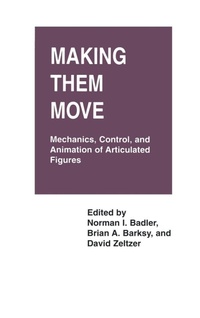
Making Them Move
Mechanics, Control & Animation of Articulated Figures
1st Edition
Published on 1. August 1990
Book
Hardback
348 pages
978-1-55860-106-2 (ISBN)
Description
Current computer graphics hardware and software make it possible to synthesize near photo-realistic images, but the simulation of natural-looking motion of articulated figures remains a difficult
and challenging task. Skillfully rendered animation of humans, animals, and robots can delight and move us, but simulating their realistic motion holds great promise for many other applications as well, including ergonomic engineering design, clinical diagnosis of pathological movements, rehabilitation therapy, and biomechanics.
Making Them Move presents the work of leading researchers in computer graphics, psychology, robotics and mechanical engineering who were invited to attend the Workshop on the Mechanics, Control and Animation of Articulated
Figures held at the MIT Media Lab in April 1989. The book explores biological and robotic motor control, as well as state-of-the-art computer
graphics techniques for simulating human and animal figures in a natural and physically realistic manner.
and challenging task. Skillfully rendered animation of humans, animals, and robots can delight and move us, but simulating their realistic motion holds great promise for many other applications as well, including ergonomic engineering design, clinical diagnosis of pathological movements, rehabilitation therapy, and biomechanics.
Making Them Move presents the work of leading researchers in computer graphics, psychology, robotics and mechanical engineering who were invited to attend the Workshop on the Mechanics, Control and Animation of Articulated
Figures held at the MIT Media Lab in April 1989. The book explores biological and robotic motor control, as well as state-of-the-art computer
graphics techniques for simulating human and animal figures in a natural and physically realistic manner.
More details
Language
English
Place of publication
San Francisco
United States
Publishing group
Elsevier Science & Technology
Target group
Professional and scholarly
Professional Practice & Development
Dimensions
Height: 235 mm
Width: 157 mm
Thickness: 26 mm
Weight
741 gr
ISBN-13
978-1-55860-106-2 (9781558601062)
Copyright in bibliographic data and cover images is held by Nielsen Book Services Limited or by the publishers or by their respective licensors: all rights reserved.
Schweitzer Classification
Other editions
New editions
Book
11/2007
2nd Edition
Morgan Kaufmann
€60.65
Article exhausted; check for reprint
Additional editions
Norman Badler | Brian Barsky | David Zeltzer
Making Them Move
Mechanics, Control & Animation of Articulated Figures
Book
07/2017
1st Edition
Routledge
€166.50
Shipment within 10-20 days
Norman Badler | Brian Barsky | David Zeltzer
Making Them Move
Mechanics, Control & Animation of Articulated Figures
E-Book
08/1990
Routledge
€125.99
Available for download
Norman Badler | Brian Barsky | David Zeltzer
Making Them Move
Mechanics, Control & Animation of Articulated Figures
E-Book
08/1990
1st Edition
Routledge
€125.99
Available for download
Persons
By Norman I. Badler, Brian A. Barsky and David Zeltzer
Content
Making Them Move: Mechanics, Control, and Animation of Articulated Figures
Edited by Norman I. Badler, Brian A. Barsky, and David Zeltzer
PART ONE -- INTERACTING WITH ARTICULATED FIGURES
Chapter 1 Task-level Graphical Simulation: Abstraction, Representation, and Control David Zeltzer
Chapter 2 Composition of Realistic Animation Sequences for Multiple Human Figures Tom Calvert
Chapter 3 Animation from Instructions Norman I. Badler, Bonnie L. Webber, Jugal Kalita, and Jeffrey Esakov
PART TWO -- ARTIFICIAL AND BIOLOGICAL MECHANISMS FOR MOTOR CONTROL
ARTIFICIAL MOTOR PROGRAMS
Chapter 4 A Robot that Walks: Emergent Behaviors from a Carefully Evolved Network Rodney A. Brooks
BIOLOGICAL MOTOR PROGRAMS
Chapter 5 Sensory Elements in Pattern-Generating
Networks K.G. Pearson
Chapter 6 Motor Programs as Units of Movement Control Douglas E. Young and Richard A. Schmidt
Chapter 7 Dynamics and Task-specific Coordinations M.T. Turvey, Elliot Saltzman, and R.C. Schmidt
Chapter 8 Dynamic Pattern Generation and Recognition J.A.S. Kelso and A.S. Pandya
LEARNING MOTOR PROGRAMS
Chapter 9 A Computer System for Movement Schemas Peter H. Greene and Dan Solomon
PART THREE -- MOTION CONTROL ALGORITHMS
Chapter 10 Constrained Optimization of Articulated Animal Movement in Computer Animation Michael Girard
Chapter 11 Goal-directed Animation of Tubular Articulated Figures or How Snakes Play Golf Gavin Miller
Chapter 12 Human Body Deformations Using Joint-dependent Local Operators and Finite-Element Theory Nadia Magnenat-Thalmann and Daniel Thalmann
PART FOUR -- COMPUTING THE DYNAMICS OF MOTION
Chapter 13 Dynamic Experiences Jane Wilhelms
Chapter 14 Using Dynamics in Computer Animation: Control and Solution Issues Mark Green
Chapter 15 Teleological Modeling Alan H. Barr
Appendix A: Video Notes
Appendix B: About the Authors
Index
Edited by Norman I. Badler, Brian A. Barsky, and David Zeltzer
PART ONE -- INTERACTING WITH ARTICULATED FIGURES
Chapter 1 Task-level Graphical Simulation: Abstraction, Representation, and Control David Zeltzer
Chapter 2 Composition of Realistic Animation Sequences for Multiple Human Figures Tom Calvert
Chapter 3 Animation from Instructions Norman I. Badler, Bonnie L. Webber, Jugal Kalita, and Jeffrey Esakov
PART TWO -- ARTIFICIAL AND BIOLOGICAL MECHANISMS FOR MOTOR CONTROL
ARTIFICIAL MOTOR PROGRAMS
Chapter 4 A Robot that Walks: Emergent Behaviors from a Carefully Evolved Network Rodney A. Brooks
BIOLOGICAL MOTOR PROGRAMS
Chapter 5 Sensory Elements in Pattern-Generating
Networks K.G. Pearson
Chapter 6 Motor Programs as Units of Movement Control Douglas E. Young and Richard A. Schmidt
Chapter 7 Dynamics and Task-specific Coordinations M.T. Turvey, Elliot Saltzman, and R.C. Schmidt
Chapter 8 Dynamic Pattern Generation and Recognition J.A.S. Kelso and A.S. Pandya
LEARNING MOTOR PROGRAMS
Chapter 9 A Computer System for Movement Schemas Peter H. Greene and Dan Solomon
PART THREE -- MOTION CONTROL ALGORITHMS
Chapter 10 Constrained Optimization of Articulated Animal Movement in Computer Animation Michael Girard
Chapter 11 Goal-directed Animation of Tubular Articulated Figures or How Snakes Play Golf Gavin Miller
Chapter 12 Human Body Deformations Using Joint-dependent Local Operators and Finite-Element Theory Nadia Magnenat-Thalmann and Daniel Thalmann
PART FOUR -- COMPUTING THE DYNAMICS OF MOTION
Chapter 13 Dynamic Experiences Jane Wilhelms
Chapter 14 Using Dynamics in Computer Animation: Control and Solution Issues Mark Green
Chapter 15 Teleological Modeling Alan H. Barr
Appendix A: Video Notes
Appendix B: About the Authors
Index