

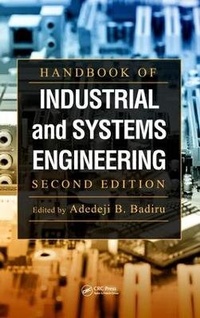
Handbook of Industrial and Systems Engineering
2nd Edition
Published on 31. March 2021
Book
Paperback/Softback
1476 pages
978-0-367-51374-0 (ISBN)
Description
A new edition of a bestselling industrial and systems engineering reference, Handbook of Industrial and Systems Engineering, Second Edition provides students, researchers, and practitioners with easy access to a wide range of industrial engineering tools and techniques in a concise format. This edition expands the breadth and depth of coverage, emphasizing new systems engineering tools, techniques, and models.
See What's New in the Second Edition:
Section covering safety, reliability, and quality
Section on operations research, queuing, logistics, and scheduling
Expanded appendix to include conversion factors and engineering, systems, and statistical formulae
Topics such as control charts, engineering economy, health operational efficiency, healthcare systems, human systems integration, Lean systems, logistics transportation, manufacturing systems, material handling systems, process view of work, and Six Sigma techniques
The premise of the handbook remains: to expand the breadth and depth of coverage beyond the traditional handbooks on industrial engineering. The book begins with a general introduction with specific reference to the origin of industrial engineering and the ties to the Industrial Revolution. It covers the fundamentals of industrial engineering and the fundamentals of systems engineering. Building on this foundation, it presents chapters on manufacturing, production systems, and ergonomics, then goes on to discuss economic and financial analysis, management, information engineering, and decision making. Two new sections examine safety, reliability, quality, operations research, queuing, logistics, and scheduling.
The book provides an updated collation of the body of knowledge of industrial and systems engineering. The handbook has been substantively expanded from the 36 seminal chapters in the first edition to 56 landmark chapters in the second edition. In addition to the 20 new chapters, 11 of the chapters in the first edition have been updated with new materials. Filling the gap that exists between the traditional and modern practice of industrial and systems engineering, the handbook provides a one-stop resource for teaching, research, and practice.
See What's New in the Second Edition:
Section covering safety, reliability, and quality
Section on operations research, queuing, logistics, and scheduling
Expanded appendix to include conversion factors and engineering, systems, and statistical formulae
Topics such as control charts, engineering economy, health operational efficiency, healthcare systems, human systems integration, Lean systems, logistics transportation, manufacturing systems, material handling systems, process view of work, and Six Sigma techniques
The premise of the handbook remains: to expand the breadth and depth of coverage beyond the traditional handbooks on industrial engineering. The book begins with a general introduction with specific reference to the origin of industrial engineering and the ties to the Industrial Revolution. It covers the fundamentals of industrial engineering and the fundamentals of systems engineering. Building on this foundation, it presents chapters on manufacturing, production systems, and ergonomics, then goes on to discuss economic and financial analysis, management, information engineering, and decision making. Two new sections examine safety, reliability, quality, operations research, queuing, logistics, and scheduling.
The book provides an updated collation of the body of knowledge of industrial and systems engineering. The handbook has been substantively expanded from the 36 seminal chapters in the first edition to 56 landmark chapters in the second edition. In addition to the 20 new chapters, 11 of the chapters in the first edition have been updated with new materials. Filling the gap that exists between the traditional and modern practice of industrial and systems engineering, the handbook provides a one-stop resource for teaching, research, and practice.
Reviews / Votes
"... contains coverage on virtually all areas of industrial engineering viewed from a system prospective ... Dr. Adedeji B. Badiru is a well-recognized and respected authority and leader in the fields of industrial and systems engineering with numerous academic and professional publications."-From the Foreword by Gary E. Whitehouse, Provost Emeritus, Distinguished University Professor, University of Central Florida, Orlando, USAMore details
Series
Edition
2nd edition
Language
English
Place of publication
London
United Kingdom
Publishing group
Taylor & Francis Ltd
Target group
College/higher education
Illustrations
497 s/w Abbildungen, 149 s/w Tabellen
149 Tables, black and white; 497 Illustrations, black and white
Dimensions
Height: 254 mm
Width: 178 mm
Weight
453 gr
ISBN-13
978-0-367-51374-0 (9780367513740)
Copyright in bibliographic data and cover images is held by Nielsen Book Services Limited or by the publishers or by their respective licensors: all rights reserved.
Schweitzer Classification
Other editions
Additional editions
Adedeji B. Badiru
Handbook of Industrial and Systems Engineering
Book
10/2013
2nd Edition
CRC Press
€308.50
Shipment within 15-20 days
Adedeji B. Badiru
Handbook of Industrial and Systems Engineering
E-Book
10/2013
2nd Edition
CRC Press
€311.99
Available for download
Person
Prof. Badiru is Dean and senior academic officer for the Graduate School of Engineering and Management at the Air Force Institute of Technology (AFIT). He was previously Professor and Head of Systems Engineering and Management at the AFIT, Professor and Department Head of Industrial & Information Engineering at the University of Tennessee in Knoxville, and Professor of Industrial Engineering and Dean of University College at the University of Oklahoma, Norman. He is a registered professional engineer (PE), a certified Project Management Professional (PMP), a Fellow of the Institute of Industrial Engineers, and a Fellow of the Nigerian Academy of Engineering. He holds BS in Industrial Engineering, MS in Mathematics, and MS in Industrial Engineering from Tennessee Technological University, and Ph.D. in Industrial Engineering from the University of Central Florida. His areas of interest include mathematical modeling, project modeling and analysis, economic analysis, systems engineering, and efficiency/productivity analysis & improvement. He is the author of over 25 books, 34 book chapters, 70 technical journal articles, 110 conference proceedings and presentations. He also has published 25 magazine articles and 20 editorials and periodicals. He is a member of several professional associations and scholastic honor societies. He is the series editor for Taylor and Francis book series on Systems Innovation.
Content
General Introductions. Fundamentals of Industrial Engineering. Fundamentals of Systems Engineering. Manufacturing and Production Systems. New Technologies. General Applications.