

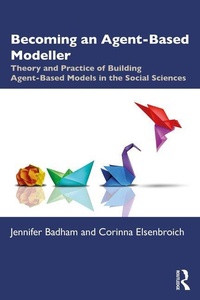
Becoming an Agent-Based Modeller
Theory and Practice of Building Agent-Based Models in the Social Sciences
1st Edition
Published on 30. April 2026
Book
Paperback/Softback
258 pages
978-1-032-61558-5 (ISBN)
Description
Becoming an Agent-based Modeller takes you on a journey, from curiosity about social phenomena to generating them with a computer simulation. The book introduces agent-based modelling as a method to understand societies as complex systems, systems of interconnected, interdependent, and interacting agents.
The book is structured like a course rather than a textbook or reference book. The core of the book is an extended tutorial introducing the NetLogo programming language. Using the example of an epidemic, it explores how an agent-based model of social influence, situational awareness, and contextual decisions by individual agents about protective behaviour can help us understand plausible epidemic trajectories. The tutorial demonstrates how to build an agent-based model from scratch and use it in research, including the conceptualisation stage, the operationalisation and implementation, experimentation, and interpretation. This practical part of the book is embedded in chapters on theory, epistemology, and ethics of agent-based modelling.
With pedagogical tools including key discussion points, illustrations, and highlighted concepts, this is an ideal resource for courses on ABM, and for postgraduate students and researchers in the social sciences and beyond, who wish to develop their understanding of agent-based modelling.
The book is structured like a course rather than a textbook or reference book. The core of the book is an extended tutorial introducing the NetLogo programming language. Using the example of an epidemic, it explores how an agent-based model of social influence, situational awareness, and contextual decisions by individual agents about protective behaviour can help us understand plausible epidemic trajectories. The tutorial demonstrates how to build an agent-based model from scratch and use it in research, including the conceptualisation stage, the operationalisation and implementation, experimentation, and interpretation. This practical part of the book is embedded in chapters on theory, epistemology, and ethics of agent-based modelling.
With pedagogical tools including key discussion points, illustrations, and highlighted concepts, this is an ideal resource for courses on ABM, and for postgraduate students and researchers in the social sciences and beyond, who wish to develop their understanding of agent-based modelling.
More details
Language
English
Place of publication
London
United Kingdom
Publishing group
Taylor & Francis Ltd
Target group
College/higher education
Professional and scholarly
Postgraduate and Undergraduate Advanced
Illustrations
6 s/w Tabellen, 36 farbige Zeichnungen, 50 Farbfotos bzw. farbige Rasterbilder, 86 farbige Abbildungen
6 Tables, black and white; 36 Line drawings, color; 50 Halftones, color; 86 Illustrations, color
Dimensions
Height: 277 mm
Width: 216 mm
Thickness: 19 mm
Weight
792 gr
ISBN-13
978-1-032-61558-5 (9781032615585)
Copyright in bibliographic data and cover images is held by Nielsen Book Services Limited or by the publishers or by their respective licensors: all rights reserved.
Schweitzer Classification
Other editions
Additional editions
Jennifer Badham | Corinna Elsenbroich
Becoming an Agent-Based Modeller
Theory and Practice of Building Agent-Based Models in the Social Sciences
Book
approx. 03/2026
1st Edition
Routledge
€215.41
Not yet published
Jennifer Badham | Corinna Elsenbroich
Becoming an Agent-Based Modeller
Theory and Practice of Building Agent-Based Models in the Social Sciences
E-Book
03/2026
1st Edition
Routledge
€68.49
Available for download
Jennifer Badham | Corinna Elsenbroich
Becoming an Agent-Based Modeller
Theory and Practice of Building Agent-Based Models in the Social Sciences
E-Book
03/2026
1st Edition
Routledge
€68.49
Available for download
Persons
Jennifer Badham is Assistant Professor in Social Data Science in the Department of Sociology at Durham University, UK. She is a computational social scientist, interested particularly in how social structure shapes the transmission of ideas, disease, or behaviour.
Corinna Elsenbroich is Reader in Computational Modelling at the School of Health and Wellbeing at the University of Glasgow, UK. She is a sociologist with a background in philosophy of science, sociology, and complexity social science methods.
Corinna Elsenbroich is Reader in Computational Modelling at the School of Health and Wellbeing at the University of Glasgow, UK. She is a sociologist with a background in philosophy of science, sociology, and complexity social science methods.
Content
I: Conceptualising Agent-based Models 1. Modelling the Social World 2. Building an Agent-based Model 3. Ethics of Agent-Based Modelling; II: Building Agent-based Models 4. Preliminaries 5. Model 1: Model Entities 6. Model 2: Introducing Time and Space 7. Model 3: Agents Making Decisions 8. Model 4: Representing Relationships 9. Models 5-8: Enhancements 10. Bringing it all Together; III: Working with Agent-based Models 11. Turtles on the Move 12. Tricks of the Trade 13. Experiments 14. Is your Model Fit for Purpose? 15. Being an Agent-Based Modeller