

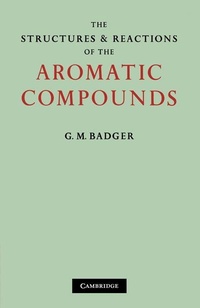
The Structures and Reactions of the Aromatic Compounds
Published on 21. July 2011
Book
Paperback/Softback
472 pages
978-0-521-10884-3 (ISBN)
Description
This 1954 book was the first to be devoted to the fundamental properties of the aromatic compounds as a whole. It describes the experimental and theoretical attempts to explain their structure and discusses their characteristic properties and the mechanism of their reactions. Heterocyclic compounds are included in Dr Badger's survey. Aromatic compounds are characterised by their cyclic molecular structure, their high degree of unsaturation and their stability. Coal tar is the chief source of aromatic compounds, but they are also made from crude oil and can be produced synthetically. Nearly all dyestuffs are 'aromatic', as are most of the common drugs and explosives. The book addressed itself primarily to graduates and final-year undergraduates. It was also of interest to research chemists in the dyestuffs, pharmaceutical and explosives industries. As some complex aromatic compounds produce cancer on the skin of laboratory animals, cancer research workers will also have found it relevant.
More details
Language
English
Place of publication
Cambridge
United Kingdom
Target group
Professional and scholarly
Product notice
Paperback (trade)
Illustrations
Worked examples or Exercises
Dimensions
Height: 216 mm
Width: 140 mm
Thickness: 28 mm
Weight
661 gr
ISBN-13
978-0-521-10884-3 (9780521108843)
Copyright in bibliographic data and cover images is held by Nielsen Book Services Limited or by the publishers or by their respective licensors: all rights reserved.
Schweitzer Classification
Other editions
Additional editions
Book
01/1954
Cambridge University Press
€8.54
Article exhausted; check for reprint
Previous edition
Book
01/1954
Cambridge University Press
€8.54
Article exhausted; check for reprint
Content
Preface; 1. The benzene problem; 2. The theoretical solution of the benzene problem and a definition of the term 'aromatic'; 3. Some properties of aromatic compounds; 4. Addition reactions of aromatic compounds; 5. The aromatic 'double' bond; 6. The effects of substituents; 7. Aromatic substitution reactions; 8. The Diels-Adler reaction; 9. Photo-oxidation and photo-dimerization; 10. Absorption and fluorescent spectra of aromatic compounds; 11. Optical activity in aromatic compounds; Indexes.