

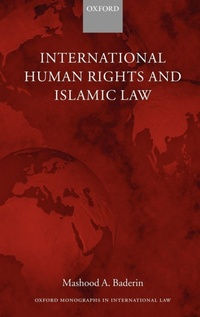
International Human Rights and Islamic Law
Published on 11. September 2003
Book
Hardback
302 pages
978-0-19-926659-3 (ISBN)
Description
This volume examines the important question of whether or not international human rights and Islamic law are compatible. It asks whether Muslim States can comply with international human rights law whilst adhering to Islamic law. The traditional arguments on this subject are examined and responded to from both international human rights and Islamic legal perspectives. The volume engages international human rights law in theoretical dialogue with Islamic law, facilitating an evaluation of the human rights policy of modern Muslim States.
International Human Rights and Islamic Law formulates a synthesis between these two extremes, and argues that although there are differences of scope and application, there is no fundamental incompatibility between these two bodies of law. Baderin argues that their differences could be better addressed if the concept of human rights were positively established from within the themes of Islamic law, rather than by imposing it upon Islamic law as an alien concept.
Each article of the International Covenant on Civil and Political Rights, and the International Covenant on Economic, Social and Cultural Rights, as well as relevant articles of the Convention on the Elimination of All Forms of Discrimination against Women are analysed in the light of Islamic law.
The volume concludes that it is possible to harmonise the differences between international human rights law and Islamic law through the adoption of the 'margin of appreciation' doctrine by international human rights treaty bodies and the utilization of the Islamic law doctrines of 'maqasid al-shari'ah' (the overall objective of Shari'ah) and 'maslahah' (welfare) by Muslim States in their interpretation and application of Islamic law respectively. Baderin asserts that Islamic law can serve as an important vehicle for the guarantee and enforcement of international human rights law in the Muslim world, and the volume concludes with recommendations to that effect.
International Human Rights and Islamic Law formulates a synthesis between these two extremes, and argues that although there are differences of scope and application, there is no fundamental incompatibility between these two bodies of law. Baderin argues that their differences could be better addressed if the concept of human rights were positively established from within the themes of Islamic law, rather than by imposing it upon Islamic law as an alien concept.
Each article of the International Covenant on Civil and Political Rights, and the International Covenant on Economic, Social and Cultural Rights, as well as relevant articles of the Convention on the Elimination of All Forms of Discrimination against Women are analysed in the light of Islamic law.
The volume concludes that it is possible to harmonise the differences between international human rights law and Islamic law through the adoption of the 'margin of appreciation' doctrine by international human rights treaty bodies and the utilization of the Islamic law doctrines of 'maqasid al-shari'ah' (the overall objective of Shari'ah) and 'maslahah' (welfare) by Muslim States in their interpretation and application of Islamic law respectively. Baderin asserts that Islamic law can serve as an important vehicle for the guarantee and enforcement of international human rights law in the Muslim world, and the volume concludes with recommendations to that effect.
Reviews / Votes
..Baderin must be applauded for his effort to bridge the two legal systems. He stands in a tradition of Islamic Scholarship that is both proud of itself and aware of modern times and demands. * Leiden Journal of International Law * This sort of scholarship is particularly important for informing public policy in the present international environment. * European Journal of International Law * Baderin presents a masterful and thoroughly documented definition, exploration, and historical analysis of both 'human rights' and 'Islamic law'. * European Journal of International Law * Sensitive, highly informed and eminently readable, it offers a unique perspective that transcends the now trite arguments between the universalistic and cultural relativistic camps - in their evaluation of Human Rights in Muslim societies. It will undoubtedly prove beneficial, for these momentous times, as well as for the future. * Hameed Agberemi, Research Fellow, Islam and Human Rights Programme, Emory University Law School, Atlanta *More details
Series
Language
English
Place of publication
Oxford
United Kingdom
Target group
Professional and scholarly
Dimensions
Height: 240 mm
Width: 161 mm
Thickness: 21 mm
Weight
622 gr
ISBN-13
978-0-19-926659-3 (9780199266593)
Copyright in bibliographic data and cover images is held by Nielsen Book Services Limited or by the publishers or by their respective licensors: all rights reserved.
Schweitzer Classification
Other editions
Additional editions
Mashood A. Baderin
International Human Rights and Islamic Law
Book
05/2005
Oxford University Press
€104.70
Shipment within 15-20 days
Person
Mashood A. Baderin is Professor of Law at the School of Oriental and Asian Studies, University of London
Content
DEDICATION; ACKNOWLEDGEMENTS; PREFACE; CONTENTS; TABLE OF CASES; TABLE OF TREATIES AND DECLARATIONS; GLOSSARY; 1 INTRODUCTION; 2 HUMAN RIGHTS AND ISLAMIC LAW; 3 THE INTERNATIONAL COVENANT ON CIVIL AND POLITICAL RIGHTS (ICCPR) IN THE LIGHT OF ISLAMIC LAW; 4 THE INTERNATIONAL COVENANT ON ECONOMIC, SOCIAL AND CULTURAL RIGHTS (ICESCR) IN THE LIGHT OF ISLAMIC LAW; 5 CONCLUSION; ANNEX: THE CAIRO DECLARATION ON HUMAN RIGHTS IN ISLAM; BIBLIOGRAPHY