

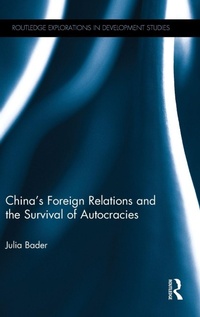
China's Foreign Relations and the Survival of Autocracies
1st Edition
Published on 7. November 2014
Book
Hardback
222 pages
978-0-415-66095-2 (ISBN)
Description
The Chinese government has frequently been criticized for propping up anti-democratic governments. This book investigates the rise of China as an emerging authoritarian power. By comparing China's bilateral relations to three Asian developing countries - Burma, Cambodia and Mongolia - it examines how China targets specific groups of actors in autocracies versus non-autocracies. It illustrates how the Chinese non-interference policy translates into support for incumbent leaders in autocratic countries and how the Chinese government has thereby profited from exploiting secretive decision making in autocracies to realize its own external interests such as achieving access to natural resources. In a statistical analysis of the patterns of Chinese external cooperation and their impact on the survival of autocratic leaders, the book finds some evidence that China is more likely to target autocracies with economic cooperation. However, only some forms of bilateral interaction are found to increase the prospect of survival for autocratic leaders.
This important contribution to the understanding of both external factors of authoritarian endurance and China's foreign relations, a field of study still lacking systematic investigation, will be of great interest to students and researchers in Development Studies, Asian Studies, International Relations, and International Political Economy.
This important contribution to the understanding of both external factors of authoritarian endurance and China's foreign relations, a field of study still lacking systematic investigation, will be of great interest to students and researchers in Development Studies, Asian Studies, International Relations, and International Political Economy.
Reviews / Votes
"China has long asserted that in its foreign policy, it follows a policy of non-interference in other countries' domestic politics. Bader (Univ. of Amsterdam) examines that claim and finds "some evidence" that China is more likely to target autocracies for economic cooperation than more democratic countries. Her analysis moves from a broad general analysis of Chinese foreign relations to three intensive case studies: Burma, Cambodia, and Mongolia. In her carefully argued conclusion, she posits three hypotheses for further exploration: China is more successful in realizing its foreign policy interests with autocratic countries, China targets such countries for economic collaboration, and autocratic leaders of these countries reap significantly more benefit from the relationship than the populaces of those countries do. Written for academic audiences, the work belongs in large university libraries with significant East Asian holdings. Summing Up: Recommended. Graduate, research, and professional collections." - CHOICE, J. A. Rhodes, emeritus, Luther CollegeMore details
Series
Language
English
Place of publication
London
United Kingdom
Publishing group
Taylor & Francis Ltd
Target group
College/higher education
Illustrations
21 s/w Abbildungen, 6 s/w Zeichnungen, 16 s/w Tabellen
16 Tables, black and white; 6 Line drawings, black and white; 21 Illustrations, black and white
Dimensions
Height: 240 mm
Width: 161 mm
Thickness: 17 mm
Weight
526 gr
ISBN-13
978-0-415-66095-2 (9780415660952)
Copyright in bibliographic data and cover images is held by Nielsen Book Services Limited or by the publishers or by their respective licensors: all rights reserved.
Schweitzer Classification
Other editions
Additional editions
Book
05/2016
1st Edition
Routledge
€71.30
Shipment within 10-20 days
E-Book
10/2014
1st Edition
Routledge
€64.49
Available for download
E-Book
10/2014
1st Edition
Routledge
€64.49
Available for download
Person
Julia Bader is an Assistant Professor for International Relations at the University of Amsterdam, the Netherlands and an Associate Fellow of the German Development Institute (DIE). Her work focuses on the political economy of authoritarian regimes, foreign aid and democracy promotion.
Content
Part 1: Supporting Dictators. If so, why and how? 1. What we Know and why we Know so Little 2. Why Autocracies should have an Interest in the Prevalence of Authoritarianism Part 2: External Exploitation: who, how and when? 3. How external exploitation materializes 4. Burma: Neither puppet, nor pawn 5. Cambodia: Rocking in China's soft underbelly 6. Mongolia: Between a rock and a hard place 7. Does China realize its interests? Part 3: Autocratic cooperation? Patterns and consequences 8. Does China target other autocrats? 9. Do China's foreign relations lead to autocratic survival? Part 4: So what? Findings, reflections and conclusions 10. Conclusion