

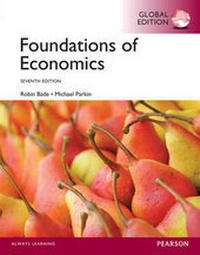
Foundations of Economics, Global Edition
7th Edition
Published on 31. October 2014
Book
Paperback/Softback
984 pages
978-1-292-01836-2 (ISBN)
Description
For two-semester Principles of Economics courses at two- and four-year colleges and universities
A practice-oriented learning system that breaks the traditional textbook mold
To help students focus on the most important concepts-and effectively practice application of those concepts-Foundations of Economics is structured around a Checklist/Checkpoint system. The result is a patient, confidence-building program that prepares students to use economics in their everyday lives, regardless of what their future career will be.
This program provides a better teaching and learning experience-for you and your students. It will help you to:
* Personalize learning with MyEconLab: This online homework, tutorial, and assessment program engages students in learning and provides instructors tools to keep students on track.
* Encourage students to learn by doing: A Checklist/Checkpoint system provides a practice-oriented framework that enables active learning.
* Command student attention and foster interest in the course: Engaging features draw students into the material, and keep them focused throughout the course
* Provide engaging, fully updated content: New and updated material on contemporary topics better motivates students to discover the economic way of thinking.
Please note that the product you are purchasing does not include MyEconLab.
MyEconLab
Join over 11 million students benefiting from Pearson MyLabs.
This title can be supported by MyEconLab, an online homework and tutorial system designed to test and build your understanding. Would you like to use the power of MyEconLab to accelerate your learning? You need both an access card and a course ID to access MyEconLab.
These are the steps you need to take:
1. Make sure that your lecturer is already using the system
Ask your lecturer before purchasing a MyLab product as you will need a course ID from them before you can gain access to the system.
2. Check whether an access card has been included with the book at a reduced cost
If it has, it will be on the inside back cover of the book.
3. If you have a course ID but no access code, you can benefit from MyEconLab at a reduced price by purchasing a pack containing a copy of the book and an access code for MyEconLab (ISBN:9781292019260)
4. If your lecturer is using the MyLab and you would like to purchase the product...
Go to www.myeconlab.com to buy access to this interactive study programme.
For educator access, contact your Pearson representative. To find out who your Pearson representative is, visit www.pearsoned.co.uk/replocator
A practice-oriented learning system that breaks the traditional textbook mold
To help students focus on the most important concepts-and effectively practice application of those concepts-Foundations of Economics is structured around a Checklist/Checkpoint system. The result is a patient, confidence-building program that prepares students to use economics in their everyday lives, regardless of what their future career will be.
This program provides a better teaching and learning experience-for you and your students. It will help you to:
* Personalize learning with MyEconLab: This online homework, tutorial, and assessment program engages students in learning and provides instructors tools to keep students on track.
* Encourage students to learn by doing: A Checklist/Checkpoint system provides a practice-oriented framework that enables active learning.
* Command student attention and foster interest in the course: Engaging features draw students into the material, and keep them focused throughout the course
* Provide engaging, fully updated content: New and updated material on contemporary topics better motivates students to discover the economic way of thinking.
Please note that the product you are purchasing does not include MyEconLab.
MyEconLab
Join over 11 million students benefiting from Pearson MyLabs.
This title can be supported by MyEconLab, an online homework and tutorial system designed to test and build your understanding. Would you like to use the power of MyEconLab to accelerate your learning? You need both an access card and a course ID to access MyEconLab.
These are the steps you need to take:
1. Make sure that your lecturer is already using the system
Ask your lecturer before purchasing a MyLab product as you will need a course ID from them before you can gain access to the system.
2. Check whether an access card has been included with the book at a reduced cost
If it has, it will be on the inside back cover of the book.
3. If you have a course ID but no access code, you can benefit from MyEconLab at a reduced price by purchasing a pack containing a copy of the book and an access code for MyEconLab (ISBN:9781292019260)
4. If your lecturer is using the MyLab and you would like to purchase the product...
Go to www.myeconlab.com to buy access to this interactive study programme.
For educator access, contact your Pearson representative. To find out who your Pearson representative is, visit www.pearsoned.co.uk/replocator
More details
Edition
7th edition
Language
English
Place of publication
Harlow
United Kingdom
Target group
College/higher education
Dimensions
Height: 276 mm
Width: 215 mm
Thickness: 37 mm
Weight
2114 gr
ISBN-13
978-1-292-01836-2 (9781292018362)
Copyright in bibliographic data and cover images is held by Nielsen Book Services Limited or by the publishers or by their respective licensors: all rights reserved.
Schweitzer Classification
Other editions
New editions
Robin Bade | Michael Parkin
Foundations of Economics, Global Edition
Book
07/2018
8th Edition
Pearson Education Limited
€95.51
Shipment within 10-20 days
Previous edition
Book
01/2012
6th Edition
Pearson
€273.91
Article exhausted; check for reprint
Content
I. Introduction
1. Getting Started
2. The U.S. and Global Economies
3. The Economic Problem
4. Demand and Supply
II. A Closer Look at Markets
5. Elasticities of Demand and Supply
6. Efficiency and Fairness of Markets
III. How Governments Influence the Economy
7. Government Actions in Markets
8. Taxes
9. Global Markets in Action
IV. Market Failure and Public Policy
10. Externalities
11. Public Goods and Common Resources
12. Markets with Private Information
V. A Closer Look at Decision Makers
13. Consumer Choice and Demand
14 Production and Cost
VI. Prices, Profits, and Industry Performance
15 Perfect Competition
16 Monopoly
17 Monopolistic Competition
18 Oligopoly
VII. Incomes and Inequality
19 Markets for Factors of Production
20 Economic Inequality
VIII. Monitoring the Macroeconomy
21. GDP: A Measure of Total Production and Income
22. Jobs and Unemployment
23. The CPI and the Cost of Living
IX. The Real Economy
24. Potential GDP and the Natural Unemployment Rate
25. Economic Growth
26. Finance, Saving, and Investment
X. The Money Economy
27. The Monetary System
28. Money, Interest, and Inflation
XI. Economic Fluctuations
29. Aggregate Supply and Aggregate Demand
30. Aggregate Expenditure Multiplier
31. The Short-Run Policy Tradeoff
XII. Macroeconomic Policy
32. Fiscal Policy
33. Monetary Policy
34. International Finance
1. Getting Started
2. The U.S. and Global Economies
3. The Economic Problem
4. Demand and Supply
II. A Closer Look at Markets
5. Elasticities of Demand and Supply
6. Efficiency and Fairness of Markets
III. How Governments Influence the Economy
7. Government Actions in Markets
8. Taxes
9. Global Markets in Action
IV. Market Failure and Public Policy
10. Externalities
11. Public Goods and Common Resources
12. Markets with Private Information
V. A Closer Look at Decision Makers
13. Consumer Choice and Demand
14 Production and Cost
VI. Prices, Profits, and Industry Performance
15 Perfect Competition
16 Monopoly
17 Monopolistic Competition
18 Oligopoly
VII. Incomes and Inequality
19 Markets for Factors of Production
20 Economic Inequality
VIII. Monitoring the Macroeconomy
21. GDP: A Measure of Total Production and Income
22. Jobs and Unemployment
23. The CPI and the Cost of Living
IX. The Real Economy
24. Potential GDP and the Natural Unemployment Rate
25. Economic Growth
26. Finance, Saving, and Investment
X. The Money Economy
27. The Monetary System
28. Money, Interest, and Inflation
XI. Economic Fluctuations
29. Aggregate Supply and Aggregate Demand
30. Aggregate Expenditure Multiplier
31. The Short-Run Policy Tradeoff
XII. Macroeconomic Policy
32. Fiscal Policy
33. Monetary Policy
34. International Finance