

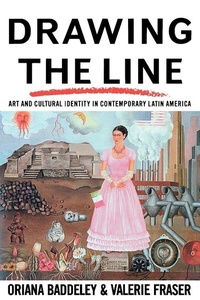
Drawing the Line
Art and Cultural Identity in Contemporary Latin America
Published on 17. July 1989
Book
Paperback/Softback
192 pages
978-0-86091-953-7 (ISBN)
Description
Recent international interest in the painters of the Mexican mural movement, such as Rivera and Orozco, has brought Latin American art to a wider audience than ever before but has often failed to confront its continuing marginalization within art criticism.
Drawing the Line is an exploration of the areas occupied by Latin American art and culture between the ongoing traditions of its indigenous inhabitants, its colonial heritage and its contemporary relationship to the cultural politics of North America and Europe. It looks at the way cultural identity has been constructed by artists from the 1940s to the present day and challenges the way art criticism has hitherto dealt with Latin American art.
Established stereotypes of Latin American culture are discussed in terms of their relevance to contemporary artists. The book looks at the frequent subversion of dominant images and conventions of European art-such as the political significance of landscape painted as an attempt to define a specifically Latin American reality, or the constant reworking of familiar icons of European art-and explores the importance of Latin America to the European surrealist movement. The authors examine the significance of popular art-such as the Chilean arpilleras which commemorate the "disappeared" of Pinochet's regime-and relate it to the traditional "high art/low art" dichotomy.
Including new perspectives on race and gender, Drawing the Line is the most comprehensive account of contemporary Latin American art ever to appear in English.
Drawing the Line is an exploration of the areas occupied by Latin American art and culture between the ongoing traditions of its indigenous inhabitants, its colonial heritage and its contemporary relationship to the cultural politics of North America and Europe. It looks at the way cultural identity has been constructed by artists from the 1940s to the present day and challenges the way art criticism has hitherto dealt with Latin American art.
Established stereotypes of Latin American culture are discussed in terms of their relevance to contemporary artists. The book looks at the frequent subversion of dominant images and conventions of European art-such as the political significance of landscape painted as an attempt to define a specifically Latin American reality, or the constant reworking of familiar icons of European art-and explores the importance of Latin America to the European surrealist movement. The authors examine the significance of popular art-such as the Chilean arpilleras which commemorate the "disappeared" of Pinochet's regime-and relate it to the traditional "high art/low art" dichotomy.
Including new perspectives on race and gender, Drawing the Line is the most comprehensive account of contemporary Latin American art ever to appear in English.
More details
Series
Language
English
Place of publication
London
United Kingdom
Target group
College/higher education
Professional and scholarly
Product notice
Paperback (trade)
Unsewn / adhesive bound
Dimensions
Height: 235 mm
Width: 156 mm
Thickness: 10 mm
Weight
272 gr
ISBN-13
978-0-86091-953-7 (9780860919537)
Copyright in bibliographic data and cover images is held by Nielsen Book Services Limited or by the publishers or by their respective licensors: all rights reserved.
Schweitzer Classification
Other editions
Previous edition

Oriana Baddeley | Valerie Fraser
Drawing the Line
Art and Cultural Identity in Contemporary Latin America
Book
05/1989
Verso Books
€60.92
Article exhausted; check for reprint
Persons
Valerie Fraser is a Reader in the Department of Art History and Theory at the University of Essex. Her books include Building the New World, The Architecture of Conquest, and, with Oriana Baddeley, Drawing the Line.