

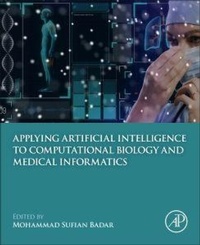
Applying Artificial Intelligence to Computational Biology and Medical Informatics
Will be published approx. on 1. September 2026
Book
Paperback/Softback
220 pages
978-0-443-44915-4 (ISBN)
Description
Applying Artificial Intelligence to Computational Biology and Medical Informatics explores the transformative role of AI and machine learning in modern biomedical research and healthcare. The book covers foundational concepts in AI/ML, computational biology, and medical informatics, followed by in-depth chapters on medical imaging, network biology, chemoinformatics, and public health. Other sections address ethical and societal implications, interpretable AI, and real-world case studies, making complex topics accessible through clear language and structured content. Designed for early-career researchers, students, and professionals without prior expertise in computer science or health sciences, this book provides a progressive learning path from basic to intermediate levels.
Readers benefit from practical examples, online resources, and a coherent chapter structure that supports both academic study and applied research.
Readers benefit from practical examples, online resources, and a coherent chapter structure that supports both academic study and applied research.
More details
Language
English
Place of publication
San Diego
United States
Publishing group
Elsevier Science Publishing Co Inc
Target group
Professional and scholarly
Product notice
Paperback (trade)
Unsewn / adhesive bound
Dimensions
Height: 235 mm
Width: 191 mm
Weight
449 gr
ISBN-13
978-0-443-44915-4 (9780443449154)
Copyright in bibliographic data and cover images is held by Nielsen Book Services Limited or by the publishers or by their respective licensors: all rights reserved.
Schweitzer Classification
Person
Mohammad Sufian Badar, PhD, is an Assistant Professor in the Department of Computer Science and Engineering, SEST, Jamia Hamdard, New Delhi. Previously, he was a Senior Teaching Faculty at UC Riverside, CA, USA, and an Analytics Architect at CenturyLink in Denver, CO, USA. He holds an MS in Molecular Science and Nanotechnology and a PhD in Engineering from Louisiana Tech University. He earned an MSc in Bioinformatics from Jamia Millia Islamia, New Delhi. With many years of teaching, research, and industry experience, Dr. Badar has published in conferences and journals, authored chapters on AI, machine learning, blockchain, IoT, and computational biology and has edited and authored several books in his area of interest like AI, ML, computational biology, and the integration of AI/ ML with health sciences.
Content
1. Introduction to AI/ML, Computational Biology, and Medical Informatics
2. AI/ML Applications in Medical Imaging
3. Natural Language Technologies in Biomedical Domain
4. AI/ML in Chemoinformatics
5. Deep Learning Methods for Network Biology
6. Probabilistic Optimization of ML for Heart Disease Prediction
7. The Need for Interpretable and Explainable Deep Learning Data in Health Care
8. Using hybrid models in healthcare data
9. Improving Disease Prediction by Integrating Multiple ML and Optimization Techniques
10. Ethical, Societal, and Legal Issues in AI/ML for Healthcare
11. Deep Learning in Gait Abnormality Detection: Principles and Illustrations
12. Broad Applications of Network Embedding in Computational Biology, Genomics, Medicine, and Health
13. AI Use in Clinical Prediction
14. AI/ML for Medical Informatics and Public Health
15. AI in Medical Imaging for Developing Countries: Challenges and Opportunities
16. AI Applications in Disease Diagnosis and Treatment: New Applications
2. AI/ML Applications in Medical Imaging
3. Natural Language Technologies in Biomedical Domain
4. AI/ML in Chemoinformatics
5. Deep Learning Methods for Network Biology
6. Probabilistic Optimization of ML for Heart Disease Prediction
7. The Need for Interpretable and Explainable Deep Learning Data in Health Care
8. Using hybrid models in healthcare data
9. Improving Disease Prediction by Integrating Multiple ML and Optimization Techniques
10. Ethical, Societal, and Legal Issues in AI/ML for Healthcare
11. Deep Learning in Gait Abnormality Detection: Principles and Illustrations
12. Broad Applications of Network Embedding in Computational Biology, Genomics, Medicine, and Health
13. AI Use in Clinical Prediction
14. AI/ML for Medical Informatics and Public Health
15. AI in Medical Imaging for Developing Countries: Challenges and Opportunities
16. AI Applications in Disease Diagnosis and Treatment: New Applications