

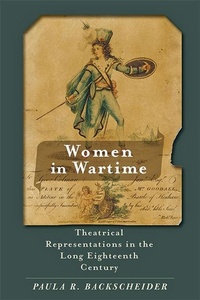
Women in Wartime
Theatrical Representations in the Long Eighteenth Century
Published on 8. February 2022
Book
Hardback
456 pages
978-1-4214-4167-2 (ISBN)
Description
A revelatory history of the characters that playwrights and managers created out of the real lives of women in intimate relationships with military men to serve Great Britain's greatest needs during the war-saturated eighteenth century.
During the long eighteenth century, Great Britain was almost continuously at war. As the era unfolded, the theatre gradually discovered the potential in having actresses, recently introduced to the stage in the 1660s, perform as wartime women characters. As playwrights and managers began casting women in transformative roles to meet each major national need, female characters came to be central figures in bringing the war home to the nation, transforming them into deeply patriotic British subjects.
Paula Backscheider's Women in Wartime is the first study of theatrical representations of women with intimate connections to military men. Drawing upon her extensive expertise in gender, performance studies, popular culture, and archival studies, Backscheider traces the rise of the London theatre's acceptance that one of its responsibilities was to support its country's wars. Rather than focusing on the historical, mythical "warrior women" on the battlefield who have been much studied, Backscheider explores the lives and work of sweethearts, wives, mothers, sisters, barmaids, provision sellers, seaport prostitutes, and more, whose relationships to active-duty men made them recruits, volunteers, or even conscripts. They represent a distinct group of thousands of real women, and the actresses who portrayed them gave performances of change, struggle, celebration, mourning, survival, love, and patriotism.
Backscheider explicates more than fifty plays-from main pieces, short farces, interludes, afterpieces, and comic operas to entr'actes, pantomimes, and even masques-as both entertainment and as ideological and propagandistic vehicles in times of severe crises. She also reveals how these works, many written by men with military experience, attest to the context of difficult, inescapable realities and momentous needs. Through the debunking of sexual stereotypes and attention to audience-pleasing roles such as impoverished-wife and breeches parts, Backscheider adds a dimension to theatrical history that substantially contributes to women's and military histories. Women in Wartime demonstrates the startling acuity and prescience of the repertoire in responding to the war-steeped culture of the period.
During the long eighteenth century, Great Britain was almost continuously at war. As the era unfolded, the theatre gradually discovered the potential in having actresses, recently introduced to the stage in the 1660s, perform as wartime women characters. As playwrights and managers began casting women in transformative roles to meet each major national need, female characters came to be central figures in bringing the war home to the nation, transforming them into deeply patriotic British subjects.
Paula Backscheider's Women in Wartime is the first study of theatrical representations of women with intimate connections to military men. Drawing upon her extensive expertise in gender, performance studies, popular culture, and archival studies, Backscheider traces the rise of the London theatre's acceptance that one of its responsibilities was to support its country's wars. Rather than focusing on the historical, mythical "warrior women" on the battlefield who have been much studied, Backscheider explores the lives and work of sweethearts, wives, mothers, sisters, barmaids, provision sellers, seaport prostitutes, and more, whose relationships to active-duty men made them recruits, volunteers, or even conscripts. They represent a distinct group of thousands of real women, and the actresses who portrayed them gave performances of change, struggle, celebration, mourning, survival, love, and patriotism.
Backscheider explicates more than fifty plays-from main pieces, short farces, interludes, afterpieces, and comic operas to entr'actes, pantomimes, and even masques-as both entertainment and as ideological and propagandistic vehicles in times of severe crises. She also reveals how these works, many written by men with military experience, attest to the context of difficult, inescapable realities and momentous needs. Through the debunking of sexual stereotypes and attention to audience-pleasing roles such as impoverished-wife and breeches parts, Backscheider adds a dimension to theatrical history that substantially contributes to women's and military histories. Women in Wartime demonstrates the startling acuity and prescience of the repertoire in responding to the war-steeped culture of the period.
Reviews / Votes
Paula R. Backscheider, a significant writer on the subject of eighteenth-century drama...analyses more than fifty plays in a substantial work that she acknowldges took years to write.-Times Literary Supplement Women in Wartime is masterfully written tying together theory, historical context and a vast body of evidence....Backscheider's work is relevant far beyond the eighteenth century; she identifies quintessential themes that continue to shape perceptions of gender in theatre and literature today, and perhaps most importantly, shows how intertheatricality can impact studies of theatre, gender, representation and reception.
-Gender & History Paula R. Backscheider offers an expansive prehistory of this familiar gendered and generational patriotism...There is much to appreciate in this study.
-Theatre Survey Particularly valuable among the critical pieces I have thus far discussed are those that contribute to the continued recovery and recentring of women's writing and women's representation in long eighteenth-century drama.... Prime among these is Paula R. Backscheider's Women in Wartime: Theatrical Representations in the Long Eighteenth Century, a tremendous undertaking that explores, as the title suggests, how the backdrop of 'intense periods of British wars' across the long eighteenth century affected playwrights' portrayals of female characters of all classes.
-The Year's Work in English Studies
More details
Language
English
Place of publication
Baltimore, MD
United States
Target group
Professional and scholarly
Product notice
sewn/stitched
Cloth over boards
Illustrations
11 s/w Abbildungen
11 Illustrations, black and white
Dimensions
Height: 231 mm
Width: 150 mm
Thickness: 33 mm
Weight
703 gr
ISBN-13
978-1-4214-4167-2 (9781421441672)
DOI
10.1353/book.94858
Copyright in bibliographic data and cover images is held by Nielsen Book Services Limited or by the publishers or by their respective licensors: all rights reserved.
Schweitzer Classification
Other editions
Additional editions
Book
02/2022
Johns Hopkins University Press
€43.50
Shipment within 10-20 days
E-Book
02/2022
Johns Hopkins University Press
€35.99
Available for download
Person
Paula R. Backscheider is the Pepperell-Philpott Eminent Scholar in English at Auburn University. She is the author of Spectacular Politics: Theatrical Power and Mass Culture in Early Modern England and Elizabeth Singer Rowe and the Development of the English Novel.
Content
List of Illustrations
Acknowledgments
Abbreviations and Textual Note
Introduction
1. Prolegomenon. The Genesis of Wartime Women: Statira, Parisatis, and Roxana
2. The Changing Face of War: Fidelia, Mrs. Gripe, and Clarinda
3. In the Shadow of Marlborough's War: Silvia, Rose, Belvedera, and Dorcas
4. Crisis Years: Women Must Say "Go"
5. From Props to Players: Nelly, Sukey, and Feridon
6. Marrying Military: Gendered Patriotism
Coda
Appendix A: Wars, Recruiting, and Women's Responsibilities and Rights
Appendix B: News
Notes
Bibliography
Index
Acknowledgments
Abbreviations and Textual Note
Introduction
1. Prolegomenon. The Genesis of Wartime Women: Statira, Parisatis, and Roxana
2. The Changing Face of War: Fidelia, Mrs. Gripe, and Clarinda
3. In the Shadow of Marlborough's War: Silvia, Rose, Belvedera, and Dorcas
4. Crisis Years: Women Must Say "Go"
5. From Props to Players: Nelly, Sukey, and Feridon
6. Marrying Military: Gendered Patriotism
Coda
Appendix A: Wars, Recruiting, and Women's Responsibilities and Rights
Appendix B: News
Notes
Bibliography
Index