

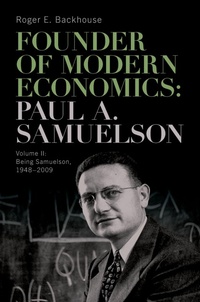
Founder of Modern Economics: Paul A. Samuelson
Volume II: Being Samuelson, 1948-2009
Will be published approx. on 27. July 2026
Book
Hardback
768 pages
978-0-19-781282-2 (ISBN)
Description
Paul A. Samuelson is widely regarded as the world's leading economist in the so-called "Age of Keynes", the three decades after WWII, acknowledged by his being the first American to win the Nobel prize in economics. Foundations of Economic Analysis was a manual on how economic theory should be done, and the nineteen editions of Economics: An Introductory Analysis provided the first exposure to economics for millions of students worldwide.
Volume I of this intellectual biography told the story of someone who established himself as the most promising economist of his generation. This volume shows how he went on to dominate the subject. He was well known as a mathematical economist at a time when the use of mathematics in economics was in its infancy but, as this volume shows, he was far more than that. He wrote seminal articles in field after field, including consumer behaviour, international trade, consumer, finance, public expenditure, optimal taxation, the economics of inflation and unemployment, and many others. He had the ability to use his knowledge of mathematics to simplify economic problems, providing the concepts that other economists could use and yet he could write in a style that entertained as well as informed his readers. He helped transform of his department at the Massachusetts Institute of Technology from a relative backwater into the most influential economics department in the United States, its graduates filling influential positions in academia, central banks, and the provision of economic advice to government. He was active in trading commodities and played a significant role in the establishment of index funds. An innovative feature of this biography is that it is not confined to what he called his scientific work but covers his political economy (his analysis of current events and his policy advice) in depth. From the start of his academic career, he was in demand as an economic adviser, his most prominent role being as adviser to President John Kennedy, and he was a regular columnist for newspapers and news magazines from the Financial Times to the Washington Post and Newsweek and a range of Japanese and Korean newspapers.
Volume I of this intellectual biography told the story of someone who established himself as the most promising economist of his generation. This volume shows how he went on to dominate the subject. He was well known as a mathematical economist at a time when the use of mathematics in economics was in its infancy but, as this volume shows, he was far more than that. He wrote seminal articles in field after field, including consumer behaviour, international trade, consumer, finance, public expenditure, optimal taxation, the economics of inflation and unemployment, and many others. He had the ability to use his knowledge of mathematics to simplify economic problems, providing the concepts that other economists could use and yet he could write in a style that entertained as well as informed his readers. He helped transform of his department at the Massachusetts Institute of Technology from a relative backwater into the most influential economics department in the United States, its graduates filling influential positions in academia, central banks, and the provision of economic advice to government. He was active in trading commodities and played a significant role in the establishment of index funds. An innovative feature of this biography is that it is not confined to what he called his scientific work but covers his political economy (his analysis of current events and his policy advice) in depth. From the start of his academic career, he was in demand as an economic adviser, his most prominent role being as adviser to President John Kennedy, and he was a regular columnist for newspapers and news magazines from the Financial Times to the Washington Post and Newsweek and a range of Japanese and Korean newspapers.
More details
Series
Language
English
Place of publication
New York
United States
Dimensions
Height: 243 mm
Width: 166 mm
Thickness: 50 mm
Weight
1225 gr
ISBN-13
978-0-19-781282-2 (9780197812822)
Copyright in bibliographic data and cover images is held by Nielsen Book Services Limited or by the publishers or by their respective licensors: all rights reserved.
Schweitzer Classification
Person
Roger E. Backhouse is Emeritus Professor of Economics, University of Birmingham.
Content
Introduction Part I. New Horizons, 1948DS60 1: MIT and Japan 2: Inflation and Stabilization Policy, 1948DS60 3: RAND and Activity Analysis 4: Economic Theory, The 1950s 5: Public Economics, The 1950s 6: Economics, 1951DS59 7: Science, Natural, and Social Part II. The KennedyDSJohnson Years, 1960DS68 8: Advising John F. Kennedy, 1960DS63 9: Johnson and Newsweek, 1963DS68 10: Economic Theory, The 1960s 11: The Two Cambridges 12: Marxism and the History of Economic Thought 13: Sunday Painting Part III. Nobel Prize Winner, 1968DS80 14: Recognition 15: Monetarism and Economic Crises of the 1970s 16: Government and the Law 17: Economic Theory, 1968DS80 18: Mathematical Biology Part IV. <"Retirement,> " 1980DS2009 19: Political Economy After 1980 20: Mathematical Theory After 1980 21: Reflections on Economists 22: Creating Modern Economics