

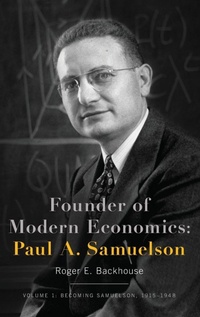
Founder of Modern Economics: Paul A. Samuelson
Volume 1: Becoming Samuelson, 1915-1948
Published on 27. July 2017
Book
Hardback
760 pages
978-0-19-066409-1 (ISBN)
Description
Paul Samuelson was at the heart of a revolution in economics. He was "the foremost academic economist of the 20th century," according to the New York Times, and the first American to win the Nobel Prize in Economics. His work transformed the field of economics and helped give it the theoretical and mathematic rigor that increased its influence in business and policy making.
In Founder of Modern Economics, Roger E. Backhouse explores the central importance of Samuelson's personality and social networks to understanding his intellectual development. This is the first of two volumes covering Samuelson's extended and productive life and career. This volume surveys Samuelson's early years growing up in the Midwest to his experiences at the University of Chicago and Harvard University, where leading scholars in economics and other disciplines stimulated and rewarded his curiosity. His thinking was influenced by the natural sciences and he understood that a critical, scientific approach increased insights into important social and economic questions. He realized that these questions could not be answered through rhetorical debate but required rigor. His "eureka" moment came, he said, when "a good fairy whispered to me that math was a skeleton key to solve age old problems in economics."
Backhouse traces Samuelson's thinking from his early days to the publication of his groundbreaking book Foundations of Economic Analysis and Economics: An Introductory Analysis, which influenced generations of students. His work set the stage for economics to become a more cohesive and coherent discipline, based on mathematical techniques that provided surprising insights into many important topics, from business cycles to wage and unemployment rates, and from how competition influences trade to how tax rates affects tax collection.
Founder of Modern Economics is a profound contribution to understanding how modern economics developed and the thinking of a revolutionary thinker.
In Founder of Modern Economics, Roger E. Backhouse explores the central importance of Samuelson's personality and social networks to understanding his intellectual development. This is the first of two volumes covering Samuelson's extended and productive life and career. This volume surveys Samuelson's early years growing up in the Midwest to his experiences at the University of Chicago and Harvard University, where leading scholars in economics and other disciplines stimulated and rewarded his curiosity. His thinking was influenced by the natural sciences and he understood that a critical, scientific approach increased insights into important social and economic questions. He realized that these questions could not be answered through rhetorical debate but required rigor. His "eureka" moment came, he said, when "a good fairy whispered to me that math was a skeleton key to solve age old problems in economics."
Backhouse traces Samuelson's thinking from his early days to the publication of his groundbreaking book Foundations of Economic Analysis and Economics: An Introductory Analysis, which influenced generations of students. His work set the stage for economics to become a more cohesive and coherent discipline, based on mathematical techniques that provided surprising insights into many important topics, from business cycles to wage and unemployment rates, and from how competition influences trade to how tax rates affects tax collection.
Founder of Modern Economics is a profound contribution to understanding how modern economics developed and the thinking of a revolutionary thinker.
Reviews / Votes
Paul Samuelson changed economics and in the process changed the economies and societies we inhabit. This important book tells his story and in the process sheds important new light on the history of our field and our times. * Lawrence H. Summers, President Emeritus and Charles W. Eliot University Professor of Harvard University * It has been well said that Paul A. Samuelson was the last great general economist-never again will any one person make such foundational contributions to so many distinct areas of economics. His profound theoretical contributions over nearly seven decades of published research have been ecumenical and his ramified influence on the whole of economics has led economists in just about every branch of economics to claim him as one of their own. Here we have an exploration of the role of personality and social networks in understanding the remarkable intellectual development of this singularly remarkable economist. To the reader, Bon Appetit! * Robert C. Merton, School of Management Distinguished Professor of Finance, MIT and University Professor Emeritus, Harvard University; Nobel Prize in Economic Science, 1997 * America's greatest modern economist transformed economic analysis. The distinguished historian Roger Backhouse has used the newly available Samuelson archives, and much more, to construct this informative and lively intellectual biography to show just how that transformation occurred and Samuelson's role in it. This volume's scholarship will define Samuelson's contributions for a generation. * E. Roy Weintraub, Duke University, author of How Economics Became a Mathematical Science * Like Harrod in his Life of Keynes, Backhouse provides us with an invaluable first full treatment of the life and work of the economist Paul Samuelson, a key transitional figure between prewar and postwar economics. Choosing as his intellectual fathers both Edwin B. Wilson and Alvin Hansen, Samuelson used his third "sacred decade" of intellectual creativity to produce two very different books, Foundations and Economics, so setting the stage for a life of work in the space between them. * Perry Mehrling, Professor of Economics, Barnard College, Columbia University * Founder of Modern Economics: Paul A. Samuelson Volume 1: Becoming Samuelson, 1915-1948, is an extraordinary achievement. Master historian of thought Roger Backhouse, in producing the definitive study of the development of one of the greatest minds in the history of economics, not only enriches our understanding of the process of the evolution of social science knowledge, but provides new perspectives on the nature of economic theory. This is a wonderful book. * Steven Durlauf, Kenneth J. Arrow Professor of Economics, University of Wisconsin *More details
Series
Language
English
Place of publication
New York
United States
Target group
College/higher education
Professional and scholarly
Dimensions
Height: 240 mm
Width: 161 mm
Thickness: 45 mm
Weight
1291 gr
ISBN-13
978-0-19-066409-1 (9780190664091)
Copyright in bibliographic data and cover images is held by Nielsen Book Services Limited or by the publishers or by their respective licensors: all rights reserved.
Schweitzer Classification
Other editions
Additional editions
Roger E. Backhouse
Founder of Modern Economics: Paul A. Samuelson
Volume 1: Becoming Samuelson, 1915-1948
E-Book
04/2017
1st Edition
OUP eBook
€23.49
Available for download
Roger E. Backhouse
Founder of Modern Economics: Paul A. Samuelson
Volume 1: Becoming Samuelson, 1915-1948
E-Book
04/2017
1st Edition
OUP eBook
€23.49
Available for download
Person
Roger E. Backhouse is Professor of the History and Philosophy of Economics, University of Birmingham.
Content
Contents
List of Figures
Preface
Part I - The Early Years, 1915-35
1. Childhood
2. The University of Chicago, 1932
3. Natural and social sciences, 1932-3
4. Social scientist to mathematical economist, 1933-4
5: Economics at Chicago, 1932-5
PART II - The Harvard Years, 1935-40
6. First Term at Harvard, Autumn 1935
7. Joseph Alois Schumpeter
8. Edwin Bidwell Wilson
9. Making Connections
10. Simplifying Economic Theory
11. Collaboration
12. Alvin Harvey Hansen
13. Hansen's Disciple
14. The Observational Significance of Economic Theory
15. Leaving Harvard
PART III - MIT, War, Foundations and the Textbook, 1940-8
16. The Massachusetts Institute of Technology
17. Statistics
18. Developing the New Economics, I: Theory, 1940-3
19. Hansen and the National Resources Planning Board, 1941-3
20. Developing the New Economics, II: Policy, 1942-3
21. Scientists and Science Policy, 1944-5
22. Foundations of Economic Analysis, 1940-7
23. Postwar Economic Policy, 1944-7
24. Keynes and Keynesian economics
25. Drafting the Textbook, 1945
26. Controversy Over the Textbook, 1947-8
27. Economics, the First Edition, 1948
28. Commitment to MIT
29. Conclusions
List of Abbreviations
References
Endnote
List of Figures
Preface
Part I - The Early Years, 1915-35
1. Childhood
2. The University of Chicago, 1932
3. Natural and social sciences, 1932-3
4. Social scientist to mathematical economist, 1933-4
5: Economics at Chicago, 1932-5
PART II - The Harvard Years, 1935-40
6. First Term at Harvard, Autumn 1935
7. Joseph Alois Schumpeter
8. Edwin Bidwell Wilson
9. Making Connections
10. Simplifying Economic Theory
11. Collaboration
12. Alvin Harvey Hansen
13. Hansen's Disciple
14. The Observational Significance of Economic Theory
15. Leaving Harvard
PART III - MIT, War, Foundations and the Textbook, 1940-8
16. The Massachusetts Institute of Technology
17. Statistics
18. Developing the New Economics, I: Theory, 1940-3
19. Hansen and the National Resources Planning Board, 1941-3
20. Developing the New Economics, II: Policy, 1942-3
21. Scientists and Science Policy, 1944-5
22. Foundations of Economic Analysis, 1940-7
23. Postwar Economic Policy, 1944-7
24. Keynes and Keynesian economics
25. Drafting the Textbook, 1945
26. Controversy Over the Textbook, 1947-8
27. Economics, the First Edition, 1948
28. Commitment to MIT
29. Conclusions
List of Abbreviations
References
Endnote