

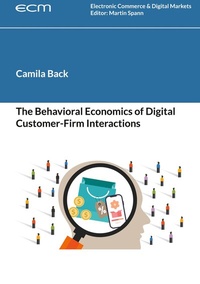
The Behavioral Economics of Digital Customer-Firm Interactions
1st Edition
Published on 27. July 2022
Book
Paperback/Softback
220 pages
978-3-7562-3248-2 (ISBN)
Description
The use of digital technologies have given rise to new forms of customer-firm interactions (e.g., the use of digital assistants in customer service). The shift towards digitization of customer-firm interactions enables a wide and easily scalable new set of offerings to consumers. From a consumer perspective, the increased use of digital technologies constantly shape individual decisions and attitudes towards firms.
This dissertation examines the extent to which customers benefit from these technological advances by taking on a behavioral economics perspective. The main focus of the dissertation lies on two aspects which are highly relevant for firms: (i) customer satisfaction, and (ii) the quality of customers' economic decisions.
The dissertation employs a wide set of methods (theoretical modelling, analysis of experimental data, analysis of observational data) and consists of three articles. Article 1 is conceptual in nature and lays the theoretical foundation by providing theoretical insights on customer-related decision processes from a behavioral economics perspective. Article 2 looks at how the availability and presentation of information influences customer satisfaction. The focus of Article 3 lies on technology's impact on economic decision making with a particular interest on automated investment advice from a robo-advisor, and the role of social design elements.
This dissertation examines the extent to which customers benefit from these technological advances by taking on a behavioral economics perspective. The main focus of the dissertation lies on two aspects which are highly relevant for firms: (i) customer satisfaction, and (ii) the quality of customers' economic decisions.
The dissertation employs a wide set of methods (theoretical modelling, analysis of experimental data, analysis of observational data) and consists of three articles. Article 1 is conceptual in nature and lays the theoretical foundation by providing theoretical insights on customer-related decision processes from a behavioral economics perspective. Article 2 looks at how the availability and presentation of information influences customer satisfaction. The focus of Article 3 lies on technology's impact on economic decision making with a particular interest on automated investment advice from a robo-advisor, and the role of social design elements.
More details
Other editions
Additional editions
Camila Back | Martin Spann
The Behavioral Economics of Digital Customer-Firm Interactions
E-Book
08/2022
1st Edition
Electronic Commerce & Digital Markets
€9.99
Available for download
Persons
Author
Camila Back is a Doctoral Researcher at the Institute of Electronic Commerce and Digital Markets at Ludwig-Maximilians-Universität (LMU) München - Munich School of Management. She holds a B.Sc. and a M.Sc. in Mathematics from LMU. She earned a Master of Business Research in 2021 and her PhD in 2022 from LMU's Munich School of Management.
Editor
Martin Spann is professor of electronic commerce and digital markets and dean of the LMU Munich School of Management at Ludwig-Maximilians-Universität (LMU). He studied Economics at the University of Kiel and obtained his PhD (2002) as well as his Habilitation (2005) from Goethe-University in Frankfurt. He has been a visiting scholar/professor at the University of California, Berkeley (UCB), New York University (NYU), the University of California at Los Angeles (UCLA), the University of Technology, Sydney (UTS), the University of Southern California (USC) and Bocconi University in Milan, Italy. From 2005 to 2010, he was a Professor of Marketing and Innovation at the University of Passau. He is a board member of the Center for Digital Technology and Management (CDTM) and member of the National Research Council of the Swiss National Science Foundation (SNSF).