

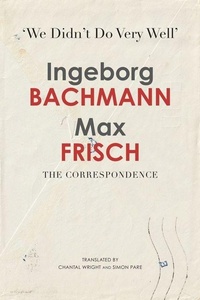
'We Didn't Do Very Well'
The Correspondence
Will be published approx. on 5. November 2026
Book
Hardback
940 pages
978-1-80309-664-3 (ISBN)
Description
The fraught and generative relationship between two postwar literary giants-revealed through a series of letters published for the first time in English.
Ingeborg Bachmann (1926-1973) stands among the most vital voices of postwar German literature-an acclaimed poet and prose writer who also reshaped radio drama and opera. In 1958, a letter of admiration from the Swiss novelist Max Frisch (1911-1991), written after hearing Bachmann's radio play The Good God of Manhattan, led to a meeting in Paris and the beginning of an intense, volatile love affair that would forever leave a mark on both their lives and work. Presented here for the first time in English, 299 letters written between 1958 and 1973 trace the arc of that relationship: long separations, the strain of two writers attempting to share a life, creative rivalry, sexual jealousy, and gendered tensions sharpened by a fifteen-year age gap. The correspondence ranges from everyday logistics to raw psychological insight, from passion and longing to bitterness, silence, and regret. The later letters, written as Bachmann's health declined, expand to include friends, relatives, and key literary figures. First published in German in 2022, this correspondence overturned long-held myths about the two writers, revealing mutual influence, negotiated freedom, and a struggle to reconcile incompatible needs. Intimate and revelatory, these letters illuminate the fragile intersection of love, power, and creativity.
Ingeborg Bachmann (1926-1973) stands among the most vital voices of postwar German literature-an acclaimed poet and prose writer who also reshaped radio drama and opera. In 1958, a letter of admiration from the Swiss novelist Max Frisch (1911-1991), written after hearing Bachmann's radio play The Good God of Manhattan, led to a meeting in Paris and the beginning of an intense, volatile love affair that would forever leave a mark on both their lives and work. Presented here for the first time in English, 299 letters written between 1958 and 1973 trace the arc of that relationship: long separations, the strain of two writers attempting to share a life, creative rivalry, sexual jealousy, and gendered tensions sharpened by a fifteen-year age gap. The correspondence ranges from everyday logistics to raw psychological insight, from passion and longing to bitterness, silence, and regret. The later letters, written as Bachmann's health declined, expand to include friends, relatives, and key literary figures. First published in German in 2022, this correspondence overturned long-held myths about the two writers, revealing mutual influence, negotiated freedom, and a struggle to reconcile incompatible needs. Intimate and revelatory, these letters illuminate the fragile intersection of love, power, and creativity.
More details
Series
Language
English
Place of publication
Greenford
United Kingdom
Illustrations
30 halftones
Dimensions
Height: 229 mm
Width: 152 mm
Weight
454 gr
ISBN-13
978-1-80309-664-3 (9781803096643)
Copyright in bibliographic data and cover images is held by Nielsen Book Services Limited or by the publishers or by their respective licensors: all rights reserved.
Schweitzer Classification
Persons
Ingeborg Bachmann is the author of Darkness Spoken, Malina, and Simultan, among other books. Max Frisch was a giant of twentieth-century German literature, achieving fame as a novelist, playwright, diarist, and essayist. His works include Andorra and Man in the Holocene. Chantal Wright is a literary translator from German and French into English, the author of Literary Translation, and Professor of Creativity and the Language Industry at Zurich University of Applied Sciences. Simon Pare is a translator from French and German living near Zurich.
Content
1.Letters
2.Thomas Straessle and Barbara Wiedemann: A mutual undoing
3.Hans Hoeller and Renate Langer: 'I too am a writer'
4.About this edition
5.Notes
6.Timeline
7.List of abbreviations with bibliography
8.Acknowledgements
9.Portraits and facsimiles
10.Credits
11.Index of works by Bachmann
12.Index of works by Frisch
13.Index of persons named in the text
2.Thomas Straessle and Barbara Wiedemann: A mutual undoing
3.Hans Hoeller and Renate Langer: 'I too am a writer'
4.About this edition
5.Notes
6.Timeline
7.List of abbreviations with bibliography
8.Acknowledgements
9.Portraits and facsimiles
10.Credits
11.Index of works by Bachmann
12.Index of works by Frisch
13.Index of persons named in the text