

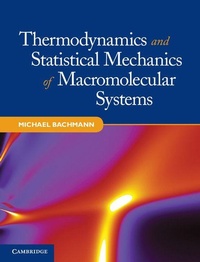
Thermodynamics and Statistical Mechanics of Macromolecular Systems
Published on 24. April 2014
Book
Hardback
354 pages
978-1-107-01447-3 (ISBN)
Description
The structural mechanics of proteins that fold into functional shapes, polymers that aggregate and form clusters, and organic macromolecules that bind to inorganic matter can only be understood through statistical physics and thermodynamics. This book reviews the statistical mechanics concepts and tools necessary for the study of structure formation processes in macromolecular systems that are essentially influenced by finite-size and surface effects. Readers are introduced to molecular modeling approaches, advanced Monte Carlo simulation techniques, and systematic statistical analyses of numerical data. Applications to folding, aggregation, and substrate adsorption processes of polymers and proteins are discussed in great detail. Particular emphasis is placed on the reduction of complexity by coarse-grained modeling, which allows for the efficient, systematic investigation of structural phases and transitions. Providing insight into modern research at this interface between physics, chemistry, biology, and nanotechnology, this book is an excellent reference for graduate students and researchers.
Reviews / Votes
'The clarity of exposition supports the author's goal with respect to his view. In fact, as stated in the preface and outline of his work, he wished to overcome the frustration for the present contradicting and inconclusive literature in this field. The richness of specific examples also supports the book scope. The approach to modelling is also clearly described. ... this book could be suitable also for non-experts in the field, due to its precise exposition of the subjects. I would recommend this book to people from different scientific backgrounds: starting from physics to biology, biochemistry and many others. The work by Bachmann should also be considered as ... an acquisition, whose value is long-lasting. Finally, the exhaustive treatment contained in [this book] might also constitute a good support for defining future research paths and projects, which have now a wide spectrum of applications.' Marco Casazza, Contemporary PhysicsMore details
Language
English
Place of publication
Cambridge
United Kingdom
Target group
Professional and scholarly
Illustrations
63 Halftones, unspecified; 86 Line drawings, unspecified
Dimensions
Height: 260 mm
Width: 208 mm
Thickness: 24 mm
Weight
994 gr
ISBN-13
978-1-107-01447-3 (9781107014473)
Copyright in bibliographic data and cover images is held by Nielsen Book Services Limited or by the publishers or by their respective licensors: all rights reserved.
Schweitzer Classification
Other editions
Additional editions
Michael Bachmann
Thermodynamics and Statistical Mechanics of Macromolecular Systems
E-Book
05/2014
1st Edition
Cambridge University Press
€52.99
Available for download
Michael Bachmann
Thermodynamics and Statistical Mechanics of Macromolecular Systems
E-Book
04/2014
Cambridge University Press
€45.49
Available for download
Person
Michael Bachmann is Associate Professor in the Department of Physics and Astronomy at the University of Georgia. His major fields of interest include theoretical physics, computational physics, statistical physics, biophysics, and chemical physics.
Content
Preface and outline; 1. Introduction; 2. Statistical mechanics: a modern review; 3. The complexity of minimalistic lattice models for protein folding; 4. Monte Carlo and chain growth methods for molecular simulations; 5. First insights to freezing and collapse of flexible polymers; 6. Crystallization of elastic polymers; 7. Structural phases of semiflexible polymers; 8. Generic tertiary folding properties of proteins in mesoscopic scales; 9. Protein folding channels and kinetics of two-state folding; 10. Inducing generic secondary structures by constraints; 11. Statistical analyses of aggregation processes; 12. Hierarchical nature of phase transitions; 13. Adsorption of polymers at solid substrates; 14. Hybrid protein-substrate interfaces; 15. Concluding remarks and outlook; Notes; References; Index.