

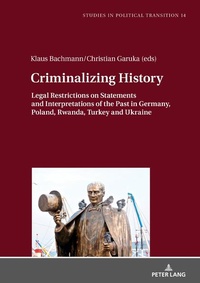
Criminalizing History
Legal Restrictions on Statements and Interpretations of the Past in Germany, Poland, Rwanda, Turkey and Ukraine
Published on 2. April 2020
Book
Hardback
182 pages
978-3-631-80957-0 (ISBN)
Description
Why do states ban certain statements and interpretations of the past, how do they ban them and what are the practical consequences? This book offers an answer to these questions and at the same time examines, whether the respective legislation was supply-or demand-driven and how prosecutors and courts applied it. The comparison between Germany, Poland, Ukraine, Rwanda and Turkey offers several surprising insights: in most countries, memory law legislation is supply driven and imposed on a reluctant society, in some countries they target apolitical hooligans more than intellectuals or the government's political opponents. The book also discusses, why and how liberal democracies differ from hybrid regimes in their approach to punitive memory laws and how such laws can be tailored to avoid constraints on free speech, the freedom of the press and academic freedoms.
More details
Persons
Klaus Bachmann is professor of social sciences at SWPS University of Social Sci -ences and Humanities in Warsaw, Poland. His research concentrates on Inter-national Criminal Justice, Modern European History and European Integration.
Christian Garuka is Lawyer and defence counsellor in Kigali, Rwanda.
Content
Memory laws, politics of history, Holocaust denial, Rwanda, Ukraine, Germany, Poland, Turkey, genocide ideology, denialism, lustration, communism, Holocaust, defamation