

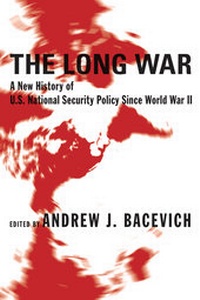
The Long War
A New History of U.S. National Security Policy Since World War II
Will be published approx. on 23. April 2009
Book
Paperback/Softback
608 pages
978-0-231-13159-9 (ISBN)
Description
Essays by a diverse and distinguished group of historians, political scientists, and sociologists examine the alarms, emergencies, controversies, and confusions that have characterized America's Cold War, the post-Cold War interval of the 1990s, and today's "Global War on Terror." This "Long War" has left its imprint on virtually every aspect of American life; by considering it as a whole, The Long War is the first volume to take a truly comprehensive look at America's response to the national-security crisis touched off by the events of World War II. Contributors consider topics ranging from grand strategy and strategic bombing to ideology and economics and assess the changing American way of war and Hollywood's surprisingly consistent depiction of Americans at war. They evaluate the evolution of the national-security apparatus and the role of dissenters who viewed the myriad activities of that apparatus with dismay. They take a fresh look at the Long War's civic implications and its impact on civil-military relations.
More than a military history, The Long War examines the ideas, policies, and institutions that have developed since the United States claimed the role of global superpower. This protracted crisis has become a seemingly permanent, if not defining aspect of contemporary American life. In breaking down the old and artificial boundaries that have traditionally divided the postwar period into neat historical units, this volume provides a better understanding of the evolution of the United States and U.S. policy since World War II and offers a fresh perspective on our current national security predicament.
More than a military history, The Long War examines the ideas, policies, and institutions that have developed since the United States claimed the role of global superpower. This protracted crisis has become a seemingly permanent, if not defining aspect of contemporary American life. In breaking down the old and artificial boundaries that have traditionally divided the postwar period into neat historical units, this volume provides a better understanding of the evolution of the United States and U.S. policy since World War II and offers a fresh perspective on our current national security predicament.
Reviews / Votes
A remarkable collection. -- Major Stephanie D. Halcrow, U.S. Air Force Proceedings A valuable resource. The Journal of Cold War Studies A welcome antidote to much of the traditional historiography that takes its cues from the official paradigms of US security policy. -- Thorsten B. Olesen The International History Review Bacevich has produced a volume that illuminates the present as much as it does the past... A fine work of history. -- Marilyn B. YoungMore details
Language
English
Place of publication
New York
United States
Target group
Professional and scholarly
Product notice
Paperback (trade)
Illustrations
8 illus.
Dimensions
Height: 235 mm
Width: 156 mm
Weight
808 gr
ISBN-13
978-0-231-13159-9 (9780231131599)
Copyright in bibliographic data and cover images is held by Nielsen Book Services Limited or by the publishers or by their respective licensors: all rights reserved.
Schweitzer Classification
Other editions
Additional editions
Book
07/2007
Columbia University Press
€116.37
Shipment within 10-20 days
E-Book
07/2007
1st Edition
Columbia University Press
from
€48.29
Available for download
Person
Andrew J. Bacevich is professor of history and international relations at Boston University. A graduate of the U.S. Military Academy, he received his Ph.D. in American diplomatic history from Princeton. His most recent book is The Limits of Power: The End of American Exceptionalism.
Content
Andrew J. Bacevich * The Pattern of U.S. Civil-Military Relations Since World War II Tami Davis Biddle * U.S. Strategic Forces and Doctrine Since 1945 James Burk * The Changing Moral Contract for Military Service Charles Chatfield * Dissent from the "Long War" Benjamin O. Fordham * Costs and Benefits of Postwar U.S. Military Spending James Kurth * Variations on the American Way of War Anna Kasten Nelson * The Evolution of the National Security State William L. O'Neill * National Security and American Culture Arnold A. Offner * The Ideology of U.S. National Security Policy George H. Quester * The Politics of Conventional Warfare in an Unconventional Age John Prados * Intelligence for Empire Alex Roland * The Military-Industrial Complex