

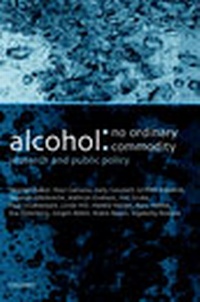
Alcohol: No Ordinary Commodity
Research and Public Policy
Published in September 2003
Book
Paperback/Softback
301 pages
978-0-19-263261-6 (ISBN)
Description
From a public health perspective, alcohol is no ordinary consumer product. On a global level, it is a major contributor to disease, disability, and premature mortality. It also has an adverse impact on many aspects of social life. "Alcohol: No Ordinary Commodity - Research and Public Policy" describes recent advances in alcohol research that have direct relevance for the development of effective alcohol policies at the local, national and international levels. It covers the search for policies that protect health, prevent disability, and address the social problems associated with the misuse of beverage alcohol. This book is, at its core, a scientific treatise on what alcohol policy is, why it is needed, which interventions are effective, how policy is made, and how scientific evidence can inform the policy-making process. The book opens with an introduction to the policy agenda. The second section then presents a snapshot of drinking patterns and alcohol-related problems throughout the world, providing a global panorama of the challenges faced.
The third section critically reviews the evidence for six strategies that have often been used as a basis for alcohol policy: taxation and pricing, regulating the physical availability of alcohol, modifying the drinking context, drinking-driving countermeasures, regulating alcohol promotion, education and persuasion programmes, and treatment and early intervention services. Section four provides an international analysis of the policy making process. The book concludes with a consumer's guide to effective alcohol policy, synthesising what is known about how communities and nation states can effectively manage this extraordinary commodity.
The third section critically reviews the evidence for six strategies that have often been used as a basis for alcohol policy: taxation and pricing, regulating the physical availability of alcohol, modifying the drinking context, drinking-driving countermeasures, regulating alcohol promotion, education and persuasion programmes, and treatment and early intervention services. Section four provides an international analysis of the policy making process. The book concludes with a consumer's guide to effective alcohol policy, synthesising what is known about how communities and nation states can effectively manage this extraordinary commodity.
Reviews / Votes
This book is a joy to read. Throughout the text is clear and jargon-lite ... Overall, an essential addition to the library of any public health department or addiction service. Clinicians wanting a starting point for examining the evidence for various interventions will find it very useful, and we can but hope that policy maker take note. Health Matters The chapters effectively summarise and synthesise the current state of knowledge, and provide a tremendous resource for those interested in alcohol-related problems and their prevention... This book, prepared with support from WHO, builds directly on two similar volumes from previous decades. It will obviously be a central reference used by those specifically working on alcohol, but also makes key contributions to understanding and designing effective prevention policies and programmes for the full range of contemporary health problems. The LancetMore details
Language
English
Place of publication
Oxford
United Kingdom
Target group
Professional and scholarly
Illustrations
11line drawings
Dimensions
Height: 234 mm
Width: 156 mm
Weight
433 gr
ISBN-13
978-0-19-263261-6 (9780192632616)
Copyright in bibliographic data and cover images is held by Nielsen Book Services Limited or by the publishers or by their respective licensors: all rights reserved.
Schweitzer Classification
Other editions
New editions
Book
02/2010
2nd Edition
Oxford University Press
€75.00
Article exhausted; check different version
Content
SECTION I: INTRODUCTION; 1. Setting the policy agenda; SECTION II: EPIDEMIOLOGY: ESTABLISHING THE NEED FOR ALCOHOL POLICY; 2. Alcohol: no ordinary commodity; 3. Alcohol consumption trends and patterns of drinking; 4. The global burden of alcohol consumption; SECTION III: THE TOOLKIT: STRATEGIES AND INTERVENTIONS; 5. Section overview: strategies and interventions to reduce alcohol-related harm; 6. Pricing and taxation; 7. Regulating the physical availability of alcohol; 8. Modifying the drinking context; 9. Drinking-driving countermeasures; 10. Regulating alcohol promotion; 11. Education and persuasion strategies; 12. Treatment and early intervention services; SECTION IV: THE PROCESS: FORMATION OF EFFECTIVE ALCOHOL POLICY; 13. Alcohol policymaking: putting the strategies into effect; 14. The international context of alcohol policy; 15. The policy arena; SECTION V: CONCLUSION; 16. Alcohol policies: a consumer's guide