

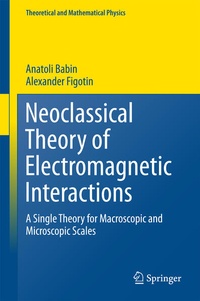
Neoclassical Theory of Electromagnetic Interactions
A Single Theory for Macroscopic and Microscopic Scales
Published on 18. August 2016
Book
Hardback
XXIII, 696 pages
978-1-4471-7282-6 (ISBN)
Description
In this monograph, the authors present their recently developed theory of electromagnetic interactions. This neoclassical approach extends the classical electromagnetic theory down to atomic scales and allows the explanation of various non-classical phenomena in the same framework.
While the classical Maxwell-Lorentz electromagnetism theory succeeds in describing the physical reality at macroscopic scales, it struggles at atomic scales. Here, quantum mechanics traditionally takes over to describe non-classical phenomena such as the hydrogen spectrum and de Broglie waves. By means of modifying the classical theory, the approach presented here is able to consistently explain quantum-mechanical effects, and while similar to quantum mechanics in some respects, this neoclassical theory also differs markedly from it. In particular, the newly developed framework omits probabilistic interpretations of the wave function and features a new fundamental spatial scalewhich, at the size of the free electron, is much larger than the classical electron radius and is relevant to plasmonics and emission physics.
This book will appeal to researchers interested in advanced aspects of electromagnetic theory. Treating the classical approach in detail, including non-relativistic aspects and the Lagrangian framework, and comparing the neoclassical theory with quantum mechanics and the de Broglie-Bohm theory, this work is completely self-contained.
While the classical Maxwell-Lorentz electromagnetism theory succeeds in describing the physical reality at macroscopic scales, it struggles at atomic scales. Here, quantum mechanics traditionally takes over to describe non-classical phenomena such as the hydrogen spectrum and de Broglie waves. By means of modifying the classical theory, the approach presented here is able to consistently explain quantum-mechanical effects, and while similar to quantum mechanics in some respects, this neoclassical theory also differs markedly from it. In particular, the newly developed framework omits probabilistic interpretations of the wave function and features a new fundamental spatial scalewhich, at the size of the free electron, is much larger than the classical electron radius and is relevant to plasmonics and emission physics.
This book will appeal to researchers interested in advanced aspects of electromagnetic theory. Treating the classical approach in detail, including non-relativistic aspects and the Lagrangian framework, and comparing the neoclassical theory with quantum mechanics and the de Broglie-Bohm theory, this work is completely self-contained.
More details
Series
Edition
1st ed. 2016
Language
English
Place of publication
London
United Kingdom
Target group
Professional and scholarly
Illustrations
XXIII, 696 p.
Dimensions
Height: 241 mm
Width: 160 mm
Thickness: 44 mm
Weight
1232 gr
ISBN-13
978-1-4471-7282-6 (9781447172826)
DOI
10.1007/978-1-4471-7284-0
Schweitzer Classification
Other editions
Additional editions
Anatoli Babin | Alexander Figotin
Neoclassical Theory of Electromagnetic Interactions
A Single Theory for Macroscopic and Microscopic Scales
Book
06/2018
Springer
€171.19
Shipment within 15-20 days
Anatoli Babin | Alexander Figotin
Neoclassical Theory of Electromagnetic Interactions
A Single Theory for Macroscopic and Microscopic Scales
E-Book
08/2016
Springer
€171.19
Available for download
Content
Introduction.- The History of Views on Charges, Currents and the Electromagnetic Field.- The Neoclassical Field Theory of Charged Matter: A Concise Presentation.- Part I. Classical Electromagnetic Theory and Special Relativity.- Part II. Classical Field Theory.- Part III. The Neoclassical Theory of Charges.- Part IV. The Neoclassical Theory of Charges with Spin.- Part V. Mathematical Aspects of the Theory of Distributed Elementary Charges.- Part VI. Appendices.