

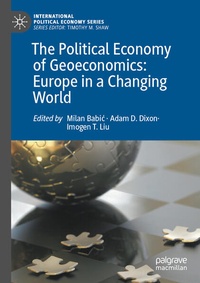
The Political Economy of Geoeconomics: Europe in a Changing World
Description
This book brings together researchers from different analytical perspectives for the study of contemporary geoeconomics to create a broader and more useful catalogue of conceptual tools, empirical entry points, and case studies around the subject. The distinctive contribution this book offers is its firm rooting in International Political Economy and the hitherto under-researched geoeconomics dynamics of Europe. Many existing accounts of geoeconomics have been developed in International Relations and often reproduce some of the state-centric and static assumptions of the discipline. Recent scholarship furthermore tends to focus on the US-China rivalry, thus discounting the role of other global powers in shaping geoeconomics. As a first collective contribution to the topic in the field of International Political Economy, the book stands to become a major reference point in the field for the coming years. Interest in geoeconomics as well as in related concepts like weaponized interdependence or emerging new rivalries has been on the rise in recent years and will be one of the key research areas in the coming decade of transition and change in Europe and beyond.
Chapters 1, 2 and 7 are available open access under a Creative Commons Attribution 4.0 International License via link.springer.com.
Reviews / Votes
This volume provides crucial conceptual framing of the geoeconomic logics that underpin rapid shifts in the ideational substructure of the post-Cold War global economic system as well as careful empirical analysis of the causes and consequences of these shifts at the domestic, regional, and international levels. By placing analytic emphasis on the role of Europe in this reordering of the global political economy, the contributing authors usefully move discussions beyond simpler US-China frames. A must read for anyone interested in the politics and economics of autonomy and interdependence in a new era (-- Sarah Bauerle Danzman, Assistant Professor of International Studies at Indiana University Bloomington)The world economy has increasingly turned into a battlefield with banks and production networks serving as the foot soldiers. As scholars and policy makers try to grapple with this new uncertainty, The Political Economy of Geoeconomics makes a critical contribution. It is a must read for anyone interested in economic coercion and Europe. (-- Abraham Newman, Director of the Mortara Center for International Studies and Professor at the School of Foreign Service and Department of Government, Georgetown University)
In the context of the war in Ukraine and sanctions against Russia, a comprehensive book on geoeconomics and the role of Europe could not be timelier. This path-breaking volume develops a novel perspective on how varieties of actors shape current rivalries in the global political economy. (-- Andreas Nölke, Professor of Political Science, Goethe University Frankfurt.)
The Political Economy of Geoeconomics: Europe in a Changing World shines an International Political Economy lens on the growing blurriness between economy and national security. Thanks to an interdisciplinary team of authors from various field including geography and political science,Babic, Dixon and Liu are able to bring a fresh analytical perspective to the new era of existential challenges to the liberal international economic order, including in rapid succession the 2008 financial crisis, the reformulation of Chinese priorities under Xi, Brexit, the Trump administration, and the pandemic. While most recent studies of economic statecraft and geopoliticization emphasize the role of contemporary states, the contributions in this volume focus on how a variety of economic actors, including firms and society groups, are adjusting to this instable "interregnum" through cooperation, competition, and conflict. The volume also brings a welcome focus to Europe, which has a powerful role to play in the supposed Sino-American clash over global dominance. (-- Sophie Meunier, Princeton University, United States )
More details
Other editions
Additional editions
Persons
Milan Babic is Assistant Professor of Global Political Economy at Roskilde University and author of The Rise of State Capital (forthcoming). His work deals with foreign state-led investment and the transformations of the global political economy from a neoliberal toward a post-neoliberal global order.
Adam Dixon is Associate Professor of Globalization and Development at Maastricht University. He is Principal Investigator of the European Research Council research project Legitimacy, Financialization, and Varieties of Capitalism: Understanding Sovereign Wealth Funds in Europe (SWFsEUROPE).
Imogen T. Liu is a Ph.D. Candidate at Maastricht University. Her research covers subjects including state capital, financialization, foreign investment, infrastructure development, and the political economy of China.
Content
Chapter 1: Geoeconomics in a changing global order.- Chapter 2: Balancing dependence: The quest for autonomy and the rise of corporate geoeconomics.- Chapter 3: European Strategic Autonomy: New Agenda, Old Constraints.- Chapter 4: European foreign policy think tanks and "strategic autonomy": making sense of EU's role in the world of geoeconomics.- Chapter 5: The EU as a Geoeconomic Actor? A review of recent European trade and investment policies.- Chapter 6: Geoeconomics and national production regimes: On German exportism and the integration of economic and security policy.- Chapter 7: The geoeconomics of Chinese bank expansion into the European Union.- Chapter 8: Moving forward: Understanding the geoeconomic decade of the 2020s.