

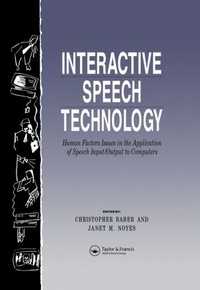
Interactive Speech Technology
Human Factors Issues In The Application Of Speech Input/Output To Computers
1st Edition
Published on 11. November 1993
Book
Hardback
224 pages
978-0-7484-0127-7 (ISBN)
Description
This book deals with two important technologies in human-computer interaction: computer generation of synthetic speech and computer recognition of human speech. It addresses the problems in generating speech with varying precision of articulation and how to convey moods and attitudes.
More details
Language
English
Place of publication
London
United Kingdom
Target group
Professional and scholarly
Academic and General
Dimensions
Height: 234 mm
Width: 156 mm
Weight
508 gr
ISBN-13
978-0-7484-0127-7 (9780748401277)
Copyright in bibliographic data and cover images is held by Nielsen Book Services Limited or by the publishers or by their respective licensors: all rights reserved.
Schweitzer Classification
Other editions
Additional editions
Chris Baber | J. Noyes
Interactive Speech Technology
Human Factors Issues In The Application Of Speech Input/Output To Computers
E-Book
11/2002
CRC Press
€264.99
Available for download

Chris Baber | J. Noyes
Interactive Speech Technology: Human Factors Issues In The Application Of Speech Input/Output To Computers
Human Factors Issues In The Application Of Speech Input/Output To Computers
Other
11/2002
CRC Press
€170.73
Article exhausted; check different version
Chris Baber | J. Noyes
Interactive Speech Technology
Human Factors Issues In The Application Of Speech Input/Output To Computers
E-Book
11/2002
CRC Press
€264.99
Available for download
Persons
Chris Baber is a member of the Industrial Ergonomics Group at the University of Birmingham. Jan Noyes lectures in Human Factors Psychology at the University of Bristol.
Content
1. Developing interactive speech technology Part I: Speech output 2. Voice output for human-machine interaction 3. Interactive speech in computer-aided learning 4. Speech-based alarm displays Part II: Speech input 5. Speech as an interface medium: How can it best be used? 6. Automatic speech recognition and mobile radio 7. Is control by voice the right answer for the avionics environment? 8. Listening typewriters in use: Some practical studies 9. Voice as a medium for document annotation Part III: Considering feedback and error correction 10. Feedback in automatic speech recognition: Who is saying what and to whom? 11. Comparing error correction strategies in speech recognition systems 12. Data-entry by voice: Facilitating correction of misrecognitions Part IV: Designing and evaluating interactive speech technology 13. Assessing the quality of synthetic speech 14. Evaluation and prototyping for voice applications 15. Intelligent dialogues in automated telephone services 16. Design guidelines for using speech in interactive multimedia systems 17. Speech technology in the future