

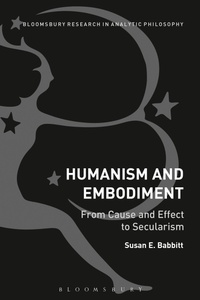
Humanism and Embodiment
From Cause and Effect to Secularism
Published on 19. June 2014
Book
Hardback
208 pages
978-1-4725-2914-5 (ISBN)
Description
A live issue in anthropology and development studies, humanism is not typically addressed by analytic philosophers. Arguing for humanism as a view about truths, Humanism and Embodiment insists that disembodied reason, not religion, should be the target of secularists promoting freedom of enquiry and human community.
Susan Babbitt's original study presents humanism as a meta-ethical view, paralleling naturalistic realism in recent analytic epistemology and philosophy of science. Considering the nature of knowledge, particularly the radical contingency of knowledge claims upon causal mechanisms, religious thinkers like Thomas Merton and Ivan Illich offer more scientific conceptions of practical deliberation than are offered by some non-religious ethicists. Drawing on philosophical sources such as Marxism, Buddhism and Christianity, this original study considers implications of an embodied conception of reason, revealing philosophical, practical and political implications.
Susan Babbitt's original study presents humanism as a meta-ethical view, paralleling naturalistic realism in recent analytic epistemology and philosophy of science. Considering the nature of knowledge, particularly the radical contingency of knowledge claims upon causal mechanisms, religious thinkers like Thomas Merton and Ivan Illich offer more scientific conceptions of practical deliberation than are offered by some non-religious ethicists. Drawing on philosophical sources such as Marxism, Buddhism and Christianity, this original study considers implications of an embodied conception of reason, revealing philosophical, practical and political implications.
Reviews / Votes
Susan Babbitt takes a fresh and enlightened view at the inescapable fact that we are bodies that think and not minds in bodies. She ventures beyond too-familiar philosophical routines to give us new perspectives on embodiment, humanism, religion, and notably on quietness. A most stimulating, even inspiring book. -- C. G. Prado, FRSC, Emeritus Professor of Philosophy, Queen's University, Canada Susan Babbitt, always challenging and original, is never more so than in her current exploration of humanism and embodiment in which she provocatively links Buddhism, Marxism, and Christianity with contemporary scientific realism. She argues cogently that the enemy of the humanism that is presupposed in liberation struggles is not religion but disembodied liberalism. This wide-ranging work will transform the debate on the limits and potential of self-knowledge needed for human liberation. -- Richmond Campbell, George Munro Professor of Philosophy Emeritus, Dalhousie University, Canada - author of Illusions of Paradox: A Feminist Epistemology NaturalizedMore details
Language
English
Place of publication
London
United Kingdom
Publishing group
Bloomsbury Publishing PLC
Target group
College/higher education
Dimensions
Height: 240 mm
Width: 161 mm
Thickness: 16 mm
Weight
479 gr
ISBN-13
978-1-4725-2914-5 (9781472529145)
DOI
CBID182016
Copyright in bibliographic data and cover images is held by Nielsen Book Services Limited or by the publishers or by their respective licensors: all rights reserved.
Schweitzer Classification
Other editions
Additional editions
E-Book
06/2014
1st Edition
Bloomsbury Academic
€42.99
Available for download
E-Book
06/2014
1st Edition
Bloomsbury Academic
€42.99
Available for download
Person
Susan E. Babbitt is Associate Professor in the Department of Philosophy at Queen's University, Kingston, Canada.
Content
Acknowledgements
Introduction
1. Humanism and embodiment: Three sources
2. Humanism and global development ethics
3. Alienation and authenticity
4. Mystics, anti-imperialists and fear of contingency
5. Secularism, ethics, philosophy: Against philosophical liberalism
Endnotes
Bibliography
Index
Introduction
1. Humanism and embodiment: Three sources
2. Humanism and global development ethics
3. Alienation and authenticity
4. Mystics, anti-imperialists and fear of contingency
5. Secularism, ethics, philosophy: Against philosophical liberalism
Endnotes
Bibliography
Index