

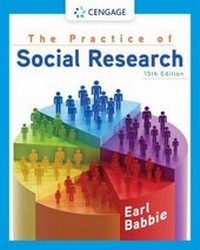
The Practice of Social Research
15th Edition
Published on 5. May 2020
Book
Paperback/Softback
592 pages
978-0-357-36076-7 (ISBN)
Description
Known as the gold standard for research methods, Babbie's THE PRACTICE OF SOCIAL RESEARCH gives you a definitive guide to research as practiced by social scientists. Combining a straightforward approach with the author's renowned sense of humor, this student-friendly text equips you with the tools and knowledge to apply research concepts as both researcher and consumer. The author emphasizes the process by showing you how to design and construct projects, introducing today's various observation modes and answering critical questions about research methods, such as how to conduct online surveys and analyze both qualitative and quantitative data. The 15th Edition includes the latest General Social Survey findings along with new coverage of the global use of social research, the emerging role of big data, demographic analysis and more. Also available: MindTap digital learning solution.
More details
Edition
15th edition
Language
English
Place of publication
Belmont, CA
United States
Publishing group
Cengage Learning, Inc
Target group
College/higher education
Dimensions
Height: 250 mm
Width: 201 mm
Thickness: 28 mm
Weight
1070 gr
ISBN-13
978-0-357-36076-7 (9780357360767)
Copyright in bibliographic data and cover images is held by Nielsen Book Services Limited or by the publishers or by their respective licensors: all rights reserved.
Schweitzer Classification
Other editions
Previous edition
Earl Babbie
The Practice of Social Research
Book
08/2020
14th Edition
Wadsworth Publishing Co Inc
€94.08
Article not available at the moment
Person
Dr. Earl Babbie is the Campbell Professor Emeritus in Behavioral Sciences at Chapman University in Southern California. He taught sociology at the University of Hawaii from 1968 through 1979 and took time off from teaching and research to write full time for eight years. He then joined the Chapman University faculty in 1987. Credited with defining research methods for the social sciences, Dr. Babbie has written several texts, including THE PRACTICE OF SOCIAL RESEARCH, as well as numerous research articles and monographs. For 25 years he has been active in the American Sociological Association, where he served on the executive committee. He is also a past president of the Pacific Sociological Association and the California Sociological Association. Dr. Babbie received his A.B. from Harvard and his doctorate from the University of California, Berkeley.
Content
Part I: AN INTRODUCTION TO INQUIRY.
1. Human Inquiry and Science.
2. Paradigms, Theory, and Social Research.
3. The Ethics and Politics of Social Research.
Part II: THE STRUCTURING OF INQUIRY: QUANTITATIVE AND QUALITATIVE.
4. Research Design.
5. Conceptualization, Operationalization, and Measurement.
6. Indexes, Scales, and Typologies.
7. The Logic of Sampling.
Part III: MODES OF OPERATION: QUANTITATIVE AND QUALITATIVE.
8. Experiments.
9. Survey Research.
10. Qualitative Field Research.
11. Unobtrusive Research.
12. Evaluation Research.
Part IV: ANALYSIS OF DATA: QUANTITATIVE AND QUALITATIVE.
13. Qualitative Data Analysis.
14. Quantitative Data Analysis.
15. The Logic of Multivariate Analysis.
16. Statistical Analyses.
17. Reading and Writing Social Research.
APPENDICES.
A. Using the Library.
B. GSS Household Enumeration Questionnaire.
C. Random Numbers.
D. Distribution of Chi Square.
E. Normal Curve Areas.
F. Estimated Sampling Error.
Preface.
Acknowledgments.
1. Human Inquiry and Science.
2. Paradigms, Theory, and Social Research.
3. The Ethics and Politics of Social Research.
Part II: THE STRUCTURING OF INQUIRY: QUANTITATIVE AND QUALITATIVE.
4. Research Design.
5. Conceptualization, Operationalization, and Measurement.
6. Indexes, Scales, and Typologies.
7. The Logic of Sampling.
Part III: MODES OF OPERATION: QUANTITATIVE AND QUALITATIVE.
8. Experiments.
9. Survey Research.
10. Qualitative Field Research.
11. Unobtrusive Research.
12. Evaluation Research.
Part IV: ANALYSIS OF DATA: QUANTITATIVE AND QUALITATIVE.
13. Qualitative Data Analysis.
14. Quantitative Data Analysis.
15. The Logic of Multivariate Analysis.
16. Statistical Analyses.
17. Reading and Writing Social Research.
APPENDICES.
A. Using the Library.
B. GSS Household Enumeration Questionnaire.
C. Random Numbers.
D. Distribution of Chi Square.
E. Normal Curve Areas.
F. Estimated Sampling Error.
Preface.
Acknowledgments.