

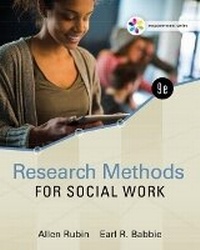
Empowerment Series: Research Methods for Social Work
9th Edition
Published on 5. April 2021
Book
Paperback/Softback
672 pages
978-0-357-67097-2 (ISBN)
Description
If you're intimidated by the thought of taking research methods, Rubin and Babbie's classic bestseller can help you overcome the fear factor often associated with this course with its reader-friendly presentation of all aspects of the research endeavor. If you're not intimidated, you'll still appreciate the authors' clear and often humorous writing style as well as the book's depth and breadth of coverage. RESEARCH METHODS FOR SOCIAL WORK, Ninth Edition, strikes an optimal balance of quantitative and qualitative research techniques -- illustrating how the two methods complement one another and can be integrated in the same study. Relevant examples from real-world settings highlight the connections between research and social work practice. Comprehensive, friendly, accurate, and integrating the best of technology, this text is widely considered the best text for the research methods course -- and when you read it, you'll see why.
More details
Edition
9th edition
Language
English
Place of publication
CA
United States
Publishing group
Cengage Learning, Inc
Target group
College/higher education
Dimensions
Height: 27 mm
Width: 200 mm
Thickness: 254 mm
Weight
1270 gr
ISBN-13
978-0-357-67097-2 (9780357670972)
Copyright in bibliographic data and cover images is held by Nielsen Book Services Limited or by the publishers or by their respective licensors: all rights reserved.
Schweitzer Classification
Other editions
New editions

Allen Rubin | Earl Babbie
Research Methods for Social Work
Book
07/2024
10th Edition
Brooks/Cole
€95.50
Shipment within 15-20 days
Persons
Allen Rubin has been doing and teaching research since 1976, when he received his Ph.D. from the University of Pittsburgh. He taught social work research at the University of Texas at Austin from 1979 through 2013 and at the University of Houston from 2013 through 2024. Renowned in social work, Dr. Rubin has written several research texts, published numerous research studies on social work practice and is a past president of the Society for Social Work and Research. Dr. Earl Babbie is the Campbell Professor Emeritus in Behavioral Sciences at Chapman University in Southern California. He taught sociology at the University of Hawaii from 1968 through 1979 and took time off from teaching and research to write full time for eight years. He then joined the Chapman University faculty in 1987. Credited with defining research methods for the social sciences, Dr. Babbie has written several texts, including THE PRACTICE OF SOCIAL RESEARCH, as well as numerous research articles and monographs. For 25 years he has been active in the American Sociological Association, where he served on the executive committee. He is also a past president of the Pacific Sociological Association and the California Sociological Association. Dr. Babbie received his A.B. from Harvard and his doctorate from the University of California, Berkeley.
Content
Part I: AN INTRODUCTION TO SCIENTIFIC INQUIRY IN SOCIAL WORK.
1. Why Study Research?
2. Evidence-Based Practice.
3. Factors Influencing the Research Process.
4. Comparing Quantitative, Qualitative, and Mixed Methods of Inquiry.
Part II: THE ETHICAL, POLITICAL, AND CULTURAL CONTEXT OF SOCIAL WORK RESEARCH.
5. The Ethics and Politics of Social Work Research.
6. Culturally Competent Research.
Part III: PROBLEM FORMULATION AND MEASUREMENT.
7. Problem Formulation.
8. Conceptualization in Quantitative and Qualitative Inquiry.
9. Measurement.
10. Constructing Measurement Instruments.
Part IV: DESIGNS FOR EVALUATING PROGRAMS AND PRACTICE.
11. Causal Inference and Experimental Designs.
12. Quasi-Experimental Designs.
13. Single-Case Evaluation Designs.
14. Program Evaluation.
Part V: DATA-COLLECTION METHODS WITH LARGE SOURCES OF DATA.
15. Sampling.
16. Survey Research.
17. Analyzing Existing Data: Quantitative and Qualitative Methods.
Part VI: QUALITATIVE RESEARCH METHODS.
18. Qualitative Research: General Principles.
19. Qualitative Research: Specific Methods.
20. Qualitative Data Analysis.
Part VII: ANALYSIS OF QUANTITATIVE DATA.
21. Descriptive Data Analysis.
22. Inferential Data Analysis.
Part VIII: WRITING RESEARCH PROPOSALS AND REPORTS.
23. Writing Research Proposals and Reports.
Appendix A: Using the Library.
Appendix B: Statistics for Estimating Sampling Error.
Appendix C: Critically Appraising Meta-Analyses.
1. Why Study Research?
2. Evidence-Based Practice.
3. Factors Influencing the Research Process.
4. Comparing Quantitative, Qualitative, and Mixed Methods of Inquiry.
Part II: THE ETHICAL, POLITICAL, AND CULTURAL CONTEXT OF SOCIAL WORK RESEARCH.
5. The Ethics and Politics of Social Work Research.
6. Culturally Competent Research.
Part III: PROBLEM FORMULATION AND MEASUREMENT.
7. Problem Formulation.
8. Conceptualization in Quantitative and Qualitative Inquiry.
9. Measurement.
10. Constructing Measurement Instruments.
Part IV: DESIGNS FOR EVALUATING PROGRAMS AND PRACTICE.
11. Causal Inference and Experimental Designs.
12. Quasi-Experimental Designs.
13. Single-Case Evaluation Designs.
14. Program Evaluation.
Part V: DATA-COLLECTION METHODS WITH LARGE SOURCES OF DATA.
15. Sampling.
16. Survey Research.
17. Analyzing Existing Data: Quantitative and Qualitative Methods.
Part VI: QUALITATIVE RESEARCH METHODS.
18. Qualitative Research: General Principles.
19. Qualitative Research: Specific Methods.
20. Qualitative Data Analysis.
Part VII: ANALYSIS OF QUANTITATIVE DATA.
21. Descriptive Data Analysis.
22. Inferential Data Analysis.
Part VIII: WRITING RESEARCH PROPOSALS AND REPORTS.
23. Writing Research Proposals and Reports.
Appendix A: Using the Library.
Appendix B: Statistics for Estimating Sampling Error.
Appendix C: Critically Appraising Meta-Analyses.