

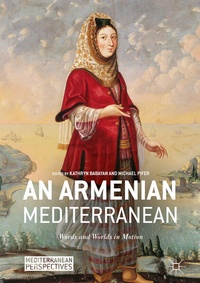
An Armenian Mediterranean
Words and Worlds in Motion
Published on 24. May 2018
Book
Hardback
XXI, 337 pages
978-3-319-72864-3 (ISBN)
Description
This book rethinks the Armenian people as significant actors in the context of Mediterranean and global history. Spanning a millennium of cross-cultural interaction and exchange across the Mediterranean world, essays move between connected histories, frontier studies, comparative literature, and discussions of trauma, memory, diaspora, and visual culture. Contributors dismantle narrow, national ways of understanding Armenian literature; propose new frameworks for mapping the post-Ottoman Mediterranean world; and navigate the challenges of writing national history in a globalized age. A century after the Armenian genocide, this book reimagines the borders of the "Armenian," pointing to a fresh vision for the field of Armenian studies that is omnivorously comparative, deeply interconnected, and rich with possibility.
More details
Series
Edition
2018 ed.
Language
English
Place of publication
Cham
Switzerland
Publishing group
Springer International Publishing
Target group
Professional and scholarly
Illustrations
9 s/w Abbildungen, 10 farbige Abbildungen
XXI, 337 p. 19 illus., 10 illus. in color.
Dimensions
Height: 216 mm
Width: 153 mm
Thickness: 24 mm
Weight
578 gr
ISBN-13
978-3-319-72864-3 (9783319728643)
DOI
10.1007/978-3-319-72865-0
Schweitzer Classification
Other editions
Additional editions
Book
02/2019
Palgrave Macmillan
€139.09
Shipment within 7-9 days
E-Book
05/2018
1st Edition
Palgrave Macmillan
€128.39
Available for download
Persons
Kathryn Babayan is Associate Professor of Iranian History and Culture and Director of the Armenian Studies Program at the University of Michigan, USA.
Michael Pifer is Lecturer in Armenian Language and Literature at the University of Michigan, USA.
Michael Pifer is Lecturer in Armenian Language and Literature at the University of Michigan, USA.
Content
1. Introduction: A Moveable Armenia.- I. Rethinking Boundaries.- 2. The Age of the
Gharib
: Strangers in the Medieval Mediterranean.- 3. Past the Mediterranean and Iran: A Comparative Study of Armenia as an Islamic Frontier, 1st/7th-5th/11th Centuries.- 4. A Fish out of Water? Medieval Armenia(ns) and the Mediterranean.- II. Connecting Histories.- 5. From "Autonomous" to "Interactive" Histories: World History's Challenge to Armenian Studies.- 6. Mapping Jerusalem: Re-Reading the City in the Context of the Medieval Mediterranean.- III. Breaking National and Imperial Paradigms.- 7. Between Anatolia and the Balkans: Tracing Armenians in the Post-Ottoman Order.- 8. Armeno-Turkish Writing and the Question of Hybridity.- 9. Wandering Minstrels, Moving Novels: The Case of Khach'atur Abovyan's
Wounds of Armenia
.- IV. Texturizing Diaspora.- 10. Weaving Images: Textile, Displacement, and Reframing the Borders of Visual Culture.- 11. Diasporic
Flânerie
: From Armenian
Ruinenlust
to Armenia's Walkscapes.- 12. Spaces of Difference, Spaces of Belonging: Negotiating Armenianness in Lebanon and France.- V. Placing Statehood.- 13. Contemporary Armenian Drama and World Literature.- 14. How to Write the History of the Third Republic (or How Not to Write It).- VI. Epilogue.- 15. The Mediterranean is Armenian.