

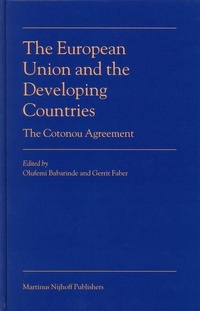
The European Union and the Developing Countries
The Cotonou Agreement
Published on 14. February 2005
Book
Hardback
318 pages
978-90-04-14199-5 (ISBN)
Description
The relationships between the European Union and developing countries in Africa, the Caribbean and the Pacific (or ACP countries) have been called a model for North South development cooperation. The Lome Conventions were the embodiment of this model. After 25 years, the European Union and the ACP group signed a new partnership agreement, the Cotonou Agreement. Given the disappointing results of the former conventions, this book investigates the innovations in the EU-ACP relationship. Authors from different backgrounds (including law, political science and economics) analyze the forces that gave rise to the new agreement as well as the negotiating process of the new agreement, and the negotiations that are taking place to produce the planned Economic Partnership Agreements (EPA) that are to replace the existing non-reciprocal trade preferences that are incompatible with WTO law. The potential benefits of EPAs are discussed, as is the alternative in the shape of an improved and general preferential system. The amended mechanism for aid delivery, the increased stress on political dialogue between the partners and the introduction of more civil society participation in the cooperation are extensively analyzed and discussed. The effects of the introduction of the Euro and the effect of the planned stimuli on Direct Foreign Investment in ACP economies make this volume very complete in coverage of the ACP-EU relations. Its relevance extends far beyond the ACP-EU relationship as it shows and discusses particular solutions for problems that occur in North South relations in general.
More details
Language
English
Place of publication
Netherlands
Publishing group
Brill
Target group
College/higher education
Professional and scholarly
Product notice
sewn/stitched
Cloth over boards
Dimensions
Height: 244 mm
Width: 163 mm
Thickness: 26 mm
Weight
708 gr
ISBN-13
978-90-04-14199-5 (9789004141995)
Copyright in bibliographic data and cover images is held by Nielsen Book Services Limited or by the publishers or by their respective licensors: all rights reserved.
Schweitzer Classification
Other editions
Additional editions

Olufemi Babarinde | Gerrit Faber
The European Union and the Developing Countries
The Cotonou Agreement
Software
02/2005
Brill | Nijhoff
Unfortunately, price unknown
Available (delivery time upon request)
Content
Tables,
Charts,
Abbreviations,
List of Contributors,
Preface,
1. From Lome to Cotonou: ACP-EU Partnership in Transition, Olufemi Babarinde and Gerrit Faber,
2. The Changing Environment of ACP-EU Relations, Olufemi Babarinde,
3. The Negotiation of the Cotonou Agreement: Negotiating Continuity or Change?, Joseph A. McMahon,
4. Negotiating Economic Partnership Agreements: Contexts and Strategies, Stephen Wright,
5. Economic Partnership Agreements and Regional Integration among ACP Countries, Gerrit Faber,
6. An Alternative Strategy for Free Trade Areas: The Generalized System of Preferences, Christopher Stevens,
7. European Development Aid in Transition, Paul Hoebink,
8. Political Dialogue in a "New" Framework, Karin Arts,
9. The Role of Civil Society in the Cotonou Agreement, Maurizio Carbone,
10Foreign Direct Investment in the Cotonou Partnership Agreement: Building on Private Sector Initiatives, Dirk Willem te Velde & Sanoussi Bilal,
11. The EMU and the ACP countries, Peter Macmillan and Alison Watson,
12. Conclusion: Synopses and Future Research, Olufemi Babarinde and Gerrit Faber, Index.
Charts,
Abbreviations,
List of Contributors,
Preface,
1. From Lome to Cotonou: ACP-EU Partnership in Transition, Olufemi Babarinde and Gerrit Faber,
2. The Changing Environment of ACP-EU Relations, Olufemi Babarinde,
3. The Negotiation of the Cotonou Agreement: Negotiating Continuity or Change?, Joseph A. McMahon,
4. Negotiating Economic Partnership Agreements: Contexts and Strategies, Stephen Wright,
5. Economic Partnership Agreements and Regional Integration among ACP Countries, Gerrit Faber,
6. An Alternative Strategy for Free Trade Areas: The Generalized System of Preferences, Christopher Stevens,
7. European Development Aid in Transition, Paul Hoebink,
8. Political Dialogue in a "New" Framework, Karin Arts,
9. The Role of Civil Society in the Cotonou Agreement, Maurizio Carbone,
10Foreign Direct Investment in the Cotonou Partnership Agreement: Building on Private Sector Initiatives, Dirk Willem te Velde & Sanoussi Bilal,
11. The EMU and the ACP countries, Peter Macmillan and Alison Watson,
12. Conclusion: Synopses and Future Research, Olufemi Babarinde and Gerrit Faber, Index.